St Patrick: From Slave to Apostle
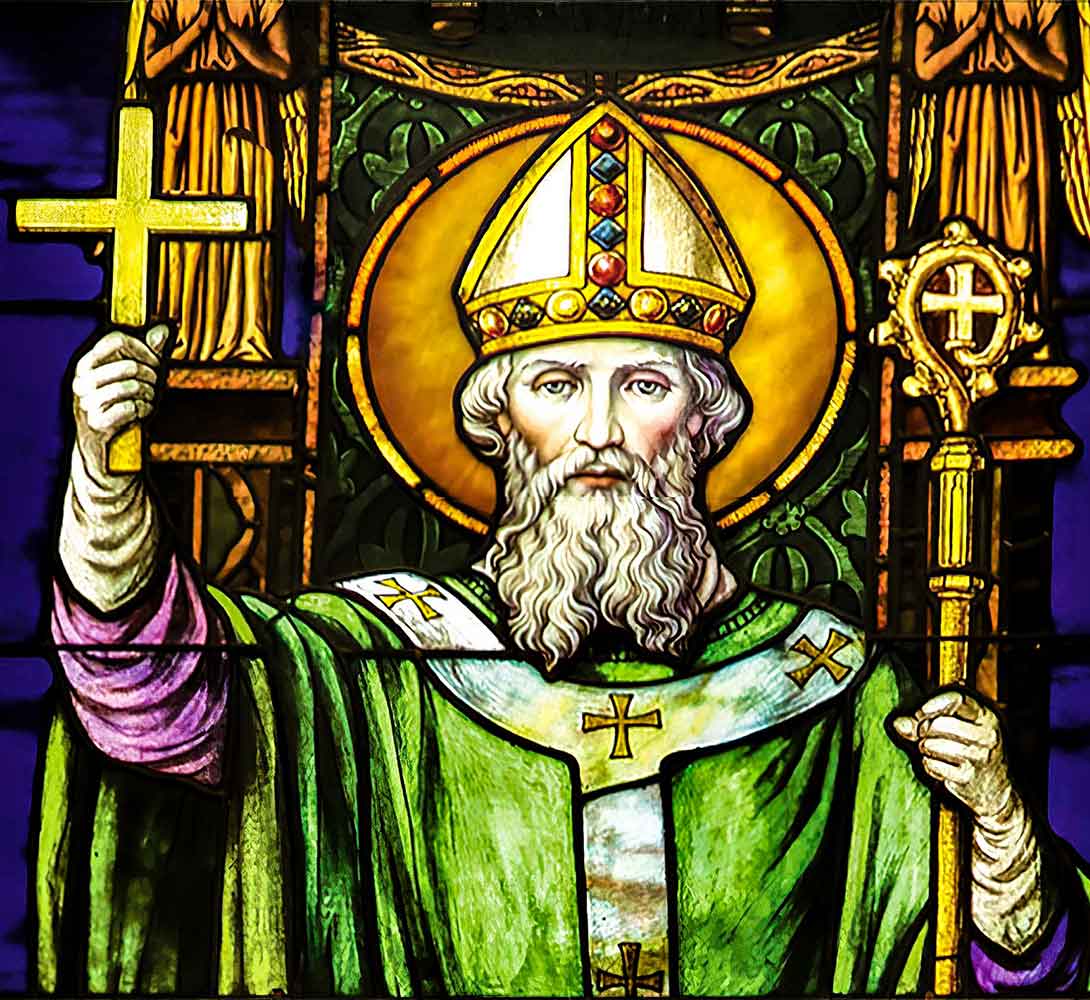
On March 17, much of the world turns green to celebrate St Patrick’s Day. Günther Simmermacher looks at the life of the Apostle of Ireland.
St Patrick at a glance
Name at birth: Unknown
Born: Early 5th century in Britain
Died: Possibly 496 in Ireland
Feast: March 17
Patronages: Ireland, Nigeria, Dioceses of Kokstad and Port Elizabeth, engineers, paralegals, invoked against snakes
Little is known about the life of St Patrick; what we do know comes from his two surviving writings — an autobiographical account and his letter to the Britannic tyrant Coroticus, as well as less reliable early hagiographies and traditions.

We know that he lived in the 5th century, but it is not even clear that his name was actually Patrick. He signed his documents with the Latin moniker Patricius, which could be a name or a title he might have as the father of his flock. Alternative names have been recorded, though these likely were titles rather than monikers.
We also don’t know exactly when or where he was born. The Catholic Encyclopedia claims that Patrick was born in Kilpatrick, Scotland, but historians also suggest various places in Wales and England.
A good guess is that Patrick was born in the earlier decades of the 400s. In his autobiographical account Confessions, Patrick recalled that he was 16 years old when he was enslaved. The 6th-century Irish annals say that he arrived in Ireland in 432, though that is an uncertain assertion. However, if so, then Patrick was born around 416.
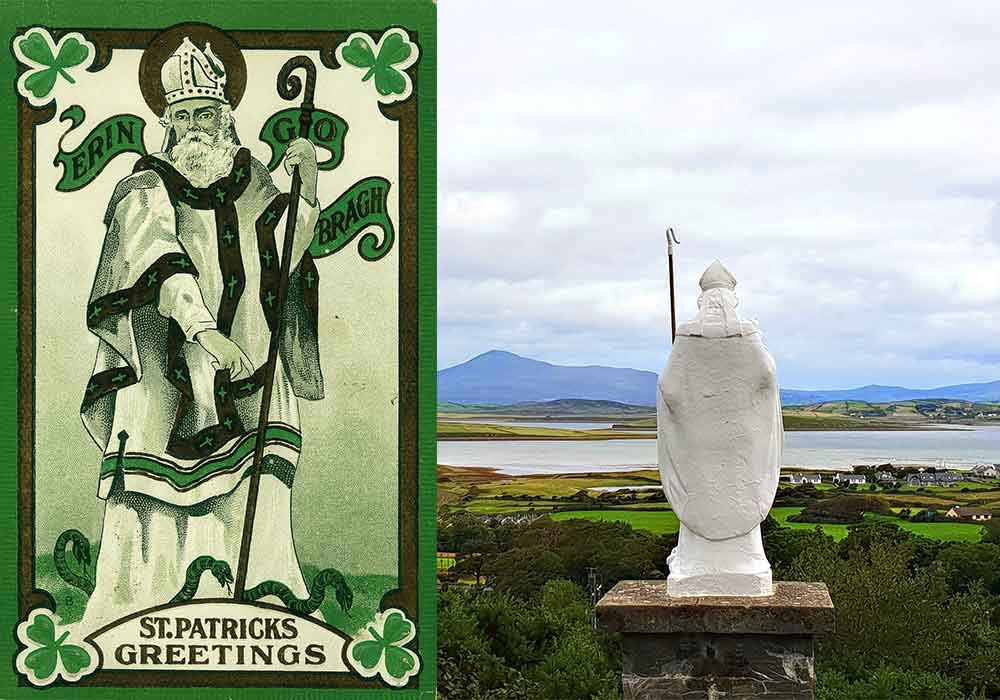
From left: A St Patrick’s Day greeting card from 1909 • A monument of St Patrick surveys the Connemara at the foot of Croagh Patrick, the mountain on which he spent 40 days and 40 nights.
Enslaved by raiders
We know more about his background. His father, Calpurnius, was a Roman decurion — a high-ranking civic leader in Roman times — and a deacon; his mother was named Concessa. Patrick’s grandfather, Potitus, was a priest. But as a youngster, Patrick himself was not keen on religion — until he was captured by Irish pirates and trafficked to Ireland.
Enslaved on the strange island, Patrick tended animals for six years under a cruel master — and found God. He later recalled: “I would pray constantly during the daylight hours. The love of God and the fear of him surrounded me more and more. And faith grew. And the spirit roused so that in one day I would say as many as a hundred prayers, and at night only slightly less.”
One day Patrick heard a voice telling him to escape, with the advice that a ship was ready to take him home. He escaped and walked for days until he found a ship which would take him home across the sea.
Now a free man, Patrick studied theology, in Britain and also in Gaul (modern-day France). He is believed to have received the tonsure at Lérins Abbey in southern France, and ordination to the priesthood by St Germanus in Auxerre.
Call to mission
One day at home, as Patrick recounted in his Confessions, he had a vision of one Victoricus — possibly St Victoricus of Rouen in France, who had visited Britain in 396 — calling him to return to Ireland to evangelise the people there.
Patrick did as instructed by the vision. He wasn’t immediately welcomed by the pagan Irish, but he soon attracted a growing following as he travelled across Ireland, converting the powerful, baptising people, setting up churches and monasteries, and ordaining priests and deacons.
He was a clever missionary. Patrick realised that the pagans would not be swayed simply by his message of salvation through Christ, so he did not demand that they give up belief in their gods. But he persuaded them that these gods were demons, in contrast to his God, who was all-powerful and good. And Patrick rightly calculated that he should concentrate on converting those in power, whom ordinary people would then follow.
Always in danger
It seems that initially Patrick’s integrity as a priest was not yet fully formed. At one point he was tried for apparent financial improprieties. Having made necessary amends, he never accepted gifts again.
But that also created a big problem in Ireland: being incorruptible and independent from patronage, he had no patron and therefore no protection from hostile secular leaders and the druids, both of whom saw him as a threat. And as a foreigner, without Irish kinship, he had no legal protection. As a result, Patrick suffered many robberies, assaults and imprisonments, even the threat of execution and assassination.
Yet even in the face of constant threat, Patrick was fearless. His strongly-worded public letter to the tyrant Coroticus, in which he demanded the release of his enslaved converts, was an immensely courageous act. Due to Patrick’s advocacy, Irish slavery ended in his lifetime, or soon thereafter.
“Daily I expect murder, fraud or captivity,” Patrick wrote, “but I fear none of these things because of the promises of heaven. I have cast myself into the hands of God almighty who rules everywhere.” Still, he also paid protection money to keep his growing group of missionaries safe.
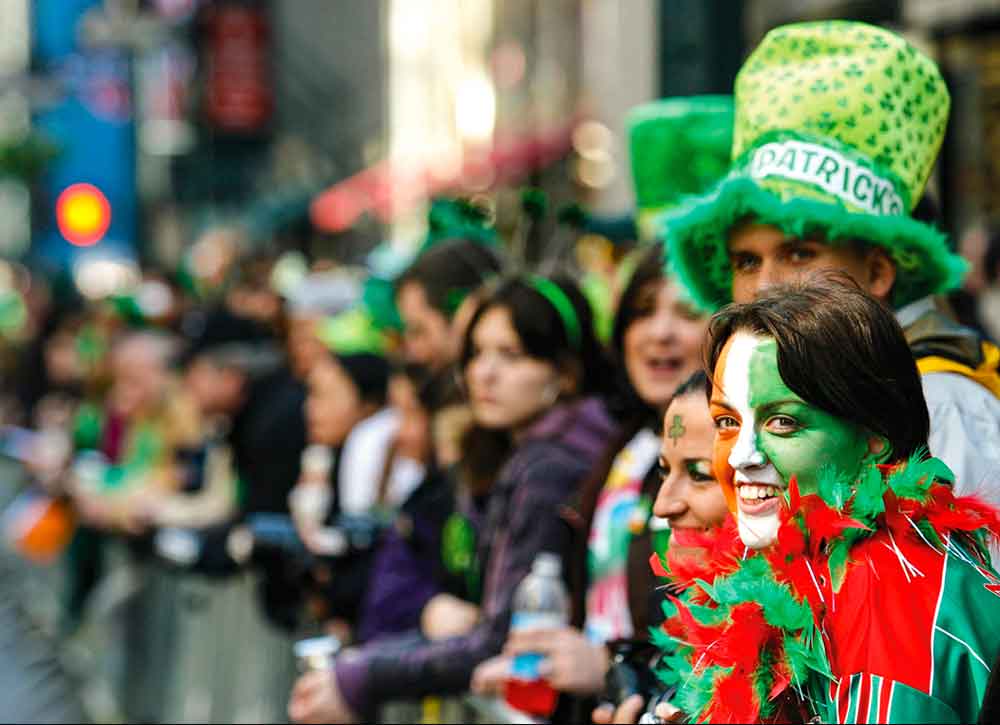
Revellers at a St Patrick’s Day parade in New York City. The saint’s feast on March 17 is celebrated especially in countries that have had Irish immigration.
(Photo: Shannon Stapleton/Reuters/CNS)
St Patrick’s legacy
It is true that St Patrick is the most important apostle of Ireland, though he certainly was not the first missionary there, nor the last one to exert evangelising influence. Indeed, bishops were appointed to Irish sees before Patrick was even born, though they did not gain a foothold. And not everybody thought he was that important. St Columba, another evangelist and now fellow co-patron of Ireland, didn’t even mention Patrick in his writings.
But the cult of St Patrick grew, helped along by legends of his druid-vanquishing martial prowess and his snake-clearing skills after a 40-day fast on Croagh Patrick mountain in the western Irish Connemara. Both of these myths may be related. There never were snakes in Ireland, but it may be that the serpents served as a metaphor for the pagan druids, whom Patrick drove out by his evangelising efforts.
The story of Patrick teaching the pagans about the Holy Trinity by use of a shamrock is relatively new; its first known reference dates to the 17th century, when the saint was depicted on a coin holding a shamrock.
We don’t know for certain when Patrick died. Some historians suggest 460, but the best guess is around 493, based on annals which record that Patrick’s remains were moved in 553, “sixty years after his death”. The date of 493 is also supported by Patrick’s known association with people who were active in the late 5th and early 6th century.
It is not certain where he was buried. Churches in Armagh, Down and Saul have claimed to hold his remains. But the date of his death was always fixed as March 17 — and on that date, more than 1500 years after his death, much of the world turns green in honour of St Patrick.

- Vocations and Easter - April 6, 2026
- Shrines around the World: Our Lady of Beauraing - March 21, 2026
- St Patrick: From Slave to Apostle - March 17, 2026