The rapid rise of artificial intelligence is changing the way people work, communicate, learn and make decisions. Yet, amid the excitement surrounding new technologies, the Catholic Church is asking a deeper question: What kind of humanity are we building?
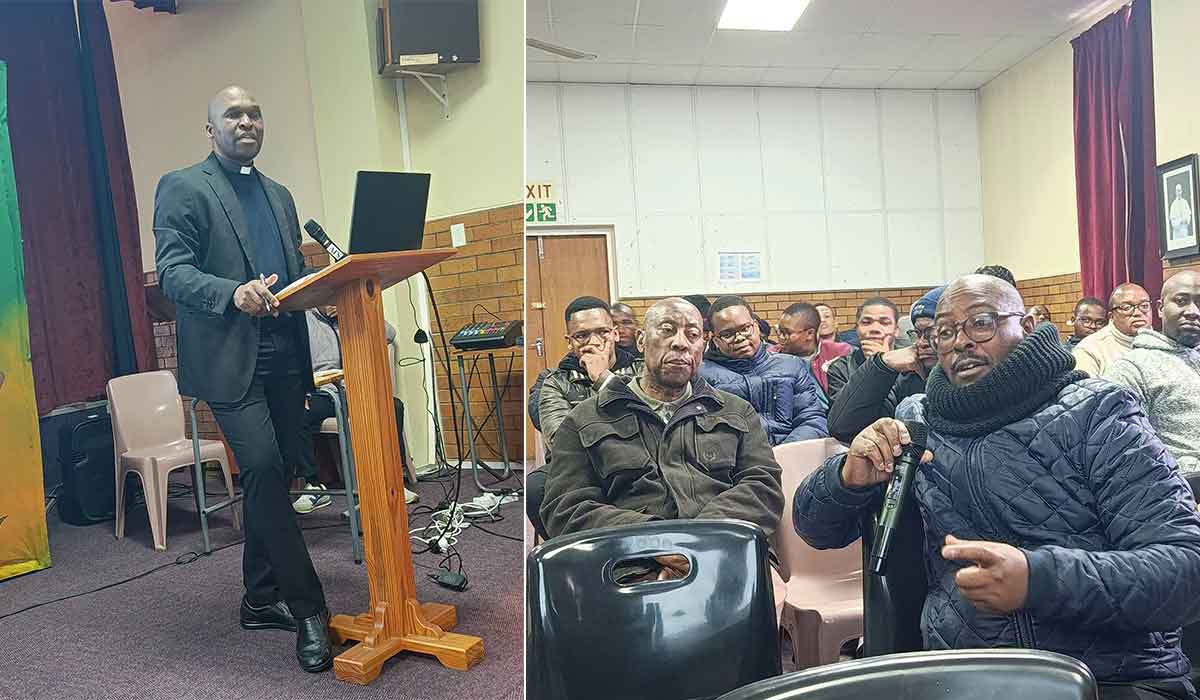
This was at the heart of a public lecture on Pope Leo XIV’s first encyclical, Magnifica Humanitas, held at St John Vianney Seminary in Pretoria on Tuesday, 11 August 2026. The lecture was delivered by Father Dumisani Vilakati, a priest of the Diocese of Manzini in Eswatini and regional coordinator for Africa at the Holy See’s Dicastery for Promoting Integral Human Development.
Invited by the seminary to unpack the encyclical and explore its implications for the Church in Southern Africa, Father Vilakati brought the document closer to the realities of the region. His presentation offered seminarians, priests, lecturers and lay faithful an opportunity to consider artificial intelligence not simply as a technological development, but as a question about human dignity, responsibility and the common good.
Magnifica Humanitas, which can be translated as “magnificent humanity” or “the grandeur of humanity”, forms part of the Church’s social doctrine. According to Father Vilakati, its central concern is the Church’s enduring mission to safeguard the human person, created in the image and likeness of God, so that all people may “have life and have it abundantly”.

A new technological revolution
Father Vilakati explained that Pope Leo XIV’s choice of name is significant. Pope Leo XIII’s Rerum Novarum, published in 1891, responded to the social challenges brought about by the Industrial Revolution, particularly the exploitation of workers and the changing relationship between labour and capital. More than a century later, Pope Leo XIV is responding to another revolution: the technological revolution driven by artificial intelligence.
The parallel is important for the Church in Southern Africa, where technological advancement exists alongside significant social and economic inequalities. AI promises enormous opportunities, but it also raises questions about access, employment, education, privacy, responsibility and the dignity of those who may be most vulnerable to its consequences. For Father Vilakati, however, the real crisis is not technology itself. “The real crisis is about us as people,” he said during the lecture. The question, therefore, is not simply whether artificial intelligence is good or bad. Rather, it is how humanity chooses to develop and use it.
Artificial intelligence can assist human beings and contribute to integral human development. But it must never cause people to be reduced to data, numbers or measures of efficiency.
What are we building?
One of the most striking images in Magnifica Humanitas is that of a construction site. Father Vilakati explained that the encyclical uses two biblical stories to illustrate the choices facing humanity in the age of artificial intelligence: the Tower of Babel in Genesis and the rebuilding of the walls of Jerusalem under Nehemiah. The people of Babel sought to build a tower reaching the heavens, with the intention of making a name for themselves. Their project, according to Father Vilakati, represents pride and domination. It had no reference to God and ultimately resulted in failure and dispersion. Nehemiah presents a different model. Rather than imposing a solution from above, Nehemiah gathered families, listened to their concerns, assigned different sections of the wall to them and coordinated their efforts. God remained at the centre of the project. The contrast provides an important lens through which to view artificial intelligence.
What are we building as a generation?
Are we building a technological Tower of Babel driven by efficiency, profit, power and domination? Or are we building a society where technology serves humanity, strengthens communities and contributes to the common good?
This question is particularly relevant to the Church in Southern Africa, where the benefits of technological advancement need to be considered alongside the lived realities of ordinary people. Father Vilakati says the Church cannot afford to discuss AI as something distant from everyday life. Its social doctrine has always sought to engage with concrete realities, from war and industrialisation to labour exploitation, colonialism and ecological destruction. Artificial intelligence is now part of that conversation.
Why ‘Magnifica Humanitas’ matters in Southern Africa
The relevance of the encyclical to Southern Africa lies precisely in this call to place the human person at the centre. Father Vilakati explained that the Church’s social doctrine is founded on principles including the dignity of the human person, solidarity and social justice. These principles provide a framework for considering how new technologies affect individuals, communities and societies. In a region where many people continue to face economic vulnerability and inequality, the question of who benefits from technological progress cannot be separated from the question of human dignity. Integral human development, Father Vilakati explained, means a process in which the growth of individuals and peoples encompasses all dimensions of existence and opens a future for subsequent generations.
This makes Magnifica Humanitas particularly relatable to the Church in Southern Africa. The Church is called not merely to celebrate technological progress, but to ask whether that progress is reaching people in ways that improve their lives, strengthen communities and ensure that no one is left behind. The encyclical therefore provides an opportunity for the Church to engage with AI through the realities already confronting Southern African societies. Technology can be a tool for development, education, communication and greater access to information. But if it deepens exclusion, removes human agency or treats people merely as data, it risks undermining the very human development it is supposed to serve.
From principles to artificial intelligence
Father Vilakati described the structure of Magnifica Humanitas as a conversation between the principles of Catholic social teaching and technological development. The first chapter traces the history of the Church’s social doctrine, while the second presents its foundational principles. The third applies those principles to artificial intelligence. The fourth considers the impact of AI on specific areas of human life, while the fifth returns to the broader question of what kind of civilisation humanity is constructing. At the centre of this reflection is the belief that technological innovation is not inherently opposed to human flourishing.
Father Vilakati stressed that artificial intelligence and technological developments can greatly contribute to integral human development and care for the common home. The challenge is ensuring that human beings remain responsible for the way these technologies are designed and used. As Father Vilakati noted, artificial intelligence may imitate certain functions of human intelligence, but it does not experience joy or pain, mature through relationships, understand love and friendship from within, or possess a moral conscience. That distinction is critical. Human intelligence is not simply the ability to process information. Human beings have relationships, responsibilities, moral consciousness and an inherent dignity that cannot be replicated by a machine.
A Church that engages the real world
The encyclical also reinforces the vision of the Church presented by the Second Vatican Council in Gaudium et Spes: a Church that remains close to humanity and engages with the concrete realities of the world. Father Vilakati noted that Pope Leo XIV recognises the contribution of philosophy, the human sciences and social sciences in helping the Church understand the cultural, economic and political dynamics surrounding complex issues. This approach is especially significant for Southern Africa.
The Church does not have to become a technology company or replace governments and institutions. Instead, it can contribute to collective discernment by asking whether developments serve human dignity, strengthen communities and promote the common good.
Bringing the encyclical into formation
Father Sbongiseni Joseph Msomi, the academic dean at St John Vianney Seminary, says that inviting Father Vilakati was an opportunity to ensure that seminarians encountered the encyclical through someone with both academic and practical experience. Father Vilakati is an alumnus of the seminary and now serves in Rome at the Dicastery for Promoting Integral Human Development. Father Msomi told Southern Cross that the seminary wanted the lecture to help seminarians understand Magnifica Humanitas and expose them to the work being undertaken by the Dicastery.
He said the intention was for the lecture to be the beginning of a wider process in which papal documents are unpacked, themes are developed and possible short courses and modules are created. For him, the formation of future priests cannot stop at simply knowing that a new papal document has been published. It should encourage deeper study and enable seminarians and lay people to bring the Church’s teaching into their communities. The public lecture was also livestreamed, extending the conversation beyond the seminary and making it part of the broader formation of the people of God.
Wisdom must guide knowledge
For Brother Nojekwa George of the Diocese of Queenstown, who is currently studying at the seminary, one of the most important lessons from the lecture was the relationship between knowledge and wisdom. He reflected that God has given humanity wisdom and knowledge, but also the ability to discern how that knowledge should be used for the betterment of humanity. AI, he observed, is not inherently bad. Its misuse, however, can be detrimental to humanity. His reflection captured one of the central messages of Magnifica Humanitas highlighted in the lecture: the question is not simply what technology can do, but what human beings should do with it. Technology must ultimately be placed at the service of humanity and the common good.
Building for the generations to come
Father Vilakati’s presentation brought the encyclical into a Southern African context by reminding the Church that integral human development must include the whole person and the whole community. The challenge is therefore both technological and spiritual. Humanity is standing on a construction site. The tools are increasingly powerful, but the builders remain responsible for what they construct.
The choice presented by Pope Leo XIV is ultimately between a civilisation shaped by pride, domination and exclusion, and one built through collaboration, solidarity and a commitment to the dignity of every person. For the Church in Southern Africa that faces social challenges, including poverty and inequality, that choice is particularly meaningful. And in the words of Brother George, AI should be used “for the betterment of humanity”.

- SECAM Seeks African Participation in World Youth Day 2027 - September 24, 2026
- ‘Carlo is an instrument of God’: His mother reflects on the first year of her son’s sainthood - September 11, 2026
- Durban youth urged to keep their lamps burning for Christ - August 31, 2026