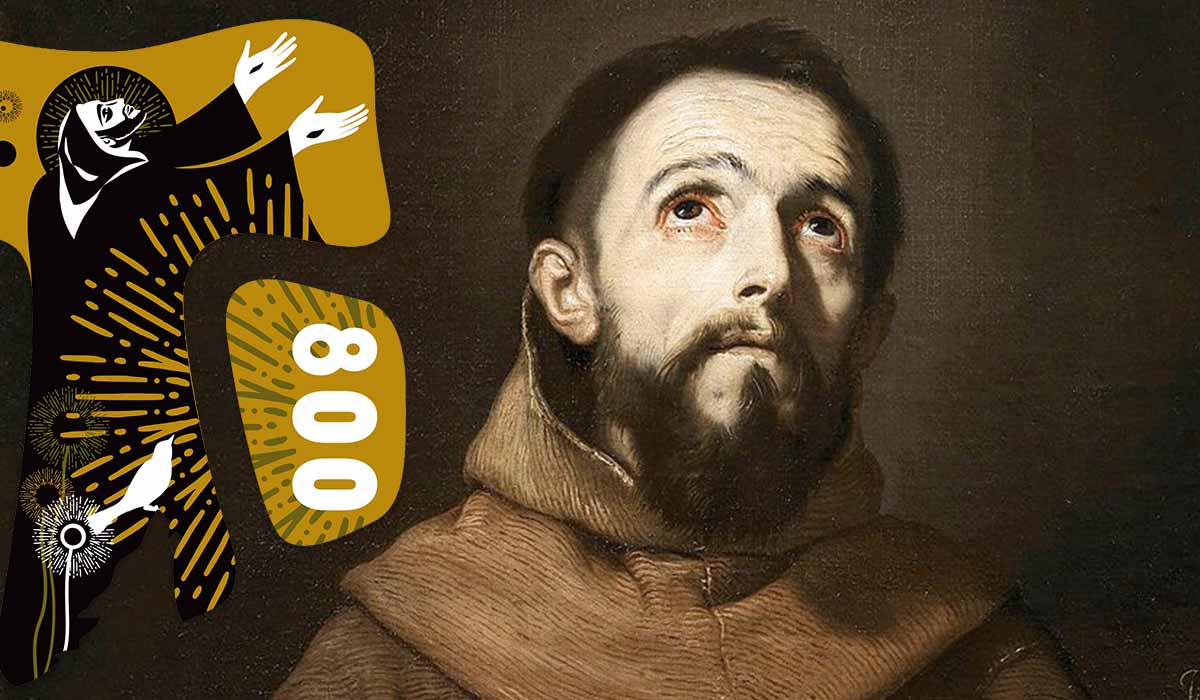
This year the Church marks the 800th anniversary of the death of St Francis of Assisi. In the first of a four-part series reflecting on different aspects of the saint’s spirituality, Günther Simmermacher looks at how Francis grew from being a well-off would-be knight to an Apostle of Poverty.
Francis of Assisi might have reformed the Church in ways that remain relevant today, but he did not imagine himself as a holy revolutionary.
Born into privilege — the son of a prosperous cloth merchant — he was a restless young man, full of charm, bravado and unfulfilled longing. He was not drawn to the chants and religious life of the Church, but rather intoxicated by the songs of troubadours and dreams of glory.
That this same man would one day strip naked in a public square, renounce his life of prosperity and instead embrace poverty, is one of the great conversion stories in Christian history.

Francis was born as Giovanni di Pietro di Bernardone in Assisi in either late 1181 or early 1182. His father, Pietro Bernardone, travelled frequently to France on business. His mother, Pica, was a woman of refined piety. The francophile Pietro named his son Francesco, which means “the little Frenchman”. The nickname stuck for eternity.
Francis grew up amid privilege, education and social access, enjoying fine clothes, feasts and the company of Assisi’s young elites. Yet even in his youth, there were signs of restlessness as well as hints of holiness.
One day Francis was selling cloth and velvet in the market for his father when a beggar asked him for alms. Francis ran after the beggar, and gave him all the money in his purse — the entire revenue of his sales that day. His furious father reprimanded him, and Francis’ friends mocked this unusual act charity.
Going into war
Still, Francis longed for honour and adventure, like many young men of his class. He was inspired by the songs of heroism and romance by the troubadours. He sought distinction through military glory, and in 1202, he joined a campaign against the rival city of Perugia. The expedition ended disastrously. Francis was captured and imprisoned for nearly a year — a period marked by illness, reflection and the slow disintegration of his youthful illusions.
Back in Assisi, he returned to his former life. In 1205 Francis set out to join the papal forces in southern Italy. But along the way, in Spoleto, he had a strange and unsettling dream. Asked whom he wished to serve — the master or the servant — Francis realised, at first vaguely, that he had been chasing the wrong kind of lord. He returned home, humbled but changed, increasingly detached from the ambitions that had once consumed him.
During a pilgrimage to St Peter’s basilica in Rome, Francis joined the beggars. In Assisi, he began to withdraw from social life, spending more time in prayer and solitude. One day, while riding outside Assisi, he encountered a leper — a person regarded with horror and revulsion by medieval society. Francis dismounted, embraced the man, and kissed him. What had once filled him with disgust became, as he later said, “sweetness of soul and body”. It was a moment of inner reversal: a crossing from fear to freedom.
Christ’s Command
Around the same time, Francis experienced a powerful encounter while praying before a crucifix in the dilapidated church of San Damiano. He heard Christ speak: “Francis, go and repair my house, which, as you see, is falling into ruin.” Taking the words literally, Francis sold cloth taken, without permission, from his father’s warehouse to fund the work.
The priest of San Damiano refused to accept the proceeds from Francis’ theft, and Pietro Bernardone got his money back, while Francis hid in a cave for a month. That exile was not enough to calm Pietro’s fury. When Francis returned home, he was beaten and locked up (and freed by his caring mother).
The conflict escalated until it reached the bishop’s court. There Francis publicly renounced his inheritance, stripped off his fine clothes and gave them to his father. “From now on,” he declared, “I have only one Father — who is in heaven.” The bishop covered the naked young man with his own cloak. Francis was now free of earthly possessions.
Francis began to live as a penitent, wearing a simple tunic, begging for food, and repairing ruined churches. In Assisi he begged for stones for the restoration of several ruined chapels in the countryside around Assisi. Most famous of these is the Portiuncola, the little chapel of St Mary of the Angels in the plain just below Assisi. This would become a central location for Francis and his followers, and the place where he would die in 1226.
Francis’ conversion deepened as he listened attentively to the Gospel. At Mass one day in February 1208, in the chapel of St Mary of the Angels, he heard Christ’s instructions to the Apostles — to take nothing for the journey, to preach repentance, and to rely on God alone. Francis felt he had found his rule of life. “This is what I want,” he said. “This is what I seek.”
Joyful Friars
Wearing his coarse woollen tunic, he started preaching peace, fraternity and penance throughout the region around Assisi. Soon others began to follow him. At first they were widely ridiculed as fools, but Francis welcomed them joyfully. He called them friars minor — “lesser brothers” — emphasising humility, fraternity and service. They owned nothing, lived among the poor, and preached by their example as much as by word. Their joy, informality and radical trust in God was in sharp contrast to a Church increasingly marked by wealth and political power.
He sought papal approval for his way of life — “to follow the teachings of our Lord Jesus Christ and to walk in his footsteps” — and in 1209 he and his 11 initial followers travelled to Rome to present a simple rule drawn almost entirely from the Gospel. Through the contacts of the sympathetic Bishop Guido of Assisi, they secured a meeting with Pope Innocent III.
The pope was initially sceptical, and several cardinals were opposed to Francis’ radical ideas. Then Pope Innocent had a dream in which Francis supported the collapsing basilica of St John Lateran, the papal cathedral. Approval was granted on April 16, 1210, tentatively at first, but the Franciscan movement was now officially part of the Church.
Imitation of Christ
What distinguished Francis was his intensity of imitation of Christ. He did not seek just to follow Christ but aimed to be like him — poor, obedient, crucified in love. His preaching was marked by simplicity and poetry. He spoke of “Brother Sun” and “Sister Moon”, of the humility of the Incarnation, of the tenderness of the Eucharist. Creation itself became for him a choir of praise, reflecting the goodness of its Creator.
But Francis’ joyful imitation of Christ was not naïve. His rapidly growing order was populated by human beings, and thus was soon subject to the whims of human behaviour. There were internal tensions, and often Francis felt misunderstood by his Brothers.
As the movement expanded, Francis struggled with the need for structure and regulation, fearing that institutionalisation would betray the original inspiration. Also suffering much ill health, he gradually withdrew from leadership, entrusting governance to others, and embracing obscurity.
By the time of his death on October 3, 1226, Francis was physically broken but spiritually luminous. Nearly blind, marked by illness and pain, he remained fixed on Christ crucified. Just two years earlier, he had received the stigmata — the wounds of Christ — on Mount La Verna, becoming the first recorded person to bear them. The stigmata did not represent an honour or a mark of special holiness, but a final conformity to the Lord whom Francis loved and imitated like few others.
Next: Poverty, Simplicity and the Franciscan Way
Published in the July 2026 issue of The Southern Cross Magazine

- Sydney Duval: We Call him Friend - October 8, 2026
- St Francis and Mission - October 6, 2026
- St Francis of Assisi: Creation and Brotherhood - September 28, 2026