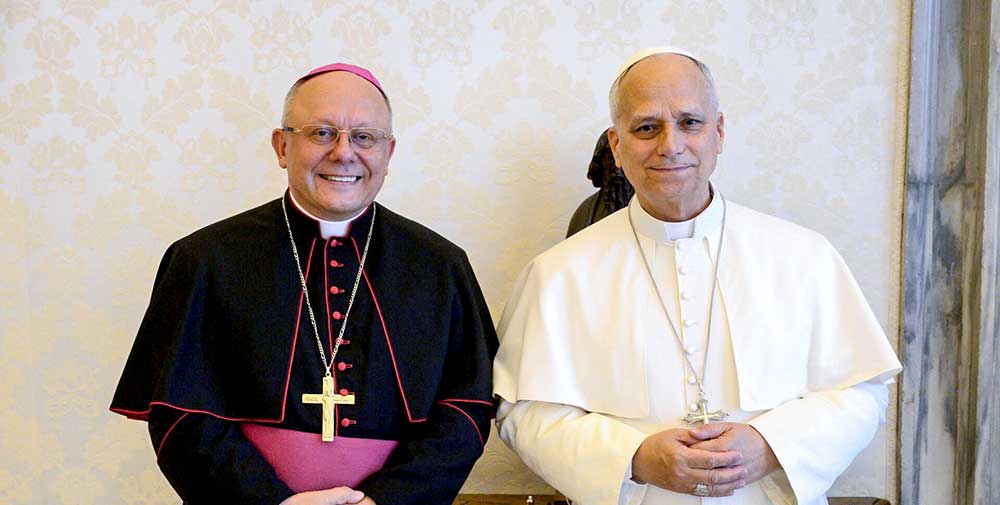
In a world marred by wars and uncertainty, Pope Leo XIV offers an alternative diplomatic vision which proposes dialogue over conflict while also acknowledging the realities of international politics. Archbishop Henryk Jagodzinski, the apostolic nuncio to Southern Africa, explains Pope Leo’s diplomacy of hope in a 6-part series.
What Makes Papal Diplomacy Different?
Understanding Pope Leo XIV’s approach to international affairs requires an important distinction: the Holy See is not just another state pursuing national interests, as Archbishop Henryk Jagodziński, the papal nuncio to Southern Africa, explains in the first of a series of six articles on the Holy Father’s diplomacy.
The election of Pope Leo XIV to the Chair of Peter on May 8, 2025, constitutes one of the most significant events in the contemporary history of the Catholic Church and of its presence on the international stage.
His pontificate emerges at a moment of profound transformation in the global system, characterised by a transition from a unipolar to a multipolar order, the erosion of multilateralism, and a crisis of international institutions.
Pope Leo XIV, born in the US as Robert Francis Prevost, represents a unique synthesis of experiences: a North American institutional background combined with a Latin American pastoral sensitivity. Consequently, from the very beginning, his pontificate assumes a “transboundary” character, both culturally and politically.
This series examines the diplomacy of Pope Leo XIV in light of his teaching and the tradition of the diplomacy of the Holy See.
A unique actor in world affairs
The diplomacy of the Holy See occupies a special place in international relations because it does not fit neatly into classical state-centred models.
Unlike sovereign states, which are guided primarily by national interest, the Holy See acts as a moral and normative actor. Scholars have long noted that it functions as a unique entity, combining elements of a religious authority, a transnational institution and a recognised subject of international law.
Its influence does not depend on military strength or economic power. Rather, it rests on moral authority, symbolic influence, and the ability to mediate between parties in conflict.
For this reason, papal diplomacy can be understood through the concept of “soft power” — influence achieved through values, ideas and moral credibility rather than through force or wealth.
For centuries, Vatican diplomacy has constituted a unique phenomenon in international relations. It is not classical state diplomacy. Rather, as Leo XIV emphasises, it arises from an “urgent pastoral necessity” and is characterised by service to humanity.
If diplomacy is generally understood as an instrument used by states to pursue their objectives and protect their interests, then papal diplomacy appears unusual.
The Holy See employs many of the same diplomatic instruments used by states. It maintains diplomatic relations, participates in international organisations and follows recognised diplomatic norms. Yet its goals differ significantly from those of nation-states.
This distinction is important because people frequently speak of “Vatican diplomacy” when they really mean the diplomacy of the Holy See.
The Vatican City State exists primarily to guarantee the pope’s independence. The actual actor in international affairs is the Holy See: the pope and the Roman Curia acting as the supreme authority of the Catholic Church.
The Holy See therefore functions not merely as a political entity but as a spiritual and moral authority with a universal mission.
Geopolitics of Mercy
In this respect, Pope Leo continues the path followed by his predecessors, particularly Pope Francis, who developed the idea of a “geopolitics of mercy”.
Yet Leo appears to introduce a subtle but significant shift. Where Francis often emphasised symbolic gestures and personal encounters, Leo increasingly focuses on the role of institutions and long-term structures. Rather than relying primarily on visible signs, he places greater emphasis on how international institutions, diplomacy and law can be shaped to promote human dignity and peace.
This does not represent a break with the past. Rather, it suggests a development in emphasis — from symbolic witness to structural influence.
The result is a vision of diplomacy that remains deeply pastoral while engaging seriously with the realities of contemporary international politics.
Next: Beyond Power Politics
Why Pope Leo XIV challenges the idea that international relations are simply a struggle for power and national interest.
Beyond Power Politics
Pope Leo XIV challenges the idea that international affairs are merely a contest of power, arguing instead that peace rests on human dignity, justice and dialogue, as Archbishop Henryk Jagodziński, the papal nuncio to Southern Africa, explains in the second of a series of six articles on the Holy Father’s diplomacy.
Political realism is among the most influential theories of international relations. Its roots can be traced to thinkers such as Thucydides, Niccolò Machiavelli and Thomas Hobbes, while its modern form was developed by scholars such as the German-American political scientist Hans Morgenthau (1904-1980).
According to the theory of political realism, states operate in an international system without any higher authority capable of enforcing law effectively. As a result, their primary concern becomes ensuring security and protecting national interests.
International politics is therefore viewed largely as a competition for power, influence and resources. War is not considered exceptional but a recurring feature of international life. Peace tends to be temporary, maintained by a balance of power or by the dominance of a particular actor.
As Morgenthau observed, international politics is a continual struggle for power. Moral considerations may play a role, but they remain secondary to state interests.
Against this background, Pope Leo XIV presents a striking alternative. In his addresses, the pope insists that lasting peace cannot be built solely on military superiority, deterrence or domination. Speaking to the diplomatic corps in May 2025, he argued that peace requires relationships rooted in human dignity, justice and dialogue.
The pope rejects the notion that peace is simply the absence of open conflict. Instead, he emphasises the need to address the social, economic and political causes of tension.
Responsibility for the Common Good
Unlike political realists, Leo XIV does not regard the international system solely as an arena of competition. His teaching reflects the conviction that states and nations share responsibility for the common good of the entire international community. This perspective is deeply rooted in Catholic social teaching, with its emphasis on solidarity, subsidiarity and integral human development.
Pope Leo argues that security cannot be achieved at the expense of the dignity of other peoples. Such an approach merely perpetuates injustice and lays the foundations for future conflict.
One of the most important aspects of Leo XIV’s vision is his critique of “peace through domination”. Realists often see hegemony or a balance of power as effective tools for stabilising the international system. The pope argues that such arrangements remain fragile because they are built upon fear and unequal relationships.
Lasting peace, he says, requires recognition of the common dignity of all people and the strengthening of institutions that foster cooperation among nations.
In this sense, Leo XIV invites us to see international conflicts not only in geopolitical terms but also in ethical and anthropological ones.
The pope does not ignore the realities of international politics. He recognises that conflicts, tensions and competing interests are permanent features of international life. Yet he refuses to accept them as the final word.
Instead of embracing a logic of permanent rivalry, he proposes a logic of dialogue and responsibility. Politics, he argues, should serve the human person rather than merely the interests of the state.
His vision therefore, combines realism about the world’s dangers with confidence that a more just international order remains possible.
The Crisis of Multilateralism
Pope Leo XIV sees international cooperation as essential for addressing global challenges, but warns that many institutions are losing credibility and effectiveness, as Archbishop Henryk Jagodziński, the papal nuncio to Southern Africa, explains in the third of a series of six articles on the Holy Father’s diplomacy.
Unlike political realism, which focuses on competition among states, liberal theories of international relations emphasise cooperation.
Liberal thinkers argue that states can build durable mechanisms to reduce conflict and promote stability. International organisations, treaties and legal norms are seen as essential tools for maintaining peace.
Institutions such as the United Nations provide forums where disputes can be addressed through dialogue rather than violence.
Pope Leo XIV’s comments on international affairs can be read within the context of the contemporary debate about the crisis of the liberal international order.
In his address to the diplomatic corps in May 2025, the pope drew attention to the weakening of multilateral cooperation and the declining effectiveness of institutions charged with maintaining peace and security.
Dialogue and negotiation, he warned, are increasingly being replaced by confrontation, political pressure and the dominance of stronger actors.
His concerns echo those of many scholars who point to the erosion of the international system that emerged after the end of World War II in 1945.
According to Leo XIV, the weakening of multilateralism creates greater uncertainty and makes it harder to address global challenges. Armed conflicts, migration, poverty and humanitarian crises cannot be solved by individual states acting alone.
For this reason, the pope insists that international cooperation remains indispensable. No nation, however powerful, can successfully confront today’s challenges in isolation.
In this respect, he shares one of the central assumptions of liberal international thought: growing interdependence makes cooperation necessary.
Renewal and Reform
The pope’s critique of contemporary institutions should not be misunderstood. He does not reject international organisations or international law. On the contrary, he argues for their renewal and reform.
The problem, in his view, lies not in multilateralism itself but in the loss of credibility experienced by some institutions. Too often, they no longer appear capable of serving the common good effectively or impartially. The solution is not abandonment but renewal.
Leo XIV’s approach closely resembles what scholars call normative liberalism. This perspective holds that institutions cannot function effectively without strong ethical foundations. Their legitimacy depends not only on legal structures but also on the values that animate them.
The pope argues that international cooperation must be rooted in human dignity, solidarity, justice and responsibility for the common good. Without these foundations, even the most sophisticated institutions risk becoming ineffective.
Pope Leo, therefore, offers neither a defence of the status quo nor a retreat into nationalism.
Instead, he calls for a renewal of international cooperation through institutions that are both effective and morally credible. His position combines the liberal belief in cooperation with the moral vision of Catholic social teaching.
The goal is not simply the preservation of existing structures, but the rebuilding of an international order capable of serving humanity more faithfully. Next: Narratives, Ideas and International Power
Narratives, Ideas and International Power
Pope Leo XIV argues that international politics is shaped not only by power and interests, but also by the stories nations tell about themselves, their neighbours and the human person, as Archbishop Henryk Jagodziński, the papal nuncio to Southern Africa, explains in the fourth of a series of six articles on the Holy Father’s diplomacy.
One of the most important contemporary theories of international relations is that of constructivism. Unlike realism (which focuses on power) or liberalism (which emphasises institutions), constructivism argues that international reality is largely shaped by ideas, values, norms and identities.
States do not simply respond to objective interests. They interpret the world through particular cultural, historical and religious lenses. As a result, beliefs and narratives often influence political behaviour as much as military or economic power.
In this context, Pope Leo XIV’s references to St Augustine acquire particular significance. The pope frequently draws upon Augustine’s distinction between the civitas Dei (City of God) and the civitasterrena (Earthly City), which remains one of the most influential concepts in Christian political thought.
Rather than proposing a detailed political programme, Leo offers a way of interpreting international affairs through the lens of Christian anthropology. For him, many contemporary conflicts arise not only from competing interests but also from fundamentally different understandings of human dignity, freedom, justice and the common good.
The pope argues that international politics is increasingly a contest between rival visions of the human person and society.
The narratives that shape public life influence how nations define their interests, identify threats and construct relationships with others. Politics therefore becomes more than a negotiation of interests. It also becomes a struggle over values, symbols and meaning.
In this respect, Leo’s analysis closely parallels the constructivist insight that ideas are not merely decorative additions to politics but powerful forces that help shape reality itself.
The power of Narratives
A recurring theme in the pope’s teaching is the importance of narrative. How societies describe reality influences how they behave.
Narratives rooted in fear, hostility or perpetual rivalry deepen divisions and foster distrust. By contrast, narratives that emphasise solidarity, shared responsibility and common humanity create opportunities for cooperation and peace.
For Leo XIV, language matters because words shape political realities. This insight becomes particularly relevant when examining contemporary conflicts.
The pope notes that wars are often preceded by narratives that portray opponents as threats or deny their full humanity. Such narratives make violence easier to justify and reconciliation more difficult to achieve.
For this reason, Leo repeatedly calls for a culture of dialogue and a language of respect capable of sustaining relationships even amid profound disagreement.
Changing the Culture of Politics
By drawing upon St Augustine’s vision of the two cities, the pope reminds us that history is not merely a sequence of political and economic events. It is also a contest between competing systems of values.
International conflicts can therefore be understood not only as geopolitical struggles but also as the consequences of moral and cultural choices made by societies.
This perspective moves beyond the categories of power and interest that dominate many traditional approaches to international relations.
Pope Leo’s teaching suggests that lasting peace requires more than treaties, institutions or military deterrence.
It also requires a transformation in the way people understand themselves, their neighbours and the international community.
Ideas, narratives and culture matter. For this reason, the pope sees the renewal of political culture as an essential component of building a more peaceful international order. Next: The Moral Foundations of Diplomacy
The Moral Foundations of Diplomacy
Human dignity, solidarity, justice and the common good form the foundation of Pope Leo XIV’s approach to international relations, as Archbishop Henryk Jagodziński, the papal nuncio to Southern Africa, explains in the fifth of a series of six articles on the Holy Father’s diplomacy.
An examination of Pope Leo XIV’s diplomatic teaching reveals a consistent reliance on Catholic social doctrine. Rather than developing an entirely new framework, he draws upon principles articulated by the Church since the pontificate of Pope Leo XIII in the late 19th century.
His diplomatic interventions repeatedly return to themes such as human dignity, social justice, solidarity and the common good.
A particularly significant moment came in his address to the diplomatic corps at the beginning of his pontificate. There, Leo XIV identified peace, justice and truth as the fundamental pillars of international relations.
The diplomatic activity of the Holy See, he argued, cannot be reduced to political calculation. Instead, it should serve the creation of conditions that allow the integral development of every human person.
At the heart of the pope’s vision stands the dignity of the human person. This principle becomes the criterion by which political systems, international institutions and public policies should be judged.
Leo XIV repeatedly emphasises that human rights do not originate from governments or legal systems. They arise from the inherent value of every human being.
This conviction shapes his concern for civilian populations affected by war, refugees, the poor and those deprived of religious freedom.
In this respect, Leo XIV stands firmly within the tradition of Pope St John XXIII’s encyclical Pacem in Terris. That landmark document presented human rights as essential foundations for a peaceful international order.
The current pope extends this insight to contemporary challenges, insisting that respect for human dignity remains indispensable to genuine peace.
Solidarity among Nations
Another key theme is solidarity. Leo XIV repeatedly stresses that contemporary problems are global in scope and therefore require collective responses.
Whether addressing armed conflict, migration or humanitarian crises, he argues that the international community shares responsibility for the welfare of the entire human family.
This echoes the teaching of Pope St John Paul II, who described solidarity as a firm and persevering commitment to the common good.
Pope Leo also places strong emphasis on social justice. He frequently highlights the connection between poverty, inequality and conflict.
Peace, in his understanding, is not merely the absence of war. It is the fruit of social conditions that enable individuals and nations to flourish.
This approach recalls Pope St Paul VI’s famous teaching that “development is the new name for peace”.
For this reason, the diplomatic activity of the Holy See extends beyond mediation and negotiation to include advocacy for social and economic justice.
The Common Good
A further pillar of Leo XIV’s teaching is the common good.
The pope presents the international community not as a battlefield of competing interests but as a sphere of cooperation oriented towards the welfare of the entire human family. Diplomacy therefore carries an ethical responsibility. It must continually remind the world that certain values transcend geopolitical rivalry.
Catholic social teaching is not merely a background influence on Leo XIV’s diplomacy, but its foundation. Human dignity, solidarity, social justice and the common good form a coherent framework guiding the Holy See’s engagement with international affairs.
In this sense, papal diplomacy remains a form of moral witness, seeking peace through the promotion of universal ethical principles. Next: A New Language for Diplomacy
A New Language for Diplomacy
Pope Leo XIV’s concept of “thinking charity” seeks to unite moral responsibility and political realism in a single vision of international affairs, as Archbishop Henryk Jagodziński, the papal nuncio to Southern Africa, explains in the final part of a series of six articles on the Holy Father’s diplomacy.
One of the most original aspects of Leo XIV’s teaching is the concept of carità pensante.
The phrase first appeared in a letter written on November 21, 2025, marking the 325th anniversary of the Pontifical Ecclesiastical Academy, the institution that trains Vatican diplomats.
There the Pope wrote: “For our diplomacy is born of the Gospel: it is not a tactic, but a thinking charity (caritàpensante); it seeks neither victors nor the defeated, it builds no barriers, but restores authentic bonds.”
Love and reason together
In Leo XIV’s understanding, responsible action requires the integration of two elements: charity and reason.
Charity expresses concern for the good of others. Reason enables people to understand the complexity of reality and make prudent decisions.
Neither is sufficient on its own. Love without reflection can become naïve and ineffective. Reason without a moral foundation risks degenerating into cold technocratic management.
The task of politics and diplomacy is therefore to unite both dimensions.
From a diplomatic perspective, caritàpensante means engaging in dialogue without abandoning truth or moral principles.
The pope repeatedly argues that the modern world requires diplomacy capable of building bridges between nations, cultures and religions.
This does not imply compromise at any cost. Nor does it require the abandonment of convictions.
Rather, it involves dialogue grounded in respect for human dignity and oriented towards the common good.
Diplomacy becomes not merely a mechanism for resolving disputes but a service to peace itself.
Technology and Ethics
The concept also sheds light on Leo XIV’s concerns regarding technological development.
In his first encyclical, Magnifica Humanitas, he warns against a technocratic mentality in which decisions are driven solely by efficiency, security or profit.
Artificial intelligence and other emerging technologies require not only technical expertise but also ethical discernment.
For the pope, diplomacy must help provide moral direction in a world increasingly shaped by technological power.
From the perspective of international relations theory, carità pensante offers an intriguing synthesis.
Political realism emphasises interests and security. Idealist approaches stress values and cooperation.
Leo XIV accepts important elements of both perspectives. He acknowledges the reality of conflicts, competing interests and political constraints. Yet he rejects the idea that state interests alone should determine action.
Diplomacy must be effective, but effectiveness cannot be separated from moral responsibility.
Ethical realism
For this reason, Leo XIV’s approach can be described as a form of “ethical realism”.
It recognises the complexity of international politics without surrendering to cynicism. Political action must take account of real conditions, but it must also remain guided by ethical principles.
This perspective draws heavily on Catholic social teaching and the tradition of the “civilisation of love” developed by Popes Paul VI, John Paul II and Benedict XVI.
Caritàpensante is more than a moral exhortation. It also serves as a method for interpreting international reality. Political, economic and strategic considerations must all be evaluated in the light of human dignity and the common good.
Diplomacy therefore becomes more than conflict management. Its purpose is to help create conditions in which people and nations can flourish together.
Conclusion: Leo XIV’s diplomatic vision
The first diplomatic interventions of Pope Leo XIV suggest a creative development of the Holy See’s long-standing diplomatic tradition.
The pope neither abandons realism nor embraces utopian idealism. Instead, he seeks to integrate political prudence with moral responsibility.
His vision draws upon human dignity, solidarity, social justice and the common good while recognising the realities of conflict, power and competing interests.
At the centre of this vision stands carità pensante — a concept that may well become one of the defining ideas of his pontificate.
It offers a way of understanding diplomacy not as a contest for advantage but as a form of service to humanity.
In an age marked by conflict, uncertainty and global interdependence, Leo XIV proposes a diplomacy that is at once realistic and hopeful, practical and ethical.
Whether the international community embraces this vision remains to be seen. But it demonstrates that the Holy See continues to offer a distinctive voice in global affairs — one that seeks to unite moral, spiritual and political reflection in the service of peace.
This concludes Archbishop HenrykJagodziński’s series on Pope Leo XIV’s diplomacy. Read a summary of this six-part series in the September 2026 issue of The Southern Cross, out August 22. Got to top