JOURNEYING WITH MARY, by Lyn Holness. Lux Verbi.BM, Wellington. 2008. 180pp
Reviewed by Anthony Egan SJ
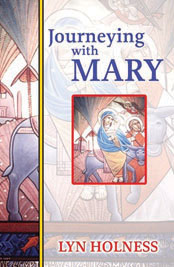 Readers who look closely at publishing details of book reviews may be a little surprised by this new book about the Blessed Virgin Mary. No, they are not reading a misprint. Yes, this is a local publication — Wellington, Western Cape, not New Zealand — and yes, it is Lux Verbi, the mainly Protestant publisher! Indeed, this is a study of Mary from a Protestant perspective. And, no, this is not an anti-Catholic tract, but a carefully-written, ecumenically sensitive, scholarly yet devotional book.
Author Lyn Holness, a member of the Rondebosch United Church in Cape Town and a PhD in religious studies from the University of Cape Town, sees this book as the fruit of a personal journey to a deeper understanding of and appreciation for the role of Mary as an exemplar to all Christians.
In Mary, she suggests, we can see “where and how God comes to us and can use us — in the ordinary things; in our relationships and in our brokenness; in what we do and who we are and in how generous we are in sharing ourselves with others.”
Starting historically, Holness outlines the developments in doctrine concerning Mary in church traditions — Catholic, Orthodox and Reformed. She notes that while there is considerable overlap there are also serious differences: all three traditions accept the virginal conception and birth of Jesus, with Catholics and particularly Orthodox seeing this as illustrating Mary’s perpetual and special relationship to her son. Orthodox (and Protestants) have trouble with the Catholic notion of Mary’s Immaculate Conception and Assumption.

The Reformers, she points out, were not of one voice about Mary: Zwingli and in particular Luther shared most Catholic doctrines of Mary, while Calvin downplayed her significance, a path trodden by many later Protestants until the 20th century. A small but growing number of Protestants have come to re-evaluate Mary positively, particularly by latching onto the Catholic understanding that all Marian doctrines are in themselves ways of speaking about Christ. Mary points to her Son. What we say about her points to what we say about Jesus.
With this point in mind — a point thoroughly Catholic yet Reformed — Holness focuses on the pastoral and spiritual implications of doctrines and devotions pertaining to Mary. Thus we see her examination of the Annunciation as an account of God’s grace poured out to us and our freedom to accept this grace epitomised by Mary’s acceptance of her mission. Interlinked here, as in other parts of this book, are the author’s autobiographical and historical anecdotes suggesting how Mary’s example might be lived out in daily life.
Moving through the events of Mary’s life, their traditional celebration and through such later phenomena as Marian apparitions and fierce intra-Catholic debates over Mary as “Co-redeemer”, the author tries consistently to blend together sound scripture scholarship, close attention to coherent Christian doctrine and a suitably contextual view of Mary as a poor but strong peasant woman whose life in often very low-key solidarity with Jesus is a model for women and men everywhere.
On the co-redeemer controversy, which is utterly anathema to even the most progressive and pro-Marian Protestants (and most thinking Catholics too!), Holness offers a delightfully clever “compromise”. Based on the belief in the priesthood of all believers, Holness understands Mary as symbol of the Church, where Christ lives in our midst within community, reaching out to others through us. Hence, “Mary can be regarded as Co-redeemer with Christ in the same sense as we are all called to be, as his Body on earth”.
In 2008, at the Theological Society of South Africa conference in Grahamstown, the author gave a keynote speech on Mary. It was very well-received by the academics present. Although this book is serious stuff — Holness draws on some of the best recent academic work on Mary done by Catholics and Protestants alike—it is not a “heavy” read. Nor is it a work of saccharine piety. It’s matter-of-fact, engaging, fast-paced and in the end very practical.
Each section ends with a short prayer — ideal for personal reflection or meditation, even perhaps as alternatives to those sometimes dreadfully archaic hymns to the Blessed Virgin that end Night Prayer.
- Saint Paul and the Bible - July 29, 2019
- Religious Orders: Then and Now - November 6, 2018
- A Brief History of Religious Orders in South Africa - October 25, 2018