
Is the Crozier a Pagan Symbol?
[Updated 2026]
Question: I was surprised recently when a friend, an agnostic, claimed that the bishop’s crozier is actually an old pagan symbol. Is that true?
Answer: Historical evidence of the use of the pastoral staff by a bishop emerges from the 5th century.

In his will, St Remigius, who was archbishop of Rheims, France, from 461 to 533, bequeathed his crozier to the local church. It was described as carved of wood and covered with gold.
St Patrick of Ireland is said to have been given his staff by Pope Celestine when he was consecrated bishop of Armagh around 422.
There is the possibility that the crozier did in fact develop from the Roman lituus, a rod that the augurs employed when they pointed to the heavens to predict the future. A frieze in Rome’s temple of Jupiter depicts the lituus being used by Romulus when he founded the city of Rome and divided it up into districts in 753 BC.
What is fascinating here is that this instrument had a curve at the top exactly like the bishop’s crozier. So there could have been some conventional influence there that gave the crozier a similar shape.
Another possibility is that the crozier was at first a walking stick to support the bishop during long and exhausting liturgical rituals.
Perhaps we cannot say for sure how the crozier as we know it became the prerogative of the bishop, but literature and art assure us that the crozier has been the bishop’s definitive badge of office for many centuries.
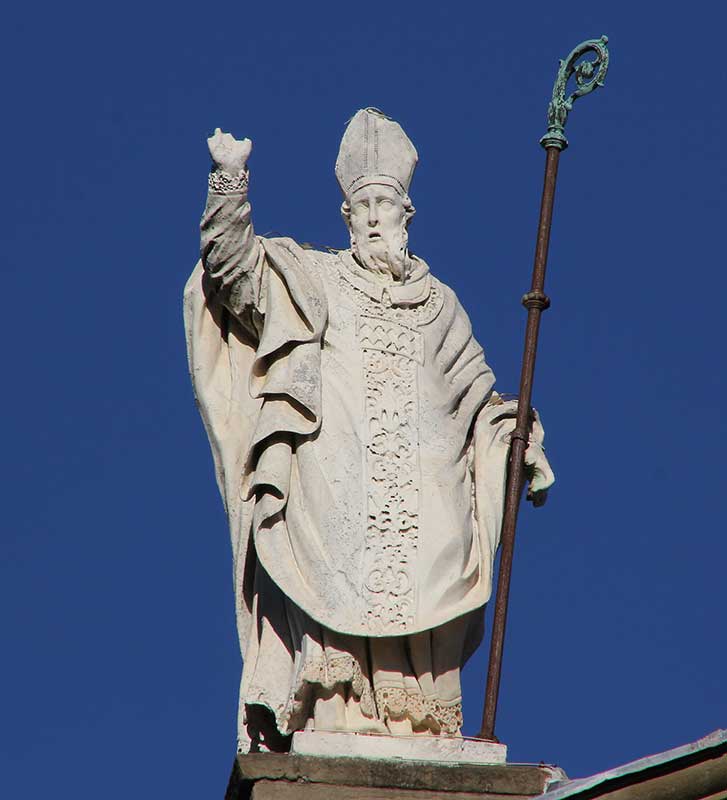
Shaped like a shepherd’s crook, it proclaims that he is the pastor of the particular flock under his spiritual care, echoing Jesus as the Good Shepherd (John 10:11).
While its form may resemble earlier staffs of authority, the Christian meaning is pastoral, not magical, pagan or secular. Ancient writings offer the explanation that the top of the crozier is curved so that, like a good shepherd, the bishop can collect sheep who have wandered from the fold; the middle part is straight and strong to give him courage to strengthen the weak, stubborn and disobedient; and the lower part is slightly pointed at the end to let him prod the slothful into action.
Depending on times and places, the crozier took on an assortment of varying designs and ornamentations. Double-headed croziers were also used, with two curved tops pointing in opposite directions. At one stage, popes, archbishops and bishops had their own individual staffs according to rank.
A bishop receives his pastoral staff at his ordination to the episcopal office. The ordaining bishop admonishes him in these words: “Take this staff as a sign of your pastoral office: keep watch over the whole flock in which the Holy Spirit has appointed you to shepherd the Church of God.”
Published in the October 2025 issue of The Southern Cross magazine

- The Day a Saint Shoved Me - November 11, 2025
- Is the Doxology Part of the Lord’s Prayer? - September 25, 2025
- Can a Christian Doubt Heaven? - June 24, 2025



