
Early Church: Anti-Catholic Prejudice at the Cape
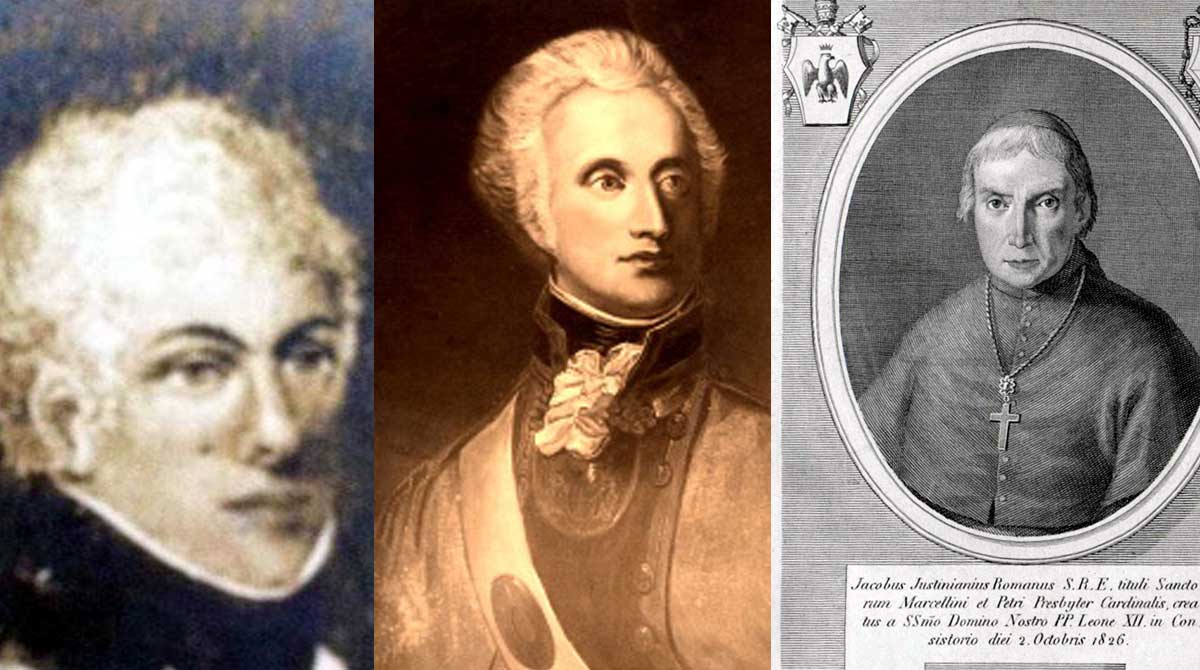
Lieutenant-Colonel Christopher Chapman Bird, who fell victim to anti-Catholic prejudice. Lord Charles Somerset, governor of the Cape Colony from 1814-26, who was virulently anti-Catholic. Cardinal Giacomo Giustiniani, whose relative, Margaret O’Flinn, reported anti-Catholic attitudes.
In his previous article on the history of the early Church in South Africa, MARTIN KEENAN showed that there was no ‘persecution’ of Catholics at the Cape, but this week he explains that there was anti-Catholic prejudice in the 1820s and ‘30s.
In this part of the history of the early Church at the Cape, about anti-Catholic prejudice, three lay Catholics feature — all of whom we have previously encountered or will meet again in connection with other matters.
Two laymen were attacked by anti-Catholic forces. One of them suffered immediate adverse consequences through loss of his highly remunerated and prestigious employment, while the other successfully sued his tormentor for libel.

The third, a laywoman, was recipient and witness of generalised anti-Catholic sentiment current in Cape Town in the 1830s of which we hear nothing from any other source.
An oath too far
The attack on Lieutenant-Colonel Christopher Chapman Bird (1769-1861) was launched in the early 1820s by the Irish Presbyterian William Parker, a former mayor of Cork in Ireland. It directly caused Bird’s dismissal in 1824 from the senior post he had held in the civil service since 1818.
Bird remained at the Cape comparatively impoverished, but with his honour and reputation intact.
His wife, a Protestant, had been received into the Church in mid-1826 by the Catholic chaplain, Fr Wagener, and was expelled from the Dutch Reformed congregation in November that year. This may account for Bird in 1836 calling Calvinists “our enemies”.
The problem was that Bird’s appointment to an office under the British Crown required him to take an oath of loyalty to the British monarch—but the standard oath was designed to make it impossible for faithful Catholics to swear it.
A variant oath which was not offensive to Catholics had been devised for the French colony of Québec, overwhelmingly Catholic, after it had been ceded to Britain by France in 1763. That is the oath Bird took.
William Parker’s anti-Jesuit agitation was cooked up by the governor, Lord Charles Somerset, while pursuing his own vendetta against his one-time deputy, Sir Rufane Shaw Donkin.
It was Somerset who pushed the British government to insist that Bird take the unmodified oath, which, as a faithful Catholic, he refused to do.
For that, at the height of his powers, Bird was dismissed from an office which paid £2000 a year plus emoluments. For comparison, Fr Wagener received an annual state salary of £100 in 1826, rising to £200 in 1831.
Bird lived in Cape Town until 1843 when he retired to Bruges, Belgium.
A foul case of libel
The libel on Dr Hubertus Bendictus van Horstok was published in the Zuid-Afrikaan Tydschrift of June 18, 1830.
Horstok had qualified in medicine in Amsterdam and his dissertation (on scurvy) was published there in 1821. On July 5, 1822 he was licensed to practise at the Cape as physician and accoucheur.
The libel was contained in a squib — a short piece of satirical writing — the English translation of which, for purposes of the litigation, was as follows:
Singular epitaph on a Quack Doctor:
Hereunder rots the corpse of Lubbert Marmoriset,
escaped, God knows whence, as village or ship barber;
Roman Catholic layman, yea, half priest, vile hypocrite,
defamer of his wife, that faithless proselyte,
too stupid even for the syringe, run-away hospital nurse,
useless either to man or beast, pitiful scribbler;
in short, here is a quack, a man murderer.
The Court accepted evidence that these words identified Horstok, and the only issue at trial was how the piece came to be printed, since the editor (Charles Boniface), printer (Breda) and publisher (Neethling) all denied they had written the squib or caused it to be written, and claimed it was inserted unilaterally by one Bernardus Josephus van de Sandt who, they claimed, sometimes helped out with the typesetting.
De Sandt was, in later life, an editor in his own right and published The Cape of Good Hope Almanac and Annual Register from 1840 onwards.
The main object of the slur was Horstok’s medical standing, but the reference to his religious beliefs and practices (“Roomsch leek, ja, half pastoor, vuilaardig hypokriet; Schandvlekker van syn’ vrouw, die trouwloos’ prosyliet”) also exposed him to hatred, contempt, or ridicule (the standard definition of defamation).
The court awarded Horstok £75 damages on September 7, 1830.
After serving for two years as one of the Catholic churchwardens, elected in 1832, Horstok returned to Holland in 1834.
Lies from an ex-priest
Margaret O’Flinn, née O’Connor, came out to the Cape with her husband Daniel in a party of settlers aboard the “Chapman” which left England in 1819. She was then 28, he a year younger.
Her evidence of anti-Catholicism is contained in a letter she sent in 1839 to Cardinal Giacomo Giustiniani in Rome, with whom she claimed some kinship through her mother.
She recounts the depredations among the flock of a “wolf” named—coincidentally—Louis Giustiniani, of whose presence in Cape Town on a stop-over from Europe to Western Australia we would know nothing were it not for her letter. From external sources we can place his stop-over in late summer 1836.
According to O’Flinn, Louis Giustiniani preached in all the Sunday assemblies, fulminating against the evils of Rome.
His book Papal Rome As It Is, By a Roman, published in Baltimore in 1843, contains his life story down to that date.
He was a renegade Catholic cleric ordained to the diaconate in 1826 whose faith was shaken by a book he chanced on.
Fleeing Rome (in secret, he says, to avoid the Inquisition), he reached Switzerland in mid-1829 where, having repudiated his Catholic faith, he was received into the Reformed Church in 1831.
The book mocks the cult of the saints and the doctrine of transubstantiation, and dilates on Rome’s avarice and immorality.
Particularly galling to Mrs O’Flinn would have been a passage in Louis’ book which recounts a riot allegedly provoked by Cardinal Giustiniani through his interference with an ancient Marian tradition.
There is a kernel of truth in the overblown story in as much as the cardinal had acquired a reputation for harshness when he was archbishop of Imola from 1826-32 (his successor in the see of Imola, incidentally, was elected pope in 1846, taking the name Pius IX).
Louis Giustiniani had stopped over at Cape Town on his way to preach the Gospel to the Aborigines in Western Australia, but was forced to abandon that mission field in 1838 and made his way to the United States where his book was published and where he went over to evangelical Lutheranism.
As if that were not enough, evangelical “New Lights” deluged Cape Town with anti-Catholic publications from India, presumably disseminated by an individual or individuals arrived from Calcutta. O’Flinn forwarded a pamphlet to Bishop O’Connor, vicar-apostolic of Madras, another of her connections.
O’Flinn and her husband died in the 1850s, within two years of each other.
‘Let church be shut down’
A final anecdote from this period is particularly perturbing, if true.
As reported in a Catholic journal published in London in 1841, the chief justice at the Cape in 1832 is alleged to have uttered blatantly prejudicial remarks during a trial relating to control of Scully’s Chapel, the first Catholic church in South Africa, built by Fr Patrick Scully. The journal reports:
“‘Supposing,’ argued the counsel for the Catholic clergyman, ‘Supposing this chapel were to exist for very many years…’, ‘I trust not,’ interrupted his honour; ‘I trust to see it shut up, and the congregation no longer frequenting it’.”
This irruption of anti-Catholic feeling in the 1830s contrasts with ecclesiastical charity in the 1820s.
Even if the goodwill shown by the numerous non-Catholic contributors to Fr Scully’s building fund in 1821 can be attributed to the temporary absence on home leave of the notoriously anti-Catholic Lord Charles Somerset, that does not nullify what they did actually do in his absence.
Scully’s personal qualities will have contributed largely to the ecumencial harmony evident in the 1820s. All the non-Catholic clergy, the dissenting evangelicals excepted, were among those who publicly subscribed to the building fund.
Hugh Torrance, a young Scottish businessman on his way to Sydney, gave a brief account of merry evenings spent in Cape Town with Fr Scully who, he says, was a favourite with regimental officers, and Scully was given civil employment by an Anglican clergyman, the astronomer royal at the Cape, who also admitted him as a lodger.
A comic verse printed in a local English-language newspaper in February 1824 evinces affection for “Pat” Scully:
Is this Chapel of Roman or Gothic, or what style?”
said Dick to his friend, who replied with a Pat smile,
“I should rather suppose, from the name of the priest,
Mr. Scully, ‘tis Roman-Golgothic at least.
Scully’s Chapel collapsed in 1837.
In the January 24 issue, Martin Keenan will look at conflict between clergy and laity in the 1830s.

- From Our Vaults 5 Years Ago: September 23, 2015 - September 23, 2020
- New Ordinations in Pretoria - August 31, 2020
- Why Hagia Sophia Must Matter To Us - August 20, 2020



