Giving Help after Piracy Trauma
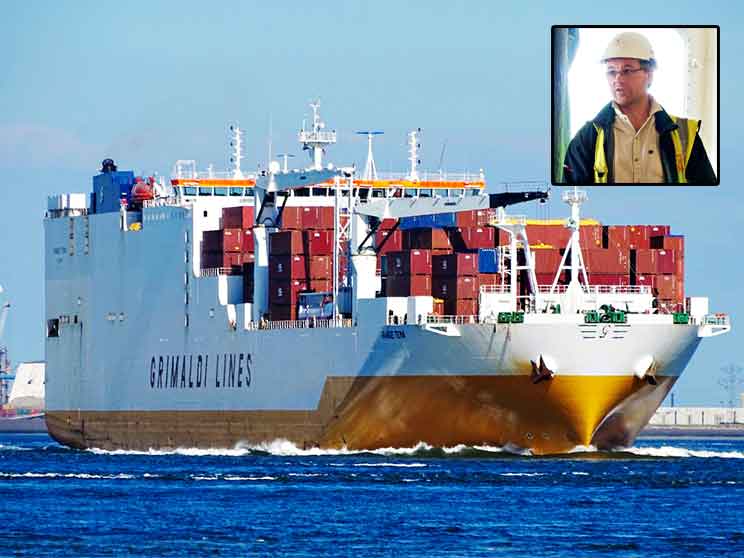
The cargo ship Grande Tema, which was the scene of an armed stand-off. (inset) Wojciech Holub, who arranged for counselling and immediate needs after crew of the Grande Tema emerged from their hostage trauma.
The storming of a cargo ship in the middle of the Thames estuary off the coast of England by heavily armed commandos of the Special Boat Service just before Christmas was the kind of incident you might expect off the coast of Somalia or Nigeria.
What led to this dramatic rescue mission under cover of darkness was a report of the crew of the Italian-registered cargo ship Grande Tema being threatened with iron bars by four men who had stowed away on the ship, which had set sail from Lagos, Nigeria, on December 7 on the 7000km voyage to Tilbury in Essex.
Terrified, the crew had locked themselves on the bridge and the captain put in an emergency call to the Maritime and Coastguard Agency.

Once the four men had been arrested by the Special Boat Service, who had abseiled onto the Grande Tema’s deck from helicopters, the ship continued to Tilbury.
The media naturally focused on the drama of the event and the fact that the four men had stowed away on the ship in order to enter the UK illegally.
But for Wojciech Holub, the Apostleship of the Sea (AoS) port chaplain in Tilbury, his focus was on the emotional wellbeing of the crew after such a traumatic experience.
Mr Holub went on board the Grande Tema, which is a regular visitor to Tilbury, and spent time listening to the crew talk about their ordeal.
“Firstly, when the crew discovered the stowaways hiding in the hold, their daily routine was disrupted, as they had to provide a watch on the cabin they had put the stowaways in,” said Mr Holub.
“The crew weren’t scared of them at this point, as there are procedures for dealing with these situations on board. It was only when the stowaways escaped and threatened the crew and demanded the ship take a course close to the English coastline that the situation became dangerous. The stowaways then became bandits,” he explained.
“That’s why the crew had to run to safety on the bridge, with three of them staying in the engine room. You can imagine how they felt when they were threatened. They were very frightened,” Mr Holub said.
All the crew, to some extent, were feeling tired because of a lack of rest, he added.
“They were deprived of sleep, which in their business is crucial. No one asked them on their arrival in Tilbury how they were, because they had to carry on working when they arrived.”
Mr Holub provided the crew with SIM cards, so they could contact loved ones back home, and invited them to come to the seafarers’centre in the port to relax. He also gave them Christmas presents.
Mr Holub contacted the AoS chaplain at the next port the Grande Tema would visit to ask him to check on the crew’s welfare.
Roaming pirates
While a crew being threatened on a ship off the coast of England might be rare, this isn’t the case in other parts of the world, where pirates roam in search of easy pickings.
The vessels most at risk are, generally, oil tankers and container ships. They carry cargoes worth huge sums, and pirates believe that they have a good chance of forcing the insurance company to pay up.
Last September, pirates attacked a Swiss ship in the Gulf of Guinea, off the coast of Nigeria, and captured the 12 crew members while destroying most of the communication equipment.
The crew were eventually released after negotiations between the ship’s owner and the pirates. It’s not known if a ransom was paid.
A total of 156 incidents of piracy and armed robbery against ships were reported to the ICC International Maritime Bureau’s Piracy Reporting Centre in the first nine months of 2018, compared to 121 for the same period in 2017.
The coast of Somalia, especially the Gulf of Aden, was up until fairly recently notorious for pirates. However, due to patrols by Britain, the US, China, France, and Russia, the waters are now much safer for vessels.
The Gulf of Guinea has now become the piracy hotspot.
On January 2, for instance, six Russian seafarers, including the captain, were kidnapped off the coast of Benin when pirates boarded and ransacked their ship, the MSC Mandy.
Traumatised seafarers
Fr Herman Giraldo, AoS port chaplain in Durban, said when a ship is attacked by pirates it can leave the crew traumatised.
“We’ve had a couple of cases of seafarers who were attacked by pirates off the coast of Guinea,” he said.
“The experience really affected them psychologically. They told me that sometimes they wake up in the middle of the night worried that pirates might be attacking their vessel,” Fr Giraldo said.
Seafarers are not allowed to carry weapons, so some companies hire armed guards to protect ships from attacks.
“When you go on board some ships, they are like prisons. They have razor wire everywhere. And some will have bottles filled with petrol and a rag. If pirates attack, the crew will light these and throw them at the pirates,” Fr Giraldo said.
The priest is part of a crisis response team to support seafarers who have been victims of pirates or endured other traumatic experiences while at sea.
The team consists of a network of trained port chaplains, drawn from a range of maritime welfare agencies, and provides a 24-hour service in South Africa, Ghana, Madagascar, Mozambique, and Réunion.
Piracy is not just confined to Africa. Waters such as the Celebes Sea around Indonesia, Malaysia, and the Philippines are particularly dangerous for seafarers.
The dramatic rescue of the Grande Tema in England and the capture of the Russian ship off Benin’s coast are poignant reminders of how we all rely on seafarers.
They might be invisible to us, but without them we wouldn’t have many of the goods we buy in our shops.
What is the AoS?
The Apostleship of the Sea provides practical and pastoral care to all seafarers, regardless of nationality, belief or race.
Its port chaplains and volunteer ship visitors welcome seafarers, offer welfare services and advice, practical help, care and friendship.
The Apostleship of the Sea in South Africa is part of an international network known to the maritime world as Stella Maris, with 216 port chaplains working in 314 ports around the world.
In South Africa, the AoS is represented in the ports of Cape Town, Durban, Mossel Bay, Port Elizabeth and Richards Bay. It is also active in Walvis Bay, Namibia.
The Apostleship of the Sea relies wholly on voluntary contributions.
Visit www.apostleshipofthesea.org.za for more information.

- Sister Eleanor Wilkinson CSsR Rest in Peace - June 6, 2020
- Justice & Peace Backs Pope on Lockdown Rescue Plan - April 17, 2020
- New Church in KZN Dedicated to Bl Benedict Daswa - February 19, 2020