The Echoes of 1934
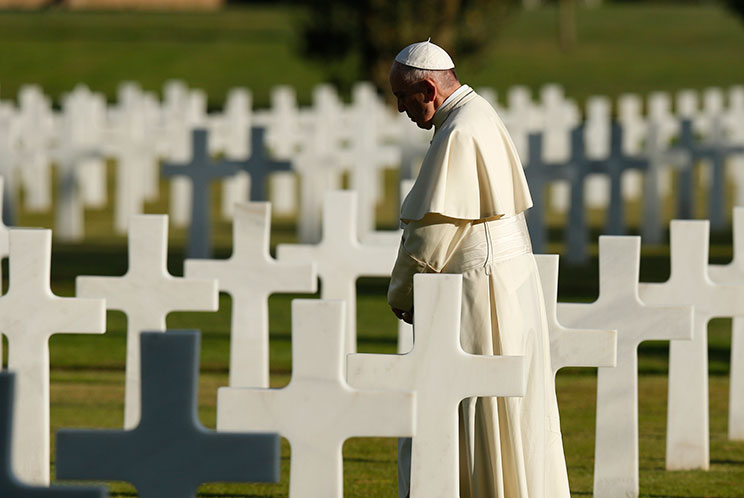
Pope Francis prays in the Sicily-Rome American Cemetery — the resting place of 7,860 American military members who died in World War II — in Nettuno, Italy, Nov. 2, 2017, the feast of All Souls. In a joint appeal marking 80 years since start of World War II, Polish and German bishops warn that Europeans still need to work toward peace and unity. (CNS photo/Paul Haring)
Pope Francis last month sounded a warning from history when he noted that much of the current political rhetoric reminded him of the populism applied by Adolf Hitler in 1934, as the Nazis were entrenching their power in Germany.
As we mark the 80th anniversary this month of the start of World War II, and the horror this conflagration created, the pope’s remarks serve to warn us not only about today but also to caution us on what such rhetoric can lead to.
The pope’s comments in an interview with the Italian daily La Stampa are not the first time he has rebuked the populist rhetoric of nationalism, exclusion, division, fear-mongering and selfishness.

In 2017 he recalled the Germans of the early 1930s as “a people who were immersed in a crisis, who were searching for their identity until this charismatic leader came and promised to give their identity back — and he gave them a distorted identity, and we all know what happened”.
He obviously sees parallels with current political developments. The Holocaust started with propaganda which in print, in speeches, on film, in caricatures portrayed Jews in such a way as to legitimise prejudice against them. That propaganda was used to justify the merciless persecution of Jews, or at least encouraged acquiescence in it.
The Holocaust started with propaganda which in print, in speeches, on film, in caricatures portrayed Jews in such a way as to legitimise prejudice against them. That propaganda was used to justify the merciless persecution of Jews, or at least encouraged acquiescence in it.
It is notable that when US President Donald Trump declared his candidacy for the White House, he propagated prejudice against migrants from Latin America in words that came straight out of the textbook for racist propaganda: “They’re bringing drugs. They’re bringing crime. They’re rapists.”
Four years later we see large-scale deportations which are tearing families and communities apart. One priest in Mississippi reported having lost half of his parishioners in deportation round-ups.
We see detention camps where children are separated from their parents, and where conditions are abysmal.
Helping undocumented immigrants is now illegal in the US. Critics have described that as the criminalisation of solidarity.
Large parts of the US public seem to have accepted, or even welcomed, the policies of their president, which even his supporters in the US episcopate have criticised (though without mounting great moral outrage). Much as Germans stood by as their Jewish neighbours were taken away, so are Americans standing by as their Hispanic neighbours are rounded up.
Much as Germans stood by as their Jewish neighbours were taken away, so are Americans standing by as their Hispanic neighbours are rounded up.
The populism of Mr Trump is by no means unique. We hear echoes of it in South Africa, too. In Europe, anti-migrant and xenophobic sentiment has empowered right-wing movements in virtually every country; in some, they are governing.
Their rise in legitimacy has been accompanied by an increase in hate crimes against minorities and perceived enemies. That is no coincidence; political incorrectness has gone mad.
One must, of course, blame the populists for the fear and prejudice that they spread with their divisive rhetoric, but the willing recipients of their hatemongering are likewise to blame, for they have a choice and they have access to alternative information — both liberties which Germans were starting to be deprived of in 1934. Distressingly, many Christians subscribe to the rhetoric of hate, or at least acquiesce in it. There may be many good reasons for it — agreement with other policy areas, or the illusory promise of stability, or old-fashioned partisanship — but these are not good enough to reject the demands of the Gospel.
Distressingly, many Christians subscribe to the rhetoric of hate, or at least acquiesce in it. There may be many good reasons for it — agreement with other policy areas, or the illusory promise of stability, or old-fashioned partisanship — but these are not good enough to reject the demands of the Gospel.
The Gospel commands us to stand in solidarity with the weak, the poor, the oppressed, the persecuted, the reviled. When we fail to do so — when we fail to stand with the aborted child or the drowning migrant or the deported mother — we fail Christ.
At this perilous time of brutal rhetoric, racist policies, increasing hate crimes and intolerance, the Church has to take its lead from Pope Francis and give prophetic witness. The Church — from the pope to the faithful in the pews — has to bring the Christ of the Beatitudes into the public forum.
The Church has to speak out loudly and with courage against all injustice, wherever in the world, even if that comes at a political cost.
The Church — from the pope to the faithful in the pews — has to bring the Christ of the Beatitudes into the public forum.
And when we hear the echoes of Germany’s 1934 in today’s political discourse, we must hold up Christ’s love for the weak and the persecuted as an antidote to the populists’ messages of hate.

- The Look of Christ - May 24, 2022
- Putting Down a Sleeping Toddler at Communion? - March 30, 2022
- To See Our Good News - March 23, 2022