Marriage is difficult, but with love, communication and faith, it is possible to overcome obstacles, writes Günther Simmermacher
Many years ago there was a song in which the singer thanks his friends for their loving hospitality. As he admires their kindness and generosity, he wonders: “Maybe it’s because in your windows, the light gives a warmer glow.” When my wife and I were asked recently to reflect on “a bright and peaceful home” as part of a novena for marriage, the beautiful image of that old song came to mind: the light that shines in the window of these friends glows more warmly than it does in other homes.
The singer obviously isn’t talking about the technology of artificial illumination but about the love that lives in that home. This is what couples and families must aim for at all times: to make sure that love lives in their home (and I exclude abusive relationships from the advice I’m offering here; those require a different set of interventions).

And that love is not just eros — the romantic love that first brings most couples together — but also agape, the unconditional love modelled by God. Eros and agape can’t be completely separated in marriage. Pope Benedict XVI in his 2005 encyclical Deus Caritas Est (God Is Love) wrote that “the more the two, in their different aspects, find a proper unity in the one reality of love, the more the true nature of love in general is realised”.
But totally selfless, unconditional love is difficult. How often do we not make our love conditional on others doing our will? Conditional love kills love and breeds resentment. But trying to love unconditionally is challenging. And yet, trying to do so is fundamental to a strong relationship.
Unconditional love requires a strength of spirit which most of us don’t have. This means that God has to live in our homes.
More than that: God must be accepted as our landlord, the head of the household by whose rules we must live. Having physical reminders of that in the home helps: a crucifix, a statue of Our Lady or favourite saints, posters or framed sacred artworks on the walls, The Southern Cross on the coffee table, an altar even… all of these remind us, constantly and concretely, of who’s in charge, and to whom we can turn when everything is not OK.
When lights go out
Of course, sometimes it’s difficult to keep that warm light glowing. Life is difficult, and marriage is difficult. At some point, every couple faces serious trials which may threaten to extinguish that light: unemployment, debt, sickness, death of a loved one, alienation of affection, worries about the children, family interference, and so on. If a couple is already stressed, even something as trivial as different ideas about where to go on holiday or what movie to watch, can cause darkness.
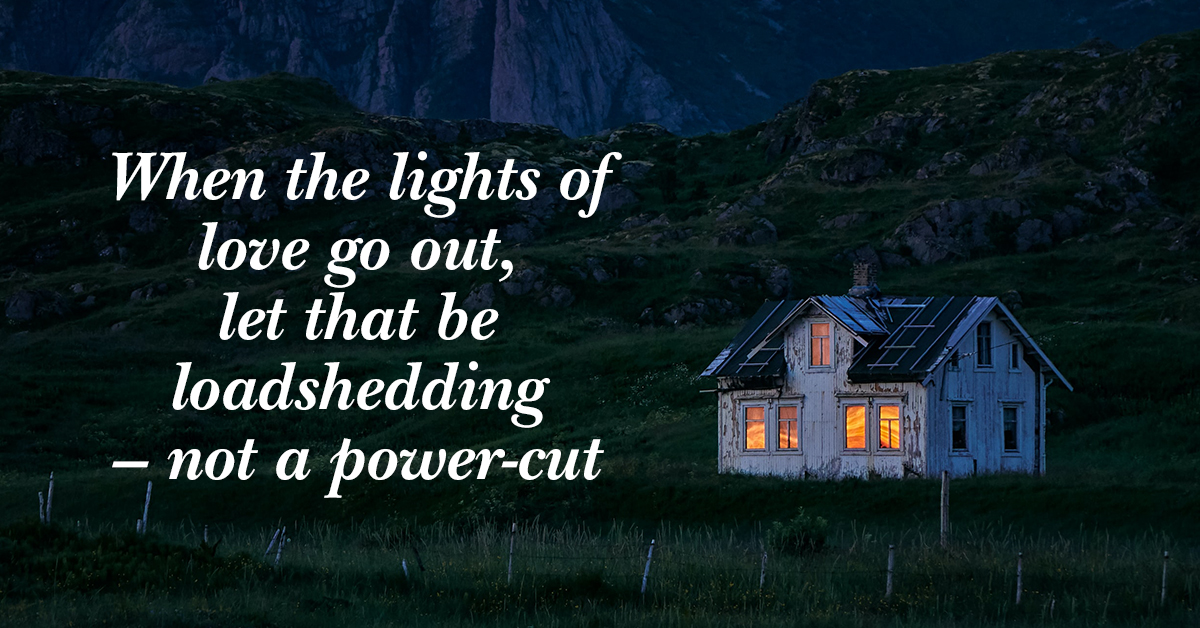
There will be testing moments in a marriage. That’s unavoidable. And at some point or another, the lights of love could go out. But when they do, let that be just temporary loadshedding, not a permanent power-cut.
Stress is inevitable, especially in times of crisis. It can kill relationships. So find peace by placing everything in God’s hands. Try not to stress, even if it’s really hard not to. When we place all in God’s hands, we can surrender our impulse to control what can’t be controlled — and, speaking as a control-freak myself, I know that this isn’t easy advice to follow! But experience has taught me that nothing eases stress and anxiety as much as surrendering to God’s will.
Call on God
And when the nuptial lights are dimming or even going out, we have recourse. First of all, pray! Together. Alone. Alone and together. But pray! Call on St Rita of Cascia, the patron of troubled marriages. Call on Our Lady and her husband, St Joseph. Go straight to Jesus. But prayer isn’t just the formal approach to God. All our acts of kindness are a prayer. If you and your partner had a big fight, don’t stew over it or plot revenge, but maybe…make them a cup of coffee. That’s an act of caritas, of love, that also calls out to God: “Be with us in this difficult moment.” And if God is with us, and we know God is with us, how can we fail to heal?
The key in marriage is not to bear grudges. My wife and I can argue with the best of them, but afterwards we take a moment to cool down, and then we carry on as before. Sometimes just a little joke or an act of kindness — such as that cup of coffee — defuses or even heals the situation. The advice offered in every marriage preparation course holds true: Never go to bed angry. What’s important is the ability to let things slide. Even if the husband is too lazy to wash up, and even if the wife nags about his driving!
In marriage, points of conflict must be resolved, through communication, mediation, acceptance and, of course, prayer. In cases of serious breakdown, call in help for healing. You can make use of Church services. Contact the SACBC Family Desk, diocesan family ministries or Marfam for referrals. You are not alone.

- Sydney Duval: We Call him Friend - October 8, 2026
- St Francis and Mission - October 6, 2026
- St Francis of Assisi: Creation and Brotherhood - September 28, 2026