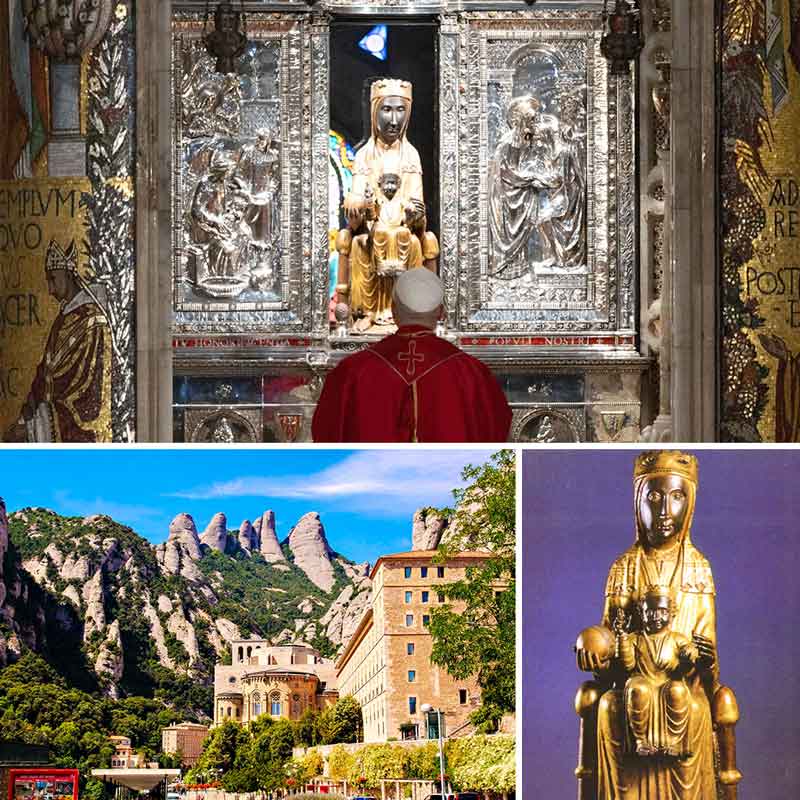
On June 10 2026, during his visit to Spain, Pope Leo XIV placed his pontificate under the protection of Our Lady of Montserrat. Here is the story of the shrine near Barcelona in a nutshell.
Where’s that: In Spain’s north-eastern Catalonia region.
Our Lady’s connection: Miraculous wooden statue.
High in the jagged mountains of Catalonia, about 50 km northwest of Barcelona, is one of Spain’s most venerated pilgrimage sites, the sanctuary of Our Lady of Montserrat.

Legend dates the devotion to the 8th century, when shepherd boys discovered a statue of the Virgin in a cave, the Santa Cova, after seeing mysterious lights in the sky. When Benedictine monks constructed their hermitage, they could not move the statue, so they built around it. By the 11th century, a community of Benedictine monks established a monastery that would become a major centre of pilgrimage.
The revered statue, known affectionately as La Moreneta (“the Little Dark One”), is a carving of the Virgin and Child, its dark hue the result of centuries of candle smoke and varnish. Pilgrims from across the world come to touch or kiss the orb she holds in her hand.
As he was recovering from his battle wounds, St Ignatius of Loyola visited the monastery in 1522 and laid down his military regalia before the image of Our Lady of Montserrat, pledging his life to God.
The monastery was destroyed by Napoleon’s troops in 1811, rebuilt, and later suppressed under anticlerical laws in the 19th century. During the Spanish Civil War (1936–39), the monks were again dispersed and many martyred. In the post-war years, it re-emerged as both a Marian shrine and a symbol of Catalan identity.
The sanctuary complex includes the basilica, the monastery of about 70 Benedictine monks, and numerous chapels clinging to the mountainside.

- Sydney Duval: We Call him Friend - October 8, 2026
- St Francis and Mission - October 6, 2026
- St Francis of Assisi: Creation and Brotherhood - September 28, 2026