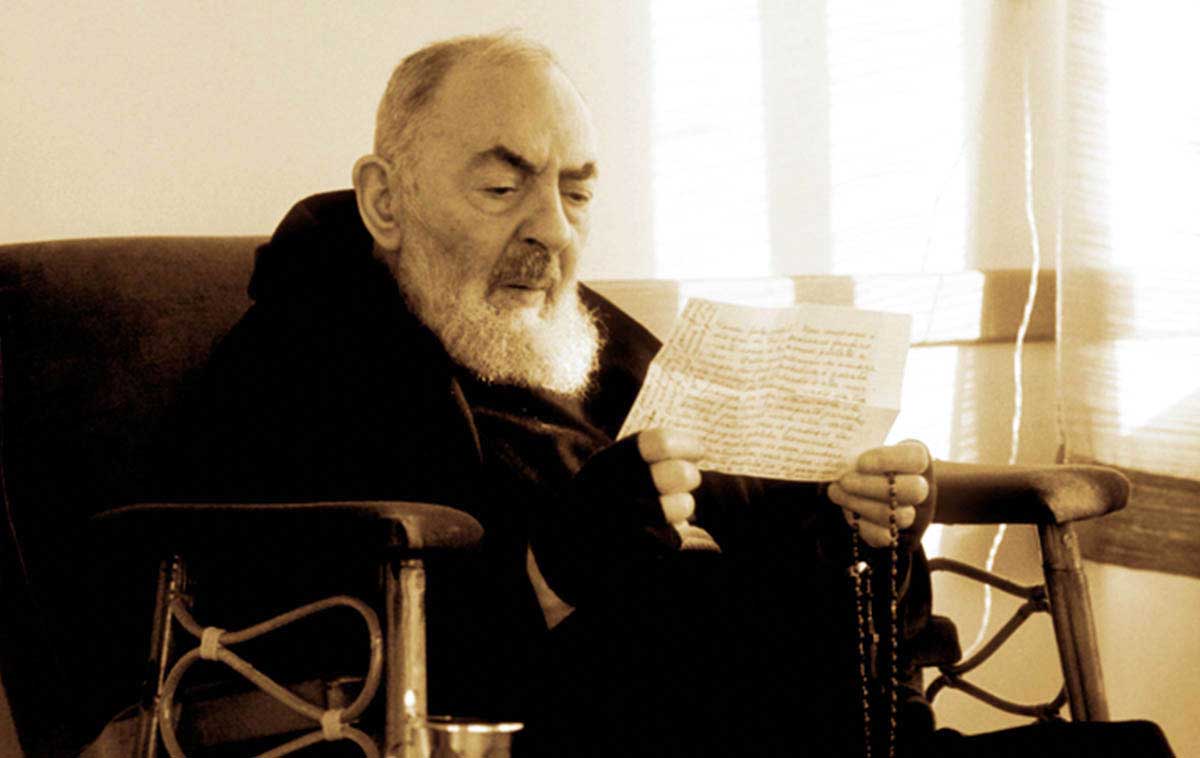
St Pio of Pietrelcina endured many trials in his life, but his holiness continues to attract devotees even today.
Few modern saints are as popular and draw such intense devotion as St Pio of Pietrelcina, better known as Padre Pio (Father Pius). And yet, for a long time, the Capuchin priest was sanctioned by the Vatican and the faithful were discouraged from following him.

The dramatic life of the enigmatic saint began on May 25, 1887, when he was born as Francesco Forgione in the remote south Italian village of Pietrelcina, about 60km from Naples. He had an older brother and three younger sisters, one of whom would become a nun.
His parents, Grazio and Maria Giuseppa, were poor but devout farmers. From an early age, Francesco showed signs of an intense interior life. At just five years old, he claimed to have had his first vision of Jesus. He later said that he often conversed with his guardian angel and saw heavenly beings as clearly as he saw other people.
Drawn to religious life, Francesco decided to enter the Franciscan Capuchin Friars at the age of ten, after hearing a friar of that order preach outside the village. The Capuchins informed the Forgiones that they would be prepared to accept Francesco, but only if the boy obtained a better education. Grazio thus migrated to the United States to finance the boy’s education.
Taking the name Pio
On January 6, 1903, the 15-year-old Francesco was admitted to the order’s novitiate, taking the name Pio in honour of Pope Pius I, a 2nd-century martyr whose relic was (and is) preserved in the Santa Anna chapel in Pietrelcina.
Pio was ordained in 1910 at the age of 23, but his fragile health meant he was frequently recalled home from the friary. After several years of poor health, in 1916 Padre Pio was finally given an assignment: to the remote village of San Giovanni Rotondo, in southeastern Italy, 40km from the city of Foggia. He arrived in the small commune’s monastery on July 28, and, apart from periods of military service during World War I, would remain for the rest of his life — 52 years.
Padre Pio’s preaching was soon gaining him a following, and he was a sought-after confessor. On September 20, 1918, while hearing confessions, Padre Pio suddenly received the stigmata, the wounds of Christ, on his hands, feet and side — much like St Francis of Assisi, founder of his order and baptismal namesake. These marks, visibly and painfully, would come and go for the rest of his life. Padre Pio often covered his hands, saying that he was humiliated by the marks.
The phenomenon brought much attention — both reverence and sceptical scrutiny. While the faithful were acclaiming Pio a living saint, the Vatican was dubious. Eminent doctors examined the wounds and suggested they were self-inflicted. Others claimed the wounds were inexplicable and noted that they never became infected.
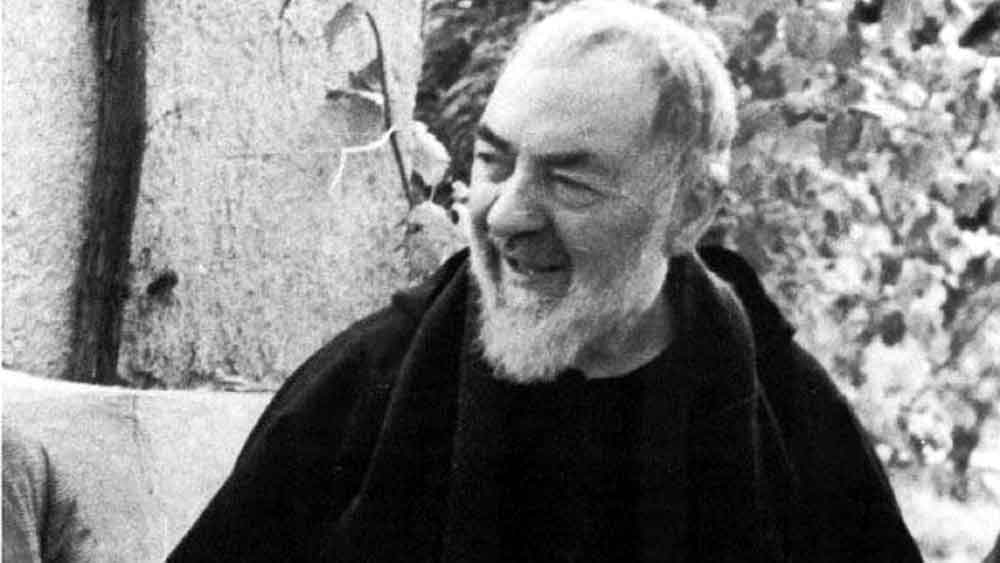
Sanctioned by the Vatican
The Vatican’s sanctions were hard. For several years, Padre Pio was forbidden from saying Mass in public, blessing people, answering letters, showing his stigmata publicly, and even communicating with his spiritual director, Padre Benedetto. The Vatican had to abandon plans to remove Padre Pio from San Giovanni Rotondo when the locals threatened a riot.
Padre Pio’s life was marked by suffering — physical, spiritual and emotional — which he accepted as a way to unite himself with Christ’s Passion. He was often heard to say, “Suffering is the ladder to heaven”, and — his mantra — “Pray, hope and don’t worry”.
After Pope Pius XI lifted all remaining sanctions in 1933, Padre Pio became a spiritual father to thousands who flocked to San Giovanni Rotondo from across Italy and beyond to seek his counsel, especially in the confessional. He was known for his extraordinary insight into people’s souls — often revealing sins they had forgotten or were too afraid to confess.
One such pilgrim to Padre Pio’s confessional was a young priest from Poland. According to Austrian Cardinal Alfons Stickler, Pio told the priest that he would ascend to “the highest post in the Church, though further confirmation is needed”. The priest was Fr Karol Wojtyła, who in 1978 would become Pope John Paul II. The pope’s long-time secretary, Cardinal Stanisław Dziwisz, has denied the prediction. Still, John Paul II would become instrumental in furthering devotion to Padre Pio and eventually canonised him.
Padre Pio was also said to have had supernatural gifts including bilocation and levitation. Although these phenomena attracted popular fascination, he discouraged any focus on them and never claimed to possess such gifts, insisting that it was God alone who deserved glory.
In 1956, the Casa Sollievo della Sofferenza (Home for the Relief of Suffering), a hospital founded by Padre Pio, officially opened. It remains one of the most advanced medical centres in southern Italy.
More Vatican troubles
Pope Pius XII encouraged the faithful to visit Padre Pio. His successor, Pope John XXIII, was more cautious, concerned by persistent rumours surrounding the friar. An apostolic visitor sent to San Giovanni Rotondo in 1960 issued a critical report and recommended further restrictions. However, in 1964, Pope Paul VI — who had previously worked with Pio on matters relating to the hospital — lifted all sanctions against the friar.
By then, the elderly Padre Pio was suffering from poor health. He was also troubled by the liturgical changes that followed Vatican II, but nevertheless insisted on obedience to the Church — unlike his sister, who left her order in protest at the reforms.
On September 22, 1968, Padre Pio celebrated Mass for the 50th anniversary of his stigmata, though he was visibly frail. It would be his last. Just after midnight on September 23, he made his final confession and renewed his Franciscan vows. He died peacefully in his cell at around 2:30am, at the age of 81.
In the days before his death, the wounds of the stigmata had vanished, leaving no trace or scar — a detail confirmed by the doctor who examined his body.
His funeral on September 26 drew a crowd of 100000 mourners. After a funeral procession, he was laid to rest in the crypt of the church of Santa Maria delle Grazie, the church of the Capuchin monastery where Padre Pio had heard confession and celebrated Mass for more than 50 years.
The process for Padre Pio’s canonisation opened in 1982; the stigmata were excluded from the investigation into his holiness. Pope John Paul II beatified his old confessor in 1999 and canonised St Pio of Pietrelcina on June 16, 2002.
By then, the church of Santa Maria delle Grazie, about 2km from the town centre, had become a popular site of pilgrimage. To accommodate the growing number of pilgrims, the Capuchins built a new modern church in the sanctuary, which can hold around 6500 people, with the parvis in front another 30000. The new shrine church was dedicated by Pope John Paul II in 2004. The saint’s body was relocated in 2010 to a large chapel in the new church’s crypt.
St Pio’s feast day is on September 23. He is a patron saint of stress relief, adolescents and civil defence volunteers.

- Sydney Duval: We Call him Friend - October 8, 2026
- St Francis and Mission - October 6, 2026
- St Francis of Assisi: Creation and Brotherhood - September 28, 2026