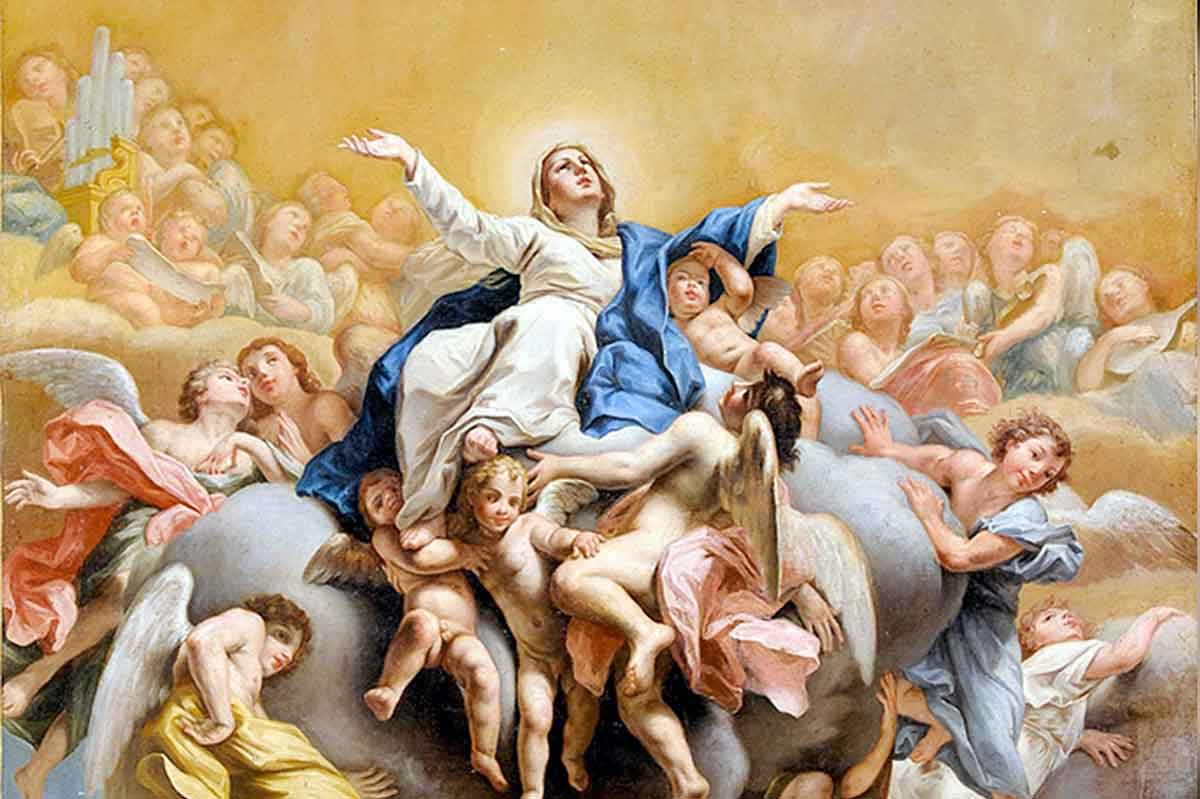
To mark this year’s 76th anniversary of Pope Pius XII declaring the Assumption of Our Lady a dogma in 1950, Günther Simmermacher visits the sites that tell us about the Assumption in Jerusalem.
Scripture is silent on Mary’s Assumption, never mind when or where it occurred, but ancient tradition places Mary’s dormition and assumption in Jerusalem, where we last meet her in Scripture.
The idea that her life ended in Ephesus is fairly new, based on the tradition that John the Apostle went to Ephesus and the presumption that Mary, entrusted to John at Calvary, went with him. The Acts of St John by Prochurus notes that John went to Ephesus only after Mary’s death. St Paul, writing from and about Ephesus, never mentions Mary or John.
In 451, St Juvenal of Jerusalem stated that Mary’s tomb was opened in Jerusalem in the presence of all the apostles — presumably before 44, when James the Greater was martyred. The apocryphal Transitus Mariae claims Mary was no older than 50 at death, which places her passing at around 33 AD, soon after her Son’s death and resurrection. According to Juvenal, the tomb was found empty — the core of the belief in the Assumption.

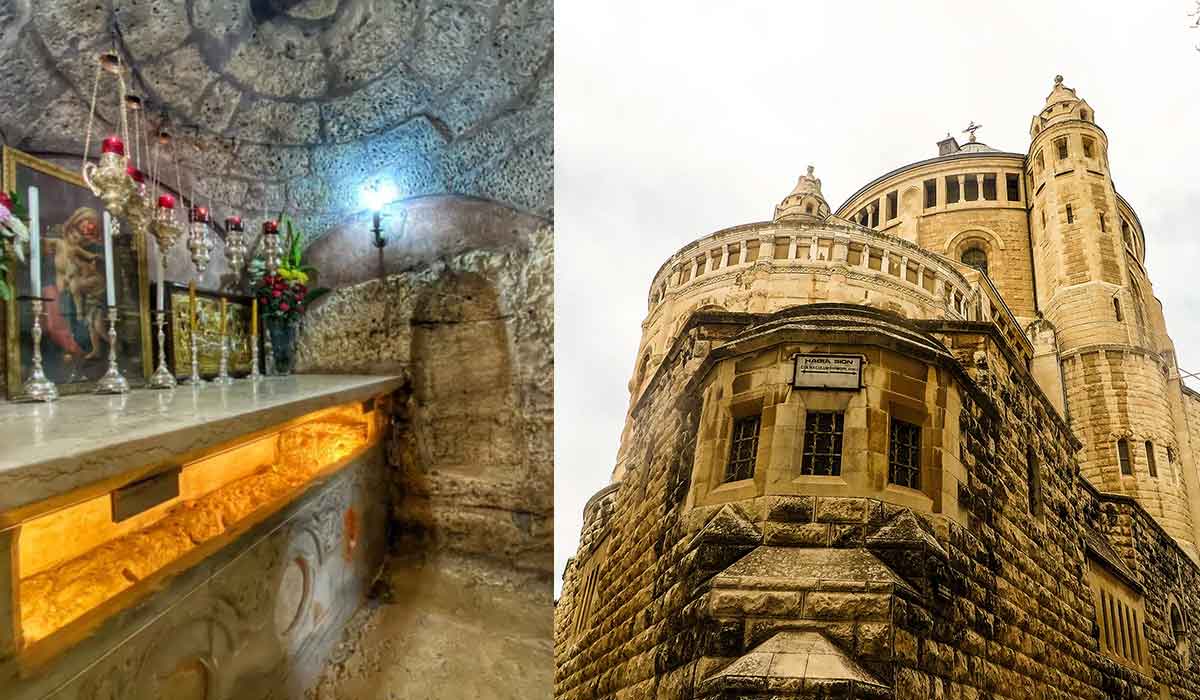
The tomb of Mary
That tomb still exists. It is located in the crypt of the remains of the 5th-century church of the Assumption, opposite the Garden of Gethsemane, east of the Old City. To reach the crypt now, one descends 47 broad steps, which were part of a Crusader church.
The crypt is owned by the Greek Orthodox Church, which shares it with the Armenian Apostolic Church, as well as with Syriacs, Copts and Abyssinians — but not with the Catholic Church. Remarkably, Muslims are also represented. They revere Mary, whom they call Maryam, and regard Jesus, or Isa, as a prophet. In fact, Mary is the only woman in the Qur’an to have a full chapter dedicated to her.
The gloomy crypt’s ceilings are black from centuries of candle smoke and incense, and many icons are so covered in soot, it is difficult to make out what they represent. To the Western mind, the place is at once somewhat eerie and garish. It is far removed in ambience from the usually light artistic depictions of the Assumption.
Mary’s tomb itself is housed in an edicule, or enclosed shrine. Through holes in a wall, the pilgrim can touch the stone ledge on which Mary’s body rested. Many churches stood above the crypt and were destroyed, but none of the various Muslim rulers destroyed the crypt — because it is the tomb of Maryam, mother of the Prophet Isa.
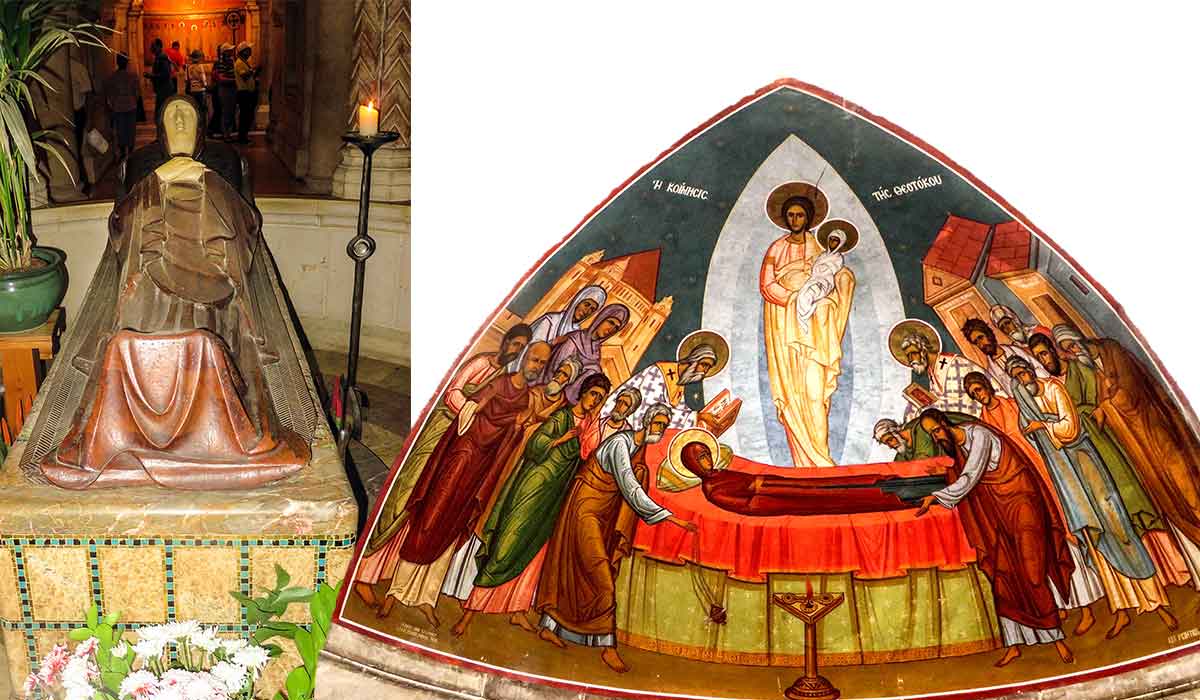
Place of Mary’s sleep
For Catholics, the preferred site of remembrance of the Assumption is Dormition Abbey, on Mount Zion, to the south of the Old City. Inside the abbey, a lifesize ivory and cherry wood effigy of Mary on a bier marks the reputed place where Our Lady fell into eternal sleep.
We have Germany’s Kaiser Wilhelm II to thank for the church, a mighty Teutonic fortress with thick walls and four towers, which incorporates the old Benedictine Hagia Maria Sion monastery. The complex is built on the site of a Byzantine church, one of Jerusalem’s oldest, which fell victim to the Persian sack of 614. Over the centuries, several churches dedicated to Mary had stood here, but by 1898 the land was in the hands of the ruling Muslims.
When Kaiser Wilhelm visited Jerusalem that year, the Ottoman Sultan Abdul Hamid II (who would later preside over the Armenian genocide) sold the land to the Germans so that a church could be built there. Dormition Abbey was completed in 1910, and is run by the Benedictines. It is located near the Cenacle, the traditional site of the Last Supper.
Recently renovated, the abbey features many frescoes honouring the Assumption. One stands out: Jesus holding Mary in swaddling clothing, a reversal of the Nativity scene, as the Apostles below mourn her death.
November will mark 76 years since Pope Pius XII declared the Assumption of Our Lady a dogma. Next year it will be 75 years since he dedicated South Africa to Our Lady Assumed into Heaven. And we find traces of the Assumption in Jerusalem even today.
Günther Simmermacher is the author of The Holy Land Trek: A Pilgrim’s Guide.
Published in the August 2025 issue of The Southern Cross magazine

- Sydney Duval: We Call him Friend - October 8, 2026
- St Francis and Mission - October 6, 2026
- St Francis of Assisi: Creation and Brotherhood - September 28, 2026