On August 22, Pope Leo XIV will visit the microstate of San Marino, a country that is very unusual for various reasons, including having been founded as a monastery.
On August 22, Pope Leo XIV will make a pastoral visit to the Republic of San Marino before travelling to Rimini that afternoon for the 47th Meeting for Friendship among Peoples.
Thus the head of the world’s smallest state will visit Europe’s third-smallest — after Vatican City itself and Monaco.
Like the Vatican, San Marino is an enclave, entirely surrounded by a single country (Italy). The only other country that is an enclave is Lesotho.

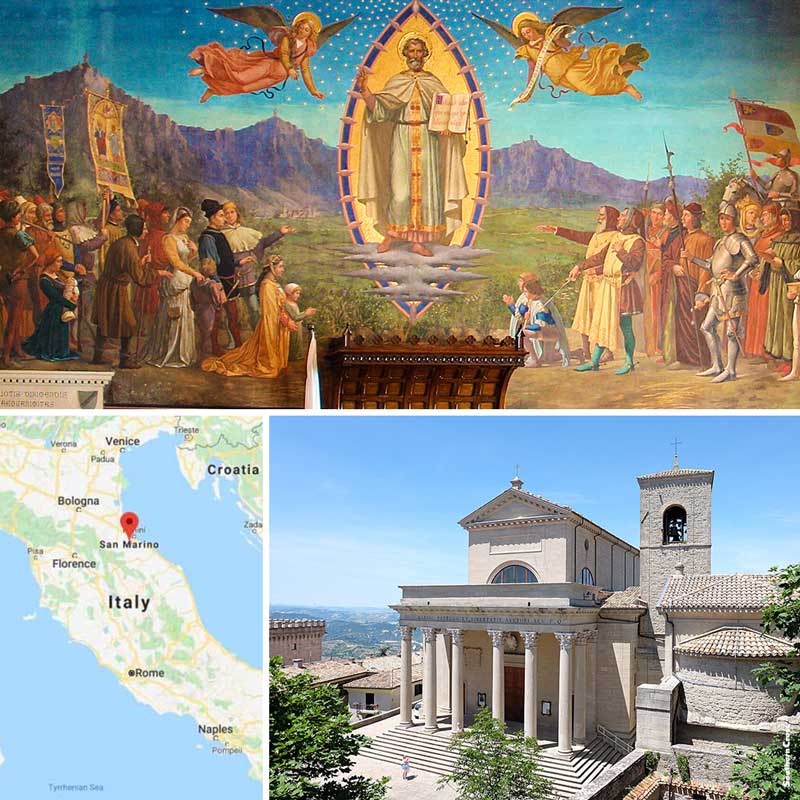
San Marino, the world’s oldest republic, owes its existence to a Catholic hermit. The story began in 301 AD, when a Christian artisan named Marinus founded a monastery at the summit of Mount Titano. From that monastery — not from a conquest, a royal dynasty, or a treaty — a nation was born. San Marino is probably the only country in the world founded on the basis of a monastic community, and almost certainly the only country in Europe named directly after a saint.
Tradition holds that Marinus was an artisan from the island of Arba (today’s Rab, on the northern Adriatic coast of what is now Croatia) who had escaped a persecution of Christians under Emperor Diocletian. He was ordained a deacon by Gaudentius, the bishop of Rimini.
In his older age Marinus lived as a hermit on Mount Titano, possibly amid Christians already hiding there to escape persecution. His reputation for sanctity grew, and people began following him to the mountain. Eventually the owner of Mount Titano, a noblewoman named Felicissima, gave Marinus the mountain as a gift, and he established a small monastery there.
Birth of a republic
Marinus died in the winter of 366. The community he left behind would become a city-state, and the city-state a republic, and the republic has survived for 17 centuries, interrupted only by a few months of Borgia rule.
In the Middle Ages, San Marino successfully defended its independence against repeated attempts at conquest by neighbouring rulers. In 1463, Pope Pius II awarded San Marino the surrounding towns of Fiorentino, Montegiardino and Serravalle, while Faetano voluntarily joined the republic later that year, giving San Marino the territorial borders it still has today.
Since 1243, San Marino has been governed by two Captains Regent, heads of state elected every six months by the country’s legislative body, usually chosen from opposing parties. Their investiture is stipulated to take place in the basilica of San Marino on April 1 and October 1.
Nine in 10 are Catholic
Today San Marino has a population of around 35 000, of whom 91% are Catholic. The country’s main sources of revenue are tourism and banking. The Catholic Church receives an allocation of income tax revenue, and Catholic instruction is provided in all state schools. The diocese of San Marino-Montefeltro covers the republic and surrounding Italian territory.
During his visit, Pope Leo will meet the institutions and people of San Marino at the Palazzo Pubblico, impart his blessing to the gathered faithful from the balcony, visit the basilica of San Marino for an act of homage before the relics of the republic’s founder, and meet the diocese’s clergy.
The basilica was built in 1836 in neoclassical style on the site of an earlier church dating back to the 7th century. It serves as co-cathedral of the diocese.
The national holiday of San Marino falls on September 3 — the feast day of its patron saint, commemorating the founding of the monastery that would, in time, become a republic.

- Sydney Duval: We Call him Friend - October 8, 2026
- St Francis and Mission - October 6, 2026
- St Francis of Assisi: Creation and Brotherhood - September 28, 2026