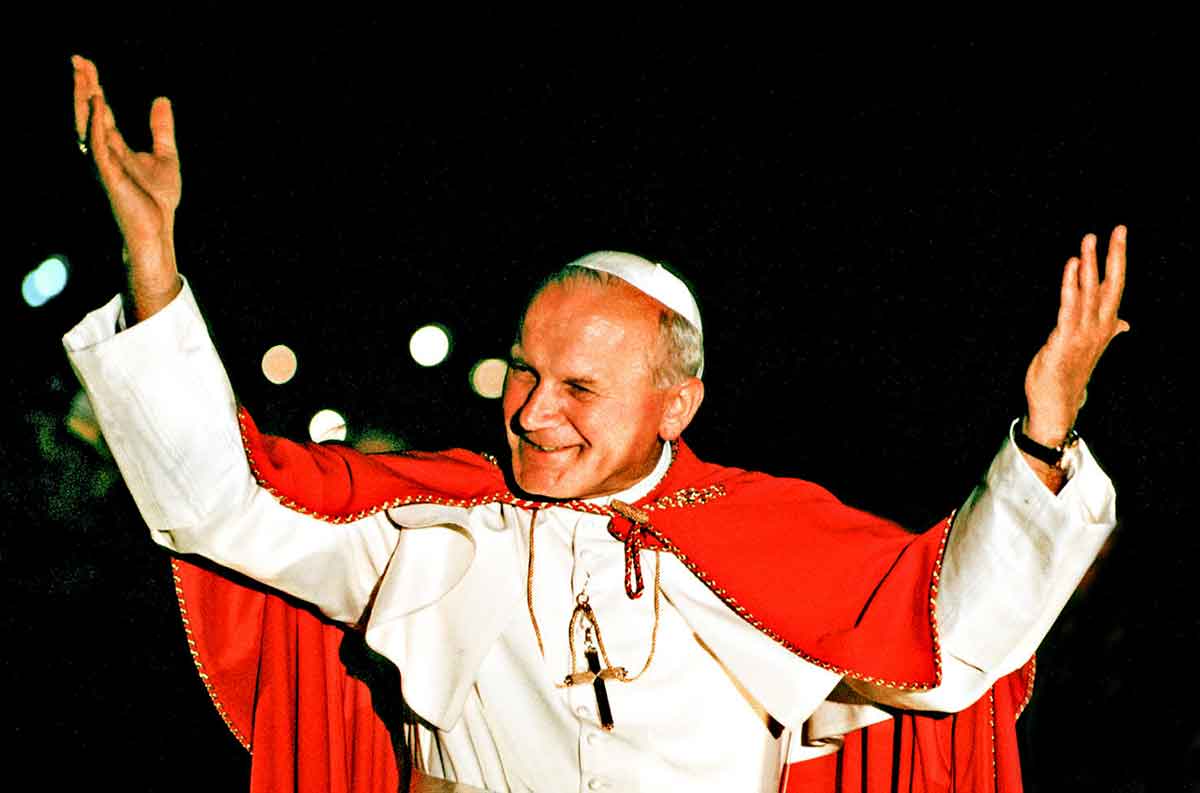
Even 25 years after his death, Pope St John Paul II is still remembered fondly. This is the story of the life of the pope born Karol Wojtyła.
Pope St John Paul II was a voice of conscience for the world and a modern-day apostle for his Church. To both roles he brought a philosopher’s intellect, a pilgrim’s spiritual intensity and an actor’s flair for the dramatic.
For many years he was a tireless evangeliser at home and abroad, but towards the end his frailty left him unable to even murmur a blessing.

Karol Jozef Wojtyła, nicknamed Lolek, was born on May 18, 1920, in Wadowice, near Krakow, in a room facing the local church. His mother, Emilia, died when he was nine. His beloved brother, Edmund, died when Karol was 12, and he lost his father in 1941. “At 20, I had already lost all the people I loved,” he later recalled.
In 1938 he moved with his father to Krakow and enrolled at the Jagiellonian University, where he developed his love for language and theatre. Eventually, he spoke 12 languages: Polish, Latin, Italian, Spanish, Portuguese, French, English, German, Ukrainian, Serbo-Croatian, Slovak and Esperanto.
His studies were cut short by the German occupation in 1939. He worked in a quarry, in a chemical factory and as a messenger to avoid deportation. Jewish authorities have said that Wojtyła helped protect many Jews during this time.
Introduced to Carmelite mysticism and the Living Rosary youth groups, and shaken by his father’s death and a series of accidents, Karol began to discern a priestly vocation. An accomplished actor in the underground theatre, he was turned away by a Carmelite monastery with the advice: “You are destined for greater things.”
In 1942, he entered Archbishop Stefan Sapieha’s clandestine seminary in Krakow. After surviving a serious accident when hit by a German lorry, he took this as confirmation of his calling. He was ordained on November 1, 1946.
Padre Pio’s prophecy
In 1947, while in Rome for further studies, Fr Wojtyła visited Padre Pio, who reportedly told him he would rise to “the highest post in the Church”, a prophecy he thought was fulfilled when he was named a cardinal.
He returned to Poland and began parish work in the village of Niegowic, where he knelt and kissed the ground on arrival — a gesture that became a trademark of his papacy. Transferred to Krakow, he taught at universities and formed a popular youth group, blending spirituality and outdoor adventure. To avoid scrutiny from the communist authorities, he asked the young people to call him “Wujek”, or “Uncle”.
When he was named auxiliary bishop of Krakow in 1958, he was Poland’s youngest bishop. He became archbishop in 1964. Bishop Wojtyła played a significant role at the Second Vatican Council, contributing to its documents on religious freedom and the Church in the modern world. Pope Paul VI made him a cardinal in 1967.
Though little known outside Poland, Cardinal Wojtyła was elected pope on October 16, 1978, the first non-Italian pope since Adrian VI in the 16th century, (read the story of that conclave.
His Legacy
As pastor of the universal Church, he travelled to 129 countries on 104 trips. These included a 1988 visit to Botswana, Lesotho, Zimbabwe and Mozambique, with an unscheduled stop in Johannesburg. He returned for his only official visit to South Africa in October 1995 — to this day, the only papal visit to the country.
Pope John Paul saw himself as the Church’s chief evangeliser. In his apostolic letter Novo Millennio Ineunte, he called for a renewed mission to bring Gospel values into all areas of life. His social encyclicals addressed labour rights, the gap between rich and poor, and the limits of free-market capitalism. In 2004, the Vatican released a compendium of Catholic Social Teaching at his request.
He was hailed as a moral voice but also derided as overly conservative. He disciplined dissenting theologians and upheld traditional teachings, while also expanding Catholic thought into areas like bioethics, economics and ecology.
Public reaction to his decisions was often mixed. He was hailed as a bold social critic, caricatured as an inquisitor, and dismissed by some as the “last socialist”. But the pope paid little heed to popularity.
He approved a universal catechism and took strong public stances, calling abortion and euthanasia a “slaughter of the innocents”. Though cautious in ecumenical matters, he made historic gestures: launching Catholic-Orthodox dialogue, visiting a synagogue and mosque, and hosting a world interfaith summit in Assisi. Pope John Paul also sought dialogue with Judaism and Islam.
He promoted Marian devotion, added the Luminous Mysteries to the rosary, and canonised more than 450 saints — more than all his predecessors combined.
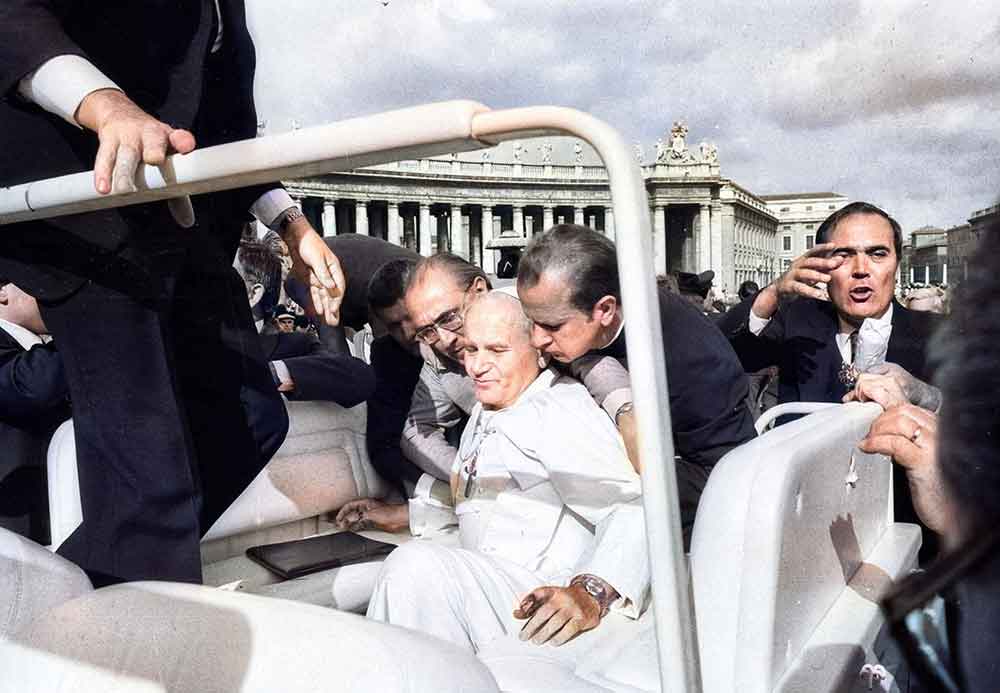
A deeply spiritual man, he was also a media-savvy figure, immortalised in images such as his meeting with his would-be assassin, Mehmet Ali Agca, in a prison cell. He had been shot on May 13, 1981 — it was the feast of Our Lady of Fatima, and he credited her with saving his life.
In later years, afflicted with Parkinson’s disease, he moved slowly and spoke with difficulty. Yet he remained a spiritual father to millions. He died on April 2, 2005, the vigil of Divine Mercy Sunday — a feast which he had established in 2000.
His funeral six days later drew more than a million people and was broadcast globally.
Pope Benedict XVI beatified him on Divine Mercy Sunday in 2011, and Pope Francis canonised him on the same feast in 2014.
St John Paul’s tomb is beneath the altar of St Sebastian in St Peter’s basilica. His feast day is October 16, the anniversary of his papal election.

- Sydney Duval: We Call him Friend - October 8, 2026
- St Francis and Mission - October 6, 2026
- St Francis of Assisi: Creation and Brotherhood - September 28, 2026