By Dr Raymond Perrier – Working at the Denis Hurley Centre in the heart of Durban means that for the past 11 years my day has been punctuated by the call to prayer (adhan) from the mosque next door. I am rarely here for fajr (the dawn prayer), but I always hear dhuhr (around noon), and if I don’t get through my to-do list, I am still at my desk for asr in the afternoon and even maghrib at sunset.
Of course, it is not my religious tradition, but the muezzin calling the Muslim faithful to prayer at key points in the day can also be a reminder to me, as a Catholic Christian, to pause and pray.
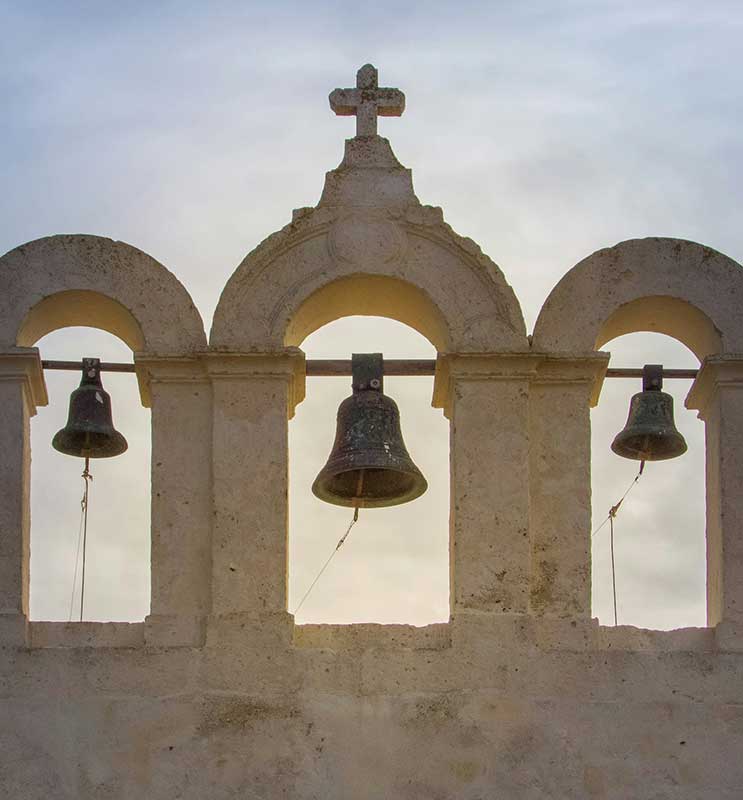
For the last few months I have had even more reason to do so, thanks to the bell tower I can see from my window. At the initiative of acting administrator Fr Nkazimulo Shange, the magnificent Emmanuel cathedral has reinstated the tradition of tolling its bell every day at noon.
Older readers will immediately recognise this particular part of Catholic culture, and probably sigh with nostalgia. Younger ones, or newer Catholics, might welcome some clarification, which I will offer.

The tradition dates back to at least the 13th century, when written records describe Franciscan friaries in Italy ringing their bell at 6am, noon and 6pm. It may not be coincidental that this Christian call to prayer emerges at a time when Muslims were increasingly seen as religious rivals in Europe — perhaps an attempt to match the impact of the adhan.
In a comparable way, historians have noted the similarity between Catholic rosary beads and Muslim prayer beads (misbaha), and that the wider popularity of the rosary followed the famous Battle of Lepanto in 1571, where the Knights Hospitallers defeated the Ottoman Empire and thus halted the westward spread of Islam.
Cathedral’s call to prayer
Whatever its story of origin, the tradition of the noonday bell is a lovely one, especially for those of us who get so absorbed in our days — with meetings, emails, Zoom calls and report-writing — that we hardly notice the time. It has been a delight to be sitting in a meeting when the bell has rung: we have paused our discussions, explained to those present what the bell means, and then led people in prayer.
I was especially moved when a colleague who is not Catholic reminisced about hearing the bell when she attended a Dominican convent school.
The bell is, of course, associated with the Angelus, named after the first word of the prayer. A version of Luke 1:28 is recited — “The Angel of the Lord declared unto Mary” — and the prayer continues, punctuated with three Hail Marys.
Just as my day is now adorned by this reminder to pray, so our collective new year begins with another reminder of Our Lady, since for Catholics, January 1 is not just New Year’s Day but also the Solemnity of Mary, Mother of God. I have written in the past about the randomness of January 1 as the “start” of the year.
Back then, I noted that, in order to Christianise a Roman celebration, a feast day was created for what is conveniently the end of the Octave of the Nativity — the eighth day after Christmas (counting December 25).
New Year’s Day feast
Now the feast celebrates Mary as Mother of God. But since it is the eighth day after Jesus’ birth, and Jewish boys are circumcised on that day, it was originally called the feast of the Circumcision, and then — less accurately, but also less squeamishly — the feast of the Naming of Jesus.
The shift to “Mary, Mother of God” might be seen as a slight to the Saviour. In fact, the Marian title used here recalls a great debate in the early Church — not about Mary but about Jesus. At the Council of Ephesus in 431, Church Fathers debated whether Mary could be called Theotokos, a Greek word meaning “God-bearer”, hence “Mother of God”.
Some argued that while a human being could be the mother of Jesus, she surely could not be called the Mother of God — after all, God has no mother.
But the counter-argument, which prevailed, was that since Jesus of Nazareth is wholly human and wholly divine, the Mother of Jesus is logically also the Mother of God. Since 1968, following a decision of Pope Paul VI, January 1 has also been observed as the World Day of Peace, usually accompanied by a topical papal reflection.
God’s presence
We should, of course, pray for peace at all times and not just on January 1; and we should remember God throughout the day, not only at noon. But these markers in our days and years are useful prompts to be more conscious of God’s presence and our reliance on God.
Again, Muslims have a lovely word for this: taqwa, which translates roughly as “God-consciousness”.
So the feast of January 1 helps us focus on God’s desire to work with human beings (Theotokos), on God’s covenant expressed in concrete ways (Jesus’ circumcision), and on our belief that God intervenes in the real world — the foundation of our hope for peace.
And the three elements of the Angelus prayer also serve as “cue cards” for our spiritual journey:
- “The Angel of the Lord declared unto Mary” — God takes the initiative in our lives, but we must be attentive;
- “Behold the handmaid of the Lord” — God does not coerce us but waits for our freely given response;
- “And the Word was made flesh” — when we do respond, our world can be transformed.
All of this points to what we have been celebrating over the past few weeks: not dinners, drink and decorations, but the mystery of the Incarnation.
“The Word was made flesh and dwelt among us” — not only for the 12 days of Christmas, not only in the Holy Land more than 2000 years ago, not only for Christians who are baptised or for Catholics who pray the Angelus, but as an ongoing, dramatic intervention by God in our world.
It is this ongoing dramatic intervention by God in our world which gives us the confidence to believe — even when everything in the news suggests otherwise — that God’s Kingdom will come, “and all shall be well”. Happy New Year!

- Lumen Christi! Deo Gratias! - April 7, 2026
- The Gift of the Irish - March 10, 2026
- Catholic Schools in the Market - February 10, 2026