
Catholic Schools in the Market
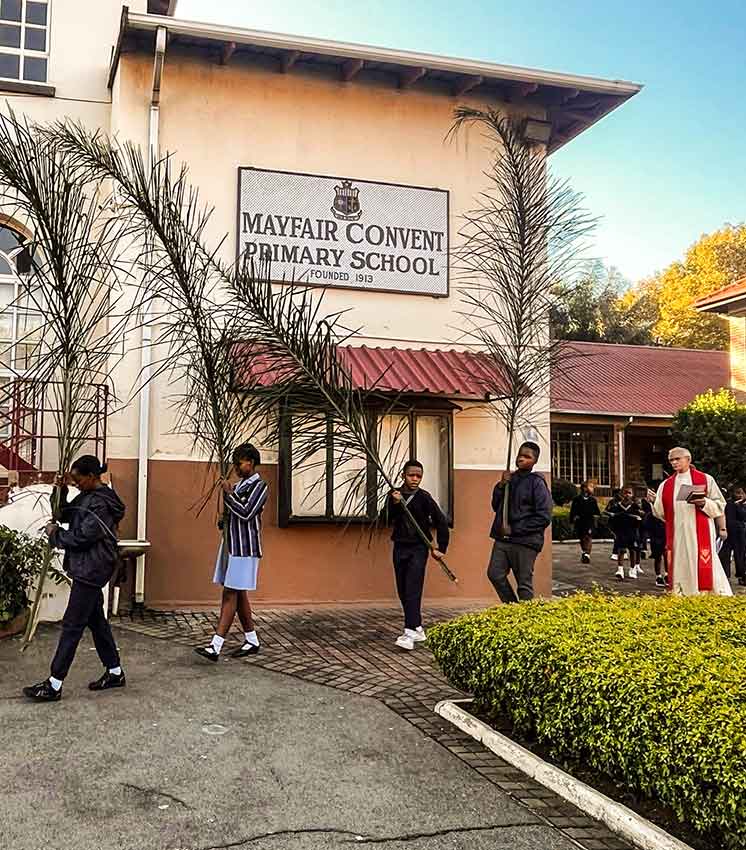
Mayfair Convent School in Johannesburg on Palm Sunday last year. At the end of 2025, the 112-year-old school closed down.
By Dr Raymond Perrier – The new school year has only just begun and yet many parents are already wondering to which schools they will send their beloved offspring in January 2027.
As I drive around Johannesburg, I am overwhelmed by how many adverts there are for different schools — even pre-primary schools! It seems that every lamppost carries a school poster and every marketing technique is deployed to “sell” education to the middle classes, as if they were promoting cellphones, insurance or fried chicken.
Given the Catholic community’s longstanding role in education in South Africa, we should at the very least be troubled by this phenomenon. After all, education is not a product to be priced, packaged and promoted. Rather, it is a “social good” that benefits the individual child, their family and the wider community.

The Vatican II document on education defines the role of the Catholic school thus: “To prepare [its students] to lead an exemplary apostolic life so they become, as it were, a saving leaven in the human community.” A great sentiment, though I understand why no Catholic school has used it on their street posters!
Of course, we do not live in a bubble. Our own Catholic families are looking beyond just Catholic schools. And our Catholic schools are also appealing to non-Catholic families.
The situation is aggravated by the growing phenomenon of commercially-operated schools which want to maximise their income by leveraging all the modern marketing techniques. I am not saying that such schools are lacking merit and are not based on values — but there is a fundamental difference between a school that is run to generate a profit for its shareholders, and a school that is inspired by a religious ethos and tradition.
Our 335 schools
It might be worth recalling the role and importance of Catholic schools in South Africa. An article in The Southern Cross of October 2025 recalled how a huge fundraising drive in 1955 saved the Catholic mission schools, while those of other denominations either closed down or were transferred to the apartheid regime. As a result, at the dawn of democracy in the 1990s, there were more Catholic schools in South Africa than of any other faith tradition.
Some of these schools have the status of “public schools on private property”. That means they are mostly independent in their governance but are still able to rely on state funding for teachers and supplies.
As of now, we have a network of 335 Catholic schools in South Africa which between them welcome 170000 learners. They range from expensively-equipped private schools to some of the poorest and most isolated farm schools. Yet they have so much in common: a Catholic ethos and tradition, support from the various arms of the Catholic Board of Education, and a shared commitment to a whole-person approach to education for all children who come through their doors, regardless of gender, class, colour or religion.
The grant dilemma
The 39 schools in Johannesburg form a subset of that wider group. Even if almost all of them charge fees, they cover a wide range of price-points. Some were founded by religious congregations which still exercise influence; some operate directly under the governance of the archdiocese.
A number of schools in this latter group depend on grants from the Gauteng Department of Education. They are now at risk because they can collect only low fees from their parents and so are very dependent on the size and the timing of government transfers. But just because a grant has been awarded does not guarantee that it will arrive at the agreed time, when bills still need to be paid.
One school recounts how they had to sell their only vehicle so that teachers could be paid their salaries on time. At the end of last year, one of the oldest Johannesburg schools, Mayfair Convent, sadly had to close after 112 years when it was clear that it was no longer financially sustainable.
Cardinal Stephen Brislin, archbishop of Johannesburg recently launched an innovative fund called Ubhuloho (“the Bridge”). This is asking donors for money that can be used to give bridging loans to help some of these vulnerable schools cope with cash flow crises. Without such assistance, the century-long tradition of Catholic schools in places like Soweto, Alexandra and Sharpeville is at risk. (For more information contact )
At the other end of the spectrum, independent schools which rely mostly or exclusively on fees have to work even harder to keep up their enrolment and so remain sustainable. This is partly because there is no longer an assumption that a Catholic family will send their children to a Catholic school. Perhaps there isn’t one nearby, or one that is affordable, or one that meets their needs — but perhaps there is, and families are just not aware of what the options are.
A new innovation
To try and address this, and help Catholic families and others navigate through the rich range of Catholic schools, the Catholic Schools Office (CSO) in Johannesburg has created a shared marketing platform for all 39 schools. This is being launched at the beginning of February and provides a simple online map on which parents can see where nearby Catholic schools are located. They can then click on the map and speedily access information about the schools that interest them, from which they can dig deeper and even book a tour.
The idea of this came from the Catholic schools in Victoria, Australia, who had recognised clearly that they are not competitors of each other but allies.
To develop this idea and adapt it for Johannesburg, I have had the privilege of working with the CSO, the professional marketers from the schools, and some principals. As they spent the day sharing their ideas and challenges, one of the most striking things was their realisation that they had so much in common. Our schools can achieve much more by working with each other, rather than working on their own or even competing with each other.
One participant commented: “If this had been a meeting of ISASA [the independent schools’ network], we would not have been sharing so freely because we’d all see each other as rivals; but here we are brothers and sisters in a shared mission.”
If this model works in Johannesburg, it could easily be replicated in other metropolitan areas. One of the advantages of such joint marketing is to make sure that information is clear and accessible. But there is another role that our Catholic schools should play, and can also do more effectively by working together: to challenge the criteria by which parents are making their decisions.
Of course, our schools do very well with their matric results and next month’s Southern Cross will proudly showcase this. They surpass many other schools in this regard. But our schools cannot and should not ever try to compete on how many swimming pools they have, or how fancy the cafeteria is, or how elitist the intake is.
Catholic schools play the same role in education as the Church does in wider society: to offer an alternative ethic, to show a different way of looking at the world and challenge consumerism. And to demonstrate how much more we can achieve by working together.

- The Gift of the Irish - March 10, 2026
- Catholic Schools in the Market - February 10, 2026
- Ring the Bells for the New Year - January 5, 2026



