Seventy years ago, the Catholic Church’s confrontation with the apartheid regime took root — starting not in the streets but at the school gate. Günther Simmermacher looks at the remarkable campaign to save Catholic mission schools from the evil of ‘Bantu Education’.
Seventy years ago, in 1955, South Africa’s Catholic Church found itself in open defiance of the apartheid state. The battleground was schooling, and the goal was freedom from the Bantu Education Act in the mission schools that had long served black communities.
The notorious Act, passed in 1953 under future prime minister Hendrik Verwoerd, placed all black schooling under state control and outlawed independent African schools unless they registered with the Department of Native Affairs and adopted the state’s racially-engineered curriculum.
The Act was explicit in its purpose: to prepare Africans for lives of menial labour and to suppress any ambitions beyond that.

This presented a crisis for the many Christian mission schools — around 790 of them Catholic — that were operating across the country, often in places where the state had made no educational provision at all.
The Catholic mission schools, which were serving some 120000 pupils, were not heavily resourced, but they were run with purpose and offered a curriculum that went beyond arithmetic and obedience. Above all, they espoused the basic Christian ethic of the equal dignity of all people — a principle that was directly at odds with apartheid.
The Catholic and Protestant Churches agreed that Bantu Education was morally indefensible. Now, after two years of fruitless negotiations with the unbending government, they faced a set of difficult choices: hand their schools over to the state; operate them on wholly inadequate subsidies; close them; or find the money to run them independently.
Most Protestant denominations grudgingly handed their schools over to the state, or they refused to collaborate in Bantu Education by closing them altogether. By 1955, of the 6000 non-Catholic African missionary schools, some 5000 had been placed under the Native Affairs Department.
The Catholic bishops, led by Archbishop Denis Hurley of Durban, took the risky option: to preserve the Church schools’ independence by raising funds to guarantee their future. The Church would continue running its schools independently, without government subsidy, and would fund them herself.
In a country where Catholics were a small minority — at the time, 2% of the population — and the Church was seen by many in power as an enemy of the state, that was an audacious plan.
The bishops’ national campaign to save the schools was the Church’s first major act of public resistance to apartheid, though it must be noted that the bishops were motivated more by the attack on the rights of the Church — including Verwoerd’s demand that European missionaries should leave the “locations” — than by protest against apartheid’s cruel social engineering. The groundbreaking statements against the “intrinsically evil” system would come later.
A masterstroke appointment
The campaign had been planned for almost a year. A Canadian expert in fundraising, Fr Peter Riffel OMI, arrived in South Africa in July 1955 to supervise the effort. His appointment was a masterstroke.
A mass mobilisation effort was launched with a pastoral letter — drafted by Archbishop William Patrick Whelan of Bloemfontein. The authorship was significant: Whelan, whose mother was an Afrikaner, usually took a conciliatory approach to the apartheid regime. The bishops hoped that his signature would reassure Verwoerd that the campaign should not be seen as an act of resistance to apartheid, only as a point of disagreement on a particular issue. Verwoerd did not care; at a meeting he absurdly called Whelan — the most regime-friendly Catholic bishop — a “subversive”.
In the pastoral letter, the bishops condemned the Act. Read in every parish on September 21, 1955, the letter asked the Catholic faithful to support their ambitious plan.
Message of support from the pope
At the same time, The Southern Cross featured the campaign on its front page — as it would over eight consecutive weeks. Even Pope Pius XII and several cardinals sent messages of support, published by the national Catholic weekly. Archbishop Hurley later paid tribute to “just one huge phenomenon of publicity”.
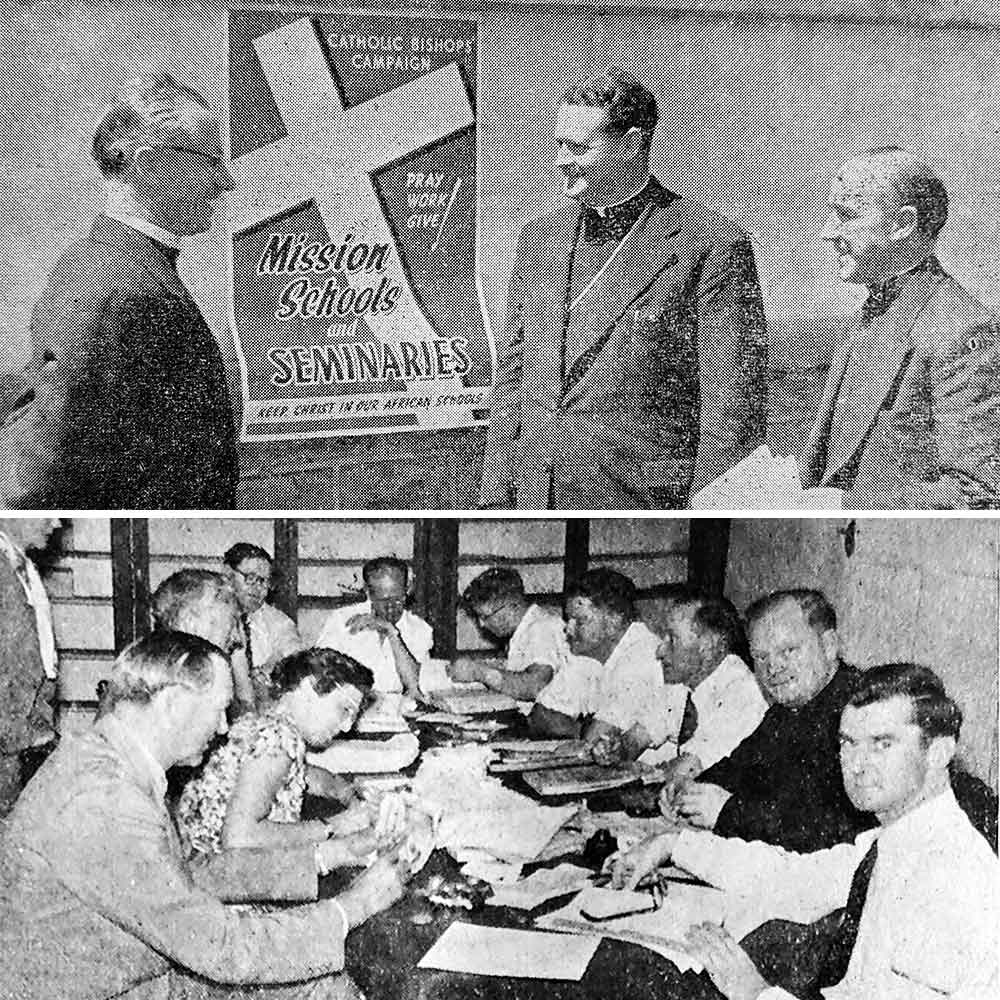
Special collections were taken in parishes around the country. A Catholic Bantu Schools Fund was launched. Some Catholics donated livestock, furniture or even their own labour. Religious orders, particularly those with teaching missions, took vows of even stricter poverty to keep schools afloat. The campaign poster demanded: “Keep Christ in our Mission Schools!”
The campaign culminated on October 30 with Masses being said in every church in the country. After Mass, as church bells were ringing, the campaign’s 8000 fundraising volunteers, all men, went out to collect pledges of monthly payment subscriptions, over a length of two years.
In the end, the campaign raised an astonishing £976000 (in 2025’s value around R600 million). The Catholic school system could survive on that for a couple of years. At a meeting with Archbishop Hurley in May 1956, Pope Pius expressed his gratitude and admiration for what the South African Church had accomplished.
At the end of the campaign, The Southern Cross identified five reasons for its success: “Firstly, the ocean of prayer that was offered up to God by South Africa’s Catholics for the success of the campaign. Secondly, the fact that the cause of the mission schools was one dear to every Catholic, arousing, too, the sympathy of many non-Catholics. Thirdly, the extraordinary generosity of South African people. Fourthly, the untiring months upon months of effort on the part of the national organisers, [national director] Fr Peter Riffel OMI and [associate national director] Fr Fred Martin, and the campaign directors in each of the 23 dioceses of the Union. Fifthly, the magnificent work done by the 8000 Catholic men and the 450 parish committees who canvassed South Africa’s 40000 Catholic wage-earners, and the army of volunteer typists.”
Battlelines were drawn
Remarkably, the Anglican archbishop of Cape Town admitted to his Catholic counterpart, Archbishop Owen McCann, that his Church wouldn’t have been able to launch such a campaign, because they couldn’t raise such funds from their white people. Methodist leaders said that they had a similar problem.
The schools campaign doubtless helped to strengthen Catholic identity among the faithful, who were always faced with anti-Catholic sentiments. Above all, battlelines were now drawn — the Catholic Church realised that in the face of apartheid, her initial policy of engagement and even appeasement was pointless. The Church had to stand up to the regime. That would prove to be a gradual process, one which would see strong disagreements among bishops and with certain nuncios, and the occasional misstep, but it eventually placed the Church unambiguously on the side of justice.
The regime wasn’t idle as the Catholic Church sought to keep her schools free from apartheid’s malevolent education policy. Government inspectors were sent to intimidate school staff. Teachers at unregistered schools, already severely underpaid by the Church, were threatened with prosecution. New regulations were introduced to make it nearly impossible to employ qualified staff or to offer recognised exams.
The regime tightened the screws financially and bureaucratically until, one by one, schools began to be absorbed into the education system they had tried to resist.
The legacy of the campaign
Still, the battles of 1955 had ensured that Catholic mission schools survived, and that even in the face of apartheid restrictions, the faith could still be taught to Catholic children. Generally, the standard of education in Catholic schools was significantly higher than it was in their state counterparts (as it is today). Above all, amid the perverted apartheid ideologies, these schools strove to maintain the Catholic ethic of human dignity.
In years to come, Catholic schools and teachers would again defy apartheid laws — most dramatically in the 1970s, when white Catholic schools unilaterally and without prior negotiations opened their doors to pupils of colour, and succeeded in keeping them open.
For the Church, the schools campaign of 1955 was the beginning of a long confrontation with the apartheid regime — one that started at the school gates.

- Sydney Duval: We Call him Friend - October 8, 2026
- St Francis and Mission - October 6, 2026
- St Francis of Assisi: Creation and Brotherhood - September 28, 2026