The Gift of the Irish
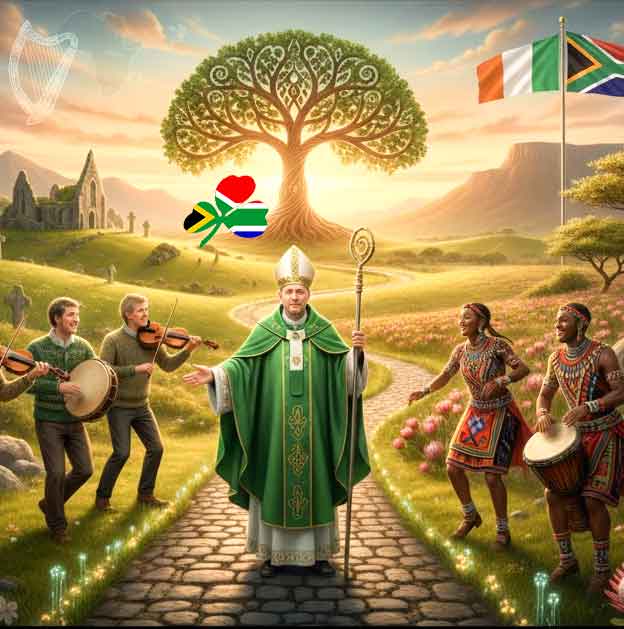
By Raymond Perrier – Throughout March we are deeply immersed in Lent and the prospect of the end of this time of abstinence might feel a long way off. But those who are of Irish origin will be looking forward to the informal dispensation that comes with St Patrick’s Day on March 17 — and even those of us with no greater claim to Irishness than a Dublin-born godfather might also take advantage of the feast day.
It is curious that alongside St Valentine and St Francis of Assisi, St Patrick’s feast day is one of the few that has retained a high profile in popular culture. I hope that this is not just because of the massive campaigns by a certain beer company to promote their brand of “black gold”, or the bizarre attempts by coffee and doughnut companies to turn their products green for the day. I think it is rather because it is a day which the Irish thoroughly enjoy and they want to share that joy with others.
Irish-South African Link
Attending events of the Irish-South African Association in both Durban and Johannesburg has made me aware of how vibrant the links between South Africa and Ireland remain today. This was shown very clearly when President Cyril Ramaphosa, hosting the G20 summit last November, chose Ireland as one of the additional countries to be invited — the first time that Ireland had enjoyed that honour.

This followed Ramaphosa’s own state visit to Dublin last October, when he emphasised the deep historical solidarity between the two countries: support against apartheid, shared values in multilateralism and justice, strong bilateral trade, and collaboration on global issues like Palestine. He said that for South Africans, going to Ireland is a sort of “homecoming” built on mutual respect and a common fight for freedom.
I hope that this has been the experience of the many young South African professionals who have moved to Ireland. But the northwards migration of recent years is a reversal of a long migration southwards dating back two centuries.
First Irish in SA
Some of the earliest Irish who came to South Africa were in fact soldiers in the British Army such as the 27th Regiment (the Inniskillings) who were doing duty on the eastern frontier of the Cape Province. It was because 75% of this regiment were Catholic that the British authorities relaxed their ban on Catholic missionaries and allowed some Irish priests to come as chaplains. This led to the founding of St Patrick’s in Grahamstown (now Makhanda) in 1838, claimed to be the oldest Catholic church in South Africa. Irish Franciscans were the first to come, and Franciscans still serve the community 188 years later.
They were the first in a long line of secular priests and religious men and women who travelled from Ireland to South Africa over the next 150 years. In fact, so Irish were the foundations of religious life in South Africa that, until a few decades ago, many male and female novices sailed 12000km to Ireland to start their religious formation. This was the experience of Denis Hurley as a young Oblate in the 1930s and again Wilfrid Napier as a young Franciscan in the 1960s.
Most of us will have vivid memories of Irish-born or Irish-trained Sisters, Brothers and Fathers who had a huge positive impact on our lives as Catholics. Rather than naming the ones to whom I owe a debt of gratitude, I will make space here for you to insert the names of the Irish for whom you wish to give thanks to God.
Of course, there are fewer and fewer Irish clergy and religious still in South Africa — some have gone back to Ireland (often reluctantly) to retire, many have died in their adopted country. Those who remain are a poignant reminder of what the Irish have brought to the Church in South Africa. We read about one of them on page 12 this month. And many told their stories in the documentary Poverty, Chastity and (dis)Obedience (see it for free at https://t.ly/9whaV).
An ingrained empathy
A few years ago, I delivered a paper at the Irish Diaspora Congress held in Durban, drawing out the Irish traits in the work of the Denis Hurley Centre under the influence of Archbishop Hurley and his “lieutenant”, Paddy Kearney — both men of Irish heritage. I think many of those traits apply more generally to the wider South African Church.
First, there is a commitment to practical action, whether it is shown in a passion for feeding people, teaching them or making them well — all of them characteristics of both Irish family life and of Irish missionaries. This, I think, comes from a deep-seated empathy and an ability to see past colour or status (or lack of it) and instead see a fellow human being.
While generally true of the Irish, I would say that it is especially the women of Ireland who form the practical backbone of every family and local community. We have benefited from that in the Church in South Africa through the selfless and passionate ministry of Irish religious Sisters (and those formed by them) as nurses, educators and social workers — and by Irish lay women who have pursued a similar ministry without being in religious life.
Funding from Ireland
And even if fewer Irish people are coming to South Africa, the Irish government continues to be a disproportionately generous donor to NGOs here — both directly and through their very creative Misean Cara model — in which they work with religious orders to have a grassroots impact in local communities.
One explanation for this might be the commitment to the person on the margins that seems to be built into the Irish psyche. This, of course, is also the lesson of Jesus’ life as illustrated in the Gospel and should be central to the life of the Church, of every parish and of every Christian. Perhaps the Irish, having so often been the underdogs themselves, — whether in Ireland or when they went to seek a better life in places like England or America as migrants — have a natural empathy for those who are struggling; that sense, which we should all have, of “there, but for the grace of God, go I”.
This is shown not only in practical acts of kindness but also in speaking out for justice, being a “voice for the voiceless”, as Archbishop Hurley was fond of saying (and doing). It is part of the political history of the Irish to stand up and speak out, and it has been part of the history of the Church in South Africa, even if the voice is not as loud as it once was.
Fight for justice
With this forthrightness comes a certain stubbornness — perhaps better termed perseverance — which stems from a belief that justice will triumph in the end, and that if you don’t keep fighting you will not win. “The Fighting Irish” is a stereotype often associated with pub brawls but I think it is better applied to those Irish men and women (lay and clerical) who fought against apartheid and who continue to fight against injustice today.
So on March 17, when you raise your glass of Irish stout or whiskey, or your green-coloured milkshake, toast the Irish who have had such a positive influence on the Church in South Africa. And offer a prayer to St Patrick that we will continue their legacy of hard work, caring for the marginalised and fighting for justice — while also never forgetting that there is always time for a bit of craic.

- The Gift of the Irish - March 10, 2026
- Catholic Schools in the Market - February 10, 2026
- Ring the Bells for the New Year - January 5, 2026