Archbishop Sithembele Sipuka of Cape Town has urged President Cyril Ramaphosa to address the underlying causes of anti-foreigner violence, warning that foreign nationals are being unfairly blamed for problems rooted in unemployment, corruption and failing public services.
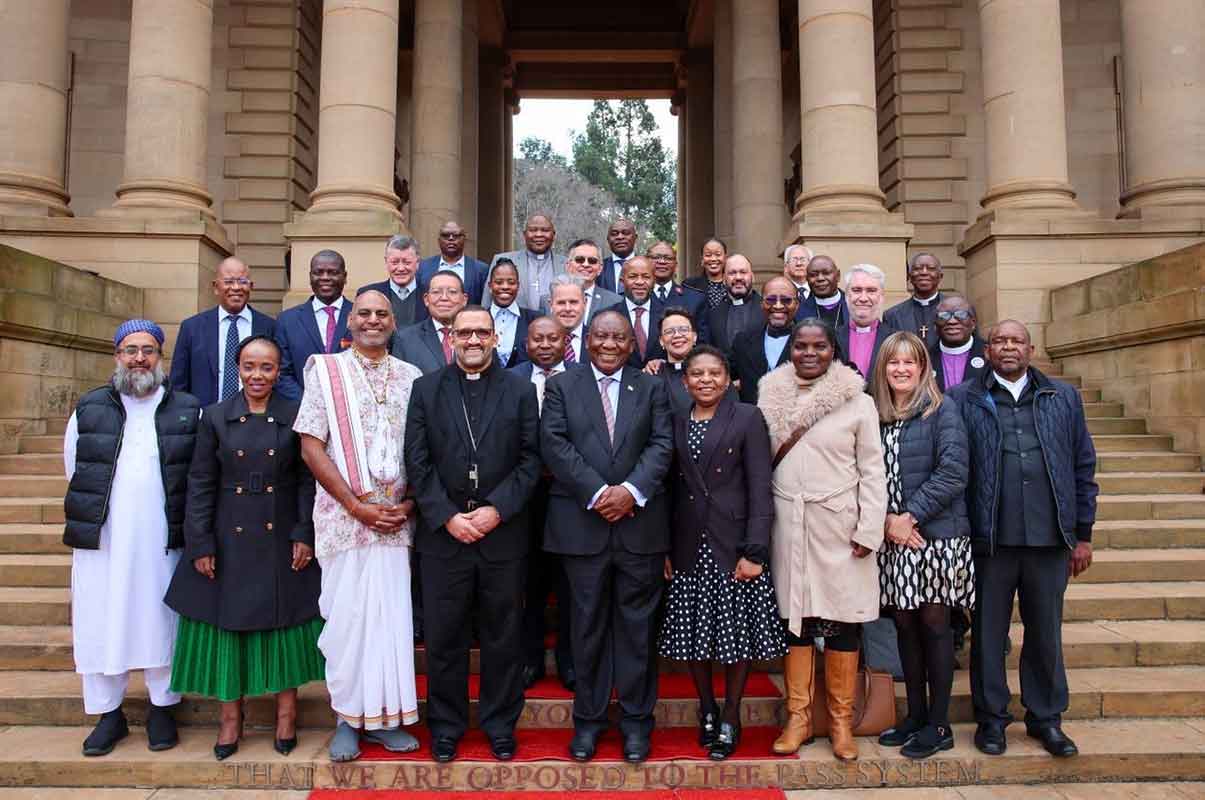
Addressing Ramaphosa during a meeting between the president and leaders of the South African Council of Churches (SACC), Archbishop Sipuka, speaking as the council’s president, condemned attacks on foreign nationals as “inhumane”, saying they violated both human dignity and the African value of ubuntu.
“We have watched with profound disquiet as fellow human beings — regardless of how they came to be in our country — have been hunted down, harassed, violated, their livelihoods destroyed, and their lives threatened unless they leave,” Archbishop Sipuka said.
The archbishop said the victims had been mainly fellow Africans and stressed that human dignity derives “not from a passport but from being created in the image of God”.

While condemning violence against foreign nationals, Archbishop Sipuka said Church leaders also understood the frustrations felt by many South Africans.
“Many who march [in demonstrations against illegal migrants] worship with us on Sundays. They are people who feel abandoned — who experience the collapse of basic services, who live under the weight of unemployment, and who feel that government has been slow to hear them,” Archbishop Sipuka said.
Concerns about porous borders, unlicensed trading and unsafe goods are legitimate, he said, but cannot justify violence. A real grievance does not justify violence.
At least five people had been killed in anti-migrant violence, while other reports cited deaths of Mozambican and Ethiopian nationals in incidents linked to the unrest. Throughout the country migrants have been threatened and told to leave South Africa by anti-immigration groups, leading thousands to seek repatriation. In some areas, migrants have been driven from their homes and communities. Hundreds of foreign nationals reportedly sought refuge in community halls and temporary shelters after attacks and threats by local groups.
Problems will remain
Archbishop Sipuka argued that South Africa’s difficulties would remain even if all foreign nationals left the country.
“If tomorrow every African foreign national were to leave this country, our problems would still be with us,” he said. “The lack of basic service delivery would persist. Unemployment would remain. The insecurity and the drugs would remain. Because the cause is not the foreigner. The cause is the elephant in the room.”
Using an isiXhosa proverb, he added: “Ukufa kusembizeni — the problem is in the pot itself.”
According to Sipuka, the real causes of social unrest include an education system that fails to equip young people to create employment, corruption that has weakened public institutions, and employers who exploit foreign nationals as a source of cheap labour.
“To blame the stranger is to let these true culprits escape scrutiny,” he said.
The SACC president also criticised law enforcement agencies, saying reports suggested police had often failed to act against perpetrators of violence, an “inaction that in some cases amounts to silent complicity”.
He stressed: “The enforcement of law is the work of the state, not of mobs.”
Sipuka further expressed concern that some politicians are exploiting the crisis for political gain through inflammatory rhetoric and fearmongering.
“We call on all political leaders, across all parties, to refuse to trade in the suffering of human beings,” he said.
Although he welcomed Ramaphosa’s address to the nation on June 7, Sipuka suggested the government’s response had come too late.
Church leaders meeting on June 2 had heard testimony that some 2000 families in KwaZulu-Natal alone had been affected, with hundreds displaced and lacking food, shelter and access to medication.
“The response must be early, not late, and it must be sustained,” he said.
Archbishop Sipuka warned that the violence risks damaging South Africa’s standing on the continent, noting that many African countries had supported South Africans during the struggle against apartheid.
“It was not so long ago that we ourselves were the ones at the door, and the African continent received us,” he said. “We risk returning to the isolation with which we were viewed during the apartheid era.”
The archbishop called for stronger law enforcement, investigations into possible police complicity, action against corruption and unemployment, improved border management, and efforts to combat misinformation.
He also urged government and civil society to develop “a human, lawful, and procedural framework” for managing migration while respecting human dignity and the rule of law.
Concluding his address, Archbishop Sipuka appealed for a more compassionate approach to migrants and refugees.
“Mr President, the stranger at our gate is not our enemy,” he said. “Not so long ago, we too were strangers, and the continent received us. Let this conversation be the beginning of a better and more just way forward.”

- Pope Leo’s Prayer for Mission Sunday - October 17, 2026
- A Call to Unity and Love: Pope Leo on the 100th World Mission Day - October 17, 2026
- Walking in the footsteps of Blessed Joseph Gérard: Missionary Associates renew their missionary call - October 15, 2026