Question: How exactly did Jesus’ followers remove his body from the cross?
Answer: Crucifixion in Roman times was a deliberately brutal form of execution, designed to inflict maximal pain and public humiliation. Jesus’ tortured body was very likely nailed to a horizontal crossbeam (called the patibulum), which he had carried through the streets of Jerusalem to Golgotha. This beam, about two metres long, was then attached to a permanent upright post already fixed in the ground.
Usually, crucifixion victims were bound to their crosses with ropes, but others were nailed to the wood, as was the case with Jesus. The nails were driven not through the palms, as often depicted in art, but through the wrists — at the junction of the radius and ulna, which are strong enough to support the body’s weight.
Once nailed or affixed to the beam, the condemned person would be lifted up by Roman soldiers using step-like platforms and positioned so that a metal loop on the crossbeam could be hooked onto a metal bracket or fitting embedded near the top of the upright post. The feet were then secured to a lower footrest or directly to the post, sometimes also with nails.

Death came slowly, often over many hours or even days, as the crucified person struggled to breathe. To hasten death, Roman soldiers would sometimes break the legs of the condemned, preventing them from pushing up to draw breath and thus causing rapid asphyxiation.
In Jesus’ case, this was unnecessary as he had already died. Instead, a soldier pierced his side with a spear to confirm death — fulfilling the prophecy that none of the Messiah’s bones would be broken (John 19:36).
Preparing for burial
Joseph of Arimathea asked Pontius Pilate for permission to take Jesus’ body and bury it. Pilate, who had been reluctant to condemn Jesus in the first place — and then did so with full, merciless authority — granted the request, likely mindful of the Jewish law forbidding the display of bodies on crosses during a special Sabbath, such as that of Passover.
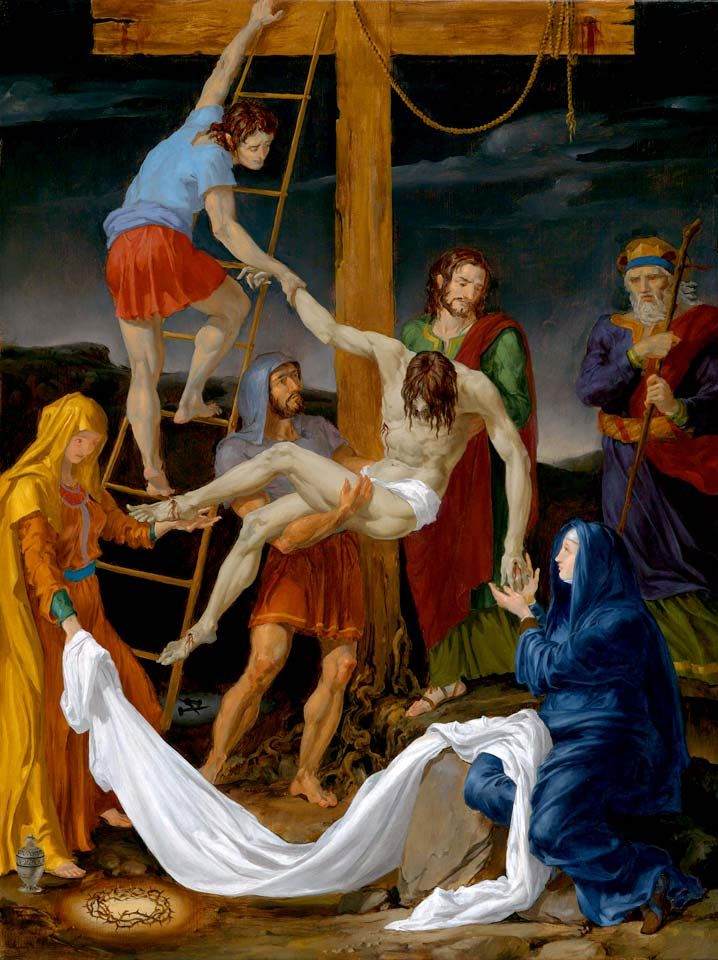
Jesus’ followers, including Joseph of Arimathea and Nicodemus, set about removing his body. First they would have detached his feet from the post. Then, standing on the same platforms used during the crucifixion, they would have lifted the crossbeam off the hook.
Once it was lowered, the nails in Jesus’ wrists were carefully removed. This process would have required care, reverence and some physical effort, but it was not impossible for a small group of devoted followers.
Because time was short before the Sabbath would begin, they wrapped Jesus’ body in linen cloths, adding some of the large quantity of spices that Nicodemus had brought.
The full anointing was left for after the Sabbath — which is why, early on the first day of the week, the women returned to the tomb to complete the burial rites, only to find it empty.
Answered by Günther Simmermacher
Published in the April 2026 issue of The Southern Cross magazine

- Are Stigmata Historically Accurate? - November 3, 2026
- Shrines around the World: Our Lady of Ta’Pinu - November 3, 2026
- God’s Many Graces - November 3, 2026