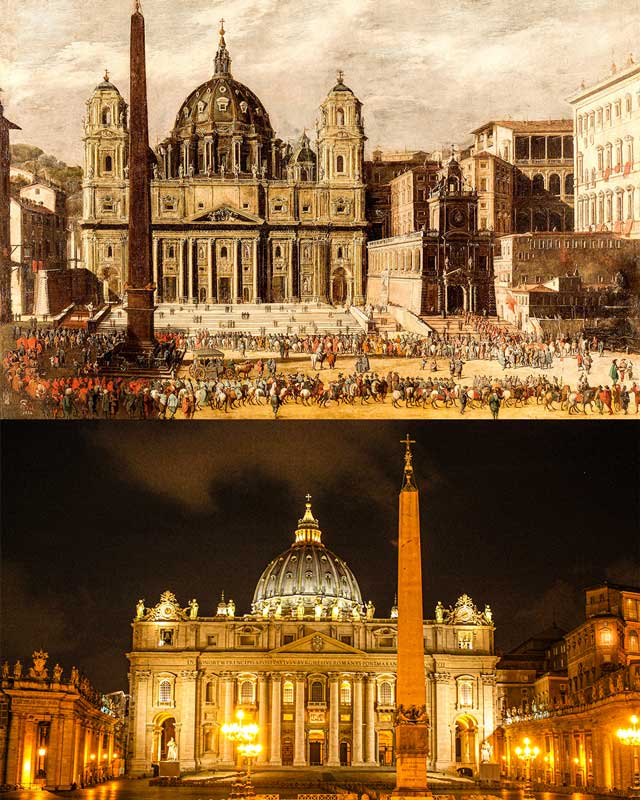
This year the Church celebrates the 400th anniversary of the dedication of St Peter’s basilica in the Vatican. Günther Simmermacher looks at the history of the world’s greatest church, and what the anniversary means.
On November 18, Pope Leo XIV will celebrate a solemn Mass in St Peter’s basilica to mark the exact 400th anniversary of its consecration by Pope Urban VIII in 1626. It is a milestone that inspires both awe and reflection, for this building was born from ambition, genius, scandal and faith on a scale that the world had rarely seen before.
The story of St Peter’s does not begin in the Renaissance but in the first century AD, when the Apostle Peter was martyred in Nero’s circus and buried nearby, both on the Vatican Hill. Christians had been venerating that burial site for many generations, when in around 320 Emperor Constantine, newly sympathetic to Christianity, ordered the construction of the first giant basilica over the tomb. It was a huge, five-aisle structure that stood for more than a thousand years.
By the 15th century, however, the old St Peter’s was crumbling and no longer worthy of a papacy that wanted its architecture to match its power.

In 1505, Pope Julius II — a warrior-pope not known for his restraint — made a shocking decision: he would demolish the ancient basilica and build a new one. The idea had been raised by Julius’ predecessor (and archenemy) Pope Alexander VI, and was met with much opposition — after all, you don’t just knock down a beloved 1200-year-old basilica. But Julius forged ahead in haste, and by 1506, construction of the new St Peter’s commenced.
Designed by HALL-OF-FAMERS
Over the next 120 years, the design of the new basilica was overseen by the great and good of Renaissance art and architecture, then two closely related disciplines:
Bramante, Raphael, Michelangelo, Bernini. Spanning more than a century, the construction of the new St Peter’s represented the transition of Renaissance and Baroque styles.
Donato Bramante drew up the first plans, conceiving a grand Greek-cross design topped with a vast dome. When Bramante died in 1514, Raphael took over briefly, followed by Antonio da Sangallo the Younger, who produced an elaborate wooden model that has survived to this day.
In 1546, the 71-year-old Michelangelo was appointed chief architect. He reportedly said he was taking on the project “to the detriment of my soul, my body, and my peace of mind”. He simplified and improved Bramante’s design and created the astonishing dome that would define the skyline of Rome. Michelangelo’s dome, rising 136m high, became the model for countless subsequent structures, from St Paul’s cathedral in London to the Capitol building in Washington.
Michelangelo died before the basilica was finished.
Construction was finally completed in 1615, and the great Baroque sculptor Gian Lorenzo Bernini later added the colonnaded piazza and the dramatic bronze baldachin over the high altar.
The cause of division
St Peter’s calls us to holiness, but its biggest controversy gave rise to blood-stained division. The building cost an almost incomprehensible fortune, and the papacy looked to the wider Church for funds. One fundraising scheme was the selling of indulgences — the remission of sins in exchange for financial contributions to the building fund. The idea was introduced by Julius II and enthusiastically promoted by Leo X.
The trade was aggressive, widespread, and in some places, such as Germany, downright mercenary. It was this practice that pushed an obscure German Augustinian monk over the edge. In 1517, Martin Luther published his “95 Theses”, listing all kinds of grievances and leading with the St Peter’s indulgence campaign.
It was the start of the Reformation that would split Western Christianity in two and lead to blood-soaked wars. These conflicts were really less about the finer points of theology than about politics and power, but religion provided the pretext.
Scene of historical moments
For centuries, St Peter’s basilica has been the principal ceremonial church of the papacy, even though the pope’s official seat, as Bishop of Rome, is the archbasilica of St John Lateran. Most popes have been crowned, inaugurated or buried at St Peter’s. The presentation of a newly-elected pope on the central balcony, or loggia, has been a tradition since the election of Gregory XV in 1621, following the completion of the façade.
St Peter’s has hosted countless canonisations, since the last century often witnessed by huge international crowds.
The basilica has also been the scene of two Church councils. The First Vatican Council (1869-70) opened in St Peter’s under Pope Pius IX. It defined the doctrine of papal infallibility under specific conditions. That authority has been invoked twice: by Popes Pius IX and Pope Pius XII, who solemnly proclaimed the dogmas of Mary’s Immaculate Conception and Assumption respectively. The dogma of the Immaculate Conception was proclaimed on December 8, 1854, in St Peter’s basilica before a vast gathering of bishops, clergy and faithful. The dogma of the Assumption of Mary was declared on November 1, 1950, in a packed St Peter’s Square.
The Second Vatican Council met each autumn from 1962-65 in St Peter’s basilica for sessions lasting between 8-12 weeks. To accommodate the daily sittings, the basilica’s nave was converted into a debating chamber, with dozens of slanted stalls on either side.
For the Council Fathers’ creature comforts, a coffee bar — nicknamed the “Bar Jonah” by the bishops — was set up under the basilica’s colonnades.
One of the basilica’s most shocking moments came on May 21, 1972, when a disturbed Australian man attacked Michelangelo’s Pietà with a hammer, damaging the Virgin Mary’s face and arm. The sculpture was painstakingly restored and is now protected behind bulletproof glass.
World’s largest church
St Peter’s is the world’s largest church, covering about 23000m2 of floor space and capable of holding up to 60000 people, albeit in a tight squeeze.
The dome was so heavy that iron chains had to be wrapped around its base to stop it from cracking — a structural solution that, centuries later, engineers confirmed was working exactly as intended. Inside the base of the dome, there is lettering that reads Tv Es Petrvs Et Svper Hanc Petram Aedificabo Ecclesiam Meam Et Tibi Dabo Claves Regni Caelorvm — Christ’s words to Peter from Matthew 16:18-19, in Latin. From below, the inscription looks only mildly impressive — until you see people walking up there, dwarfed by each two-metre-high letter.
In the square, the 140 statues of saints that line Bernini’s colonnade each stand around 3,2m tall. Viewed from the piazza below they look almost delicate, but up close, they are colossal.
Cardinal Mauro Gambetti, archpriest of St Peter’s basilica, has stressed that the anniversary is not just a historical jubilee but also an opportunity to renew the basilica’s spiritual meaning, describing it as “the living memory of our faith in Jesus Christ” and “a door open to all who seek God”.
The 400th Anniversary
The 400th anniversary year has seen the opening of previously inaccessible areas, including the full terrace; the launch of AI-powered Mass translations in 60 languages; and a comprehensive structural survey probing the foundations more than 90m below ground. “While Pope Julius II had to opt for demolition and reconstruction to allow for the renovation of a compromised structure, today Pope Leo can afford to renovate without demolishing anything,” Cardinal Gambetti said.
Tourism has changed St Peter’s. Faithful pilgrims still come to the magnificent basilica, and may be fortunate enough to attend Mass at the tombs of St John Paul II or St John XXIII — the very blessed may even celebrate Mass in the crypt, at the tomb of St Peter himself. But to see sights like the Pietà, they have to share the space with secular visitors.
And who knows, maybe being in the heart of Catholicism may set one or the other tourist on the road to conversion. St Peter surely would approve.
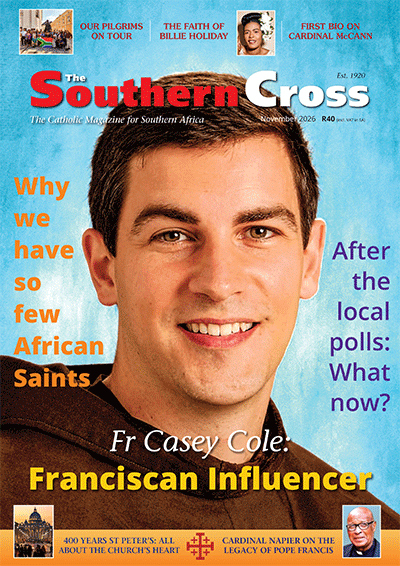
Published in the November 2026 issue of The Southern Cross magazine

- 400 years of St Peter’s Basilica - November 18, 2026
- Was Jesus Married? - November 16, 2026
- Are Stigmata Historically Accurate? - November 3, 2026