There are words that stay with us for a lifetime. Not because they are eloquent or “church language” correct, but because they arrive at the exact moment we need them.
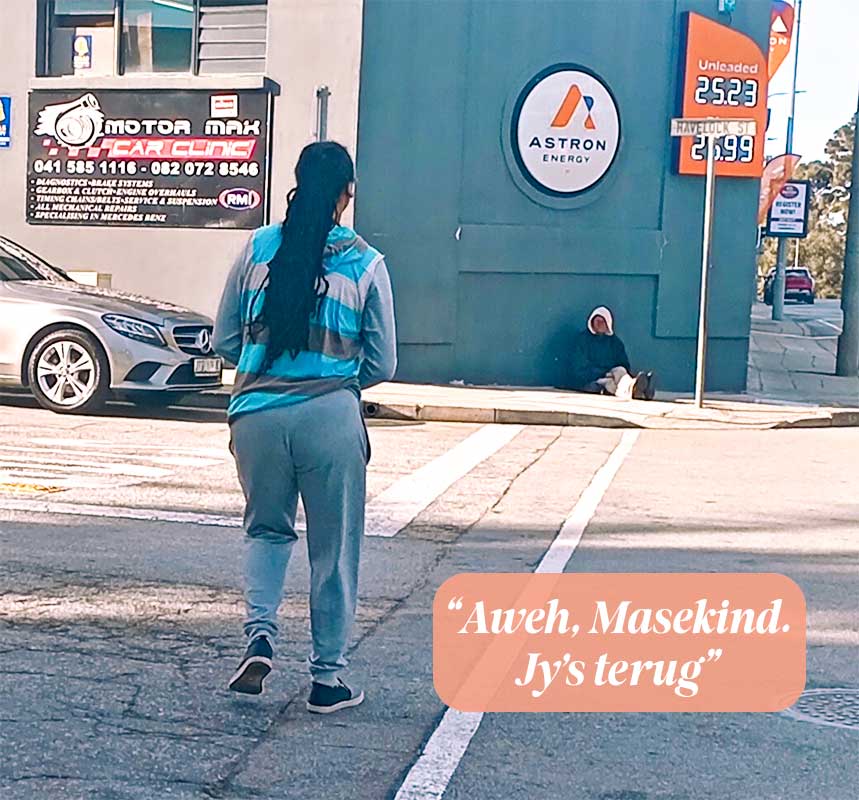
“Aweh, Masekind. Jy’s terug.”
To many, it may sound like ordinary Coloured slang, a casual greeting exchanged in passing. To me, those four words became a reminder that I mattered, that I had been missed, and that my life had value.
In 2021, I contracted Covid-19. Like so many others, I experienced the fear and uncertainty that accompanied those dark days. Breathing became a struggle. For the first time in my life, I truly appreciated the simple gift of air. Every breath felt precious.

There were moments when I questioned my own strength and resilience. There were even moments when I questioned my faith in the God I had always proclaimed as my Lord. I looked at my wife and daughters and wondered whether it would be the last time I would see them. Outside my window, life seemed to have stopped. Hearses passed by. Open-air memorial services became a common sight. Death felt uncomfortably close.
To protect my family, I kept my distance. “Stay away from me. Don’t come too close,” I would say, afraid that I might infect those I loved most. The physical isolation was difficult, but the emotional loneliness was even harder.
By God’s grace and perseverance, I slowly recovered. Weak but grateful, I eventually returned to work after more than a month away.
Then, on my first day back, I heard a familiar voice.
“Aweh, Masekind. Jy’s terug.” Direct translation: Hello, (my) mother’s child. You’re back.
The words came, not from a relative, a colleague or even a fellow parishioner. They came from a homeless man I passed every day on my way to work.
Over time, we had built a simple friendship. A greeting here, a conversation there. “Hoe gaan dit?” “Heita” ” Number 1″ “Is jy nog oraait?” Nothing extraordinary by the world’s standards.
Yet, when I disappeared, he noticed. When I returned, he welcomed me back.
In that moment, I experienced something profoundly Christian. I encountered Christ in someone society often overlooks. The man whom many would pass without a second glance became the one who reminded me that I belonged.
I often think of Jesus’ words in Matthew 25: “Whatever you did for one of the least of these brothers and sisters of mine, you did for me.”
That homeless man lived those words. He became the Church to me. He showed me what Christian community is supposed to look like.
The Eucharist we celebrate each Sunday is not simply about receiving Holy Communion. We receive one Bread and become one Body. As the familiar hymn reminds us:
“One bread, one body, one Lord of all.”
But the Eucharist calls us to more than sharing the same ciborium and drinking from the same chalice. It calls us to recognise one another, to notice when someone is absent, to ask how they are doing, to pray for them and to carry one another’s burdens.
I was reminded of this when a fellow parishioner, our altar servers’ coordinator, had been absent for some time. A simple message asking where he had been revealed that he was in hospital. He later told me how much that small gesture meant to him.
Perhaps that is our mission as Christians: to offer one another our own version of “Aweh, Masekind.”
To notice the empty pew.
To ask about the person we have not seen for weeks.
To let our parish priest know when a family is struggling.
To pray for those who are sick, lonely or grieving.
To lift one another up before God.
The world often tells us that greatness lies in extraordinary acts. Jesus teaches us that holiness is often found in ordinary acts of love and attention.
A greeting. A conversation. A phone call. A visit.
A simple acknowledgement that says, “I saw you. I missed you. I am glad you are here.”
Perhaps that homeless man never realised the gift he gave me that morning. Yet his words remain one of the most profound expressions of Christian charity I have ever received.
“Aweh, Masekind. Jy’s terug.”
May our families, our neighbourhoods and especially our parish communities become places where everyone hears those words in one form or another. And when the Mass ends and we are sent forth to “go in peace to love and serve the Lord,” may we recognise that one of the greatest ways to do so is simply to notice one another.
Because sometimes the Kingdom of God begins with the simplest of greetings. AWEH MASEKIND!
- When Wooden Spoons Become Instruments Of Grace - October 3, 2026
- All Things Bright and Beautiful — A Beautiful Hymn, An Ugly Reality - September 11, 2026
- Pilgrims of Hope: A Hymn We Must Not Leave Behind - August 14, 2026