Gillian Hugo introduces the two presenters of this year’s Living Theology series.
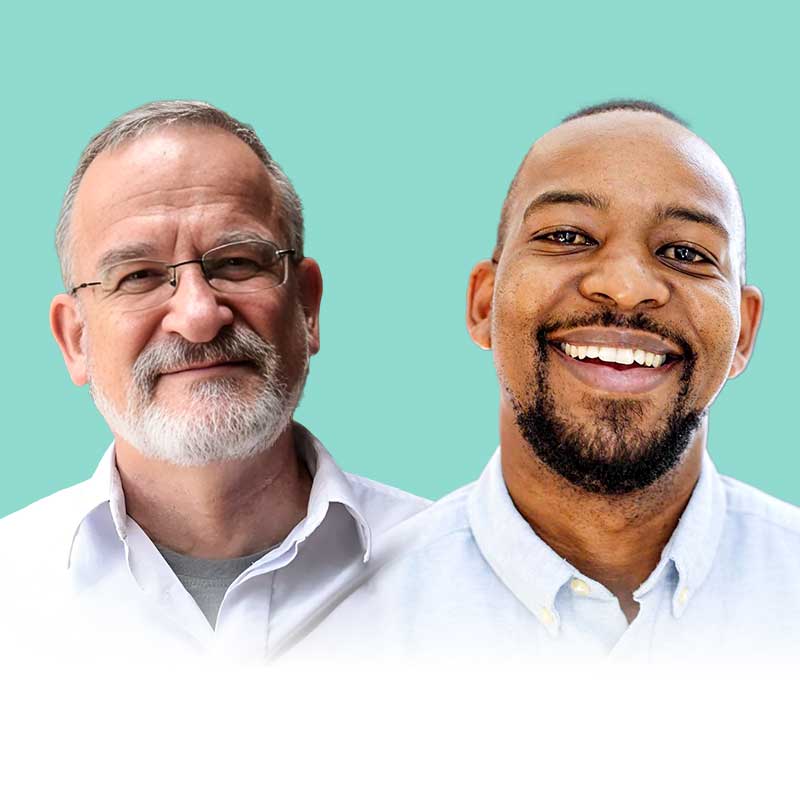
Two very different life stories converge at this year’s Living Theology series of lectures presented by the Jesuit Institute South Africa. Fr David Neuhaus SJ and Kgaugelo Habyane will present this year’s Living Theology from September to November, focusing on one of the most familiar and most contested words in the Christian vocabulary: “Father”.
Asked to describe himself, Fr Neuhaus simply declares: “I am a Jesuit priest.” His life story is unique. Born in South Africa into a Jewish family in 1962, he moved to Jerusalem in his teens. There he experienced a conversion and was baptised into the Catholic Church at the age of 26. His path led him to the priesthood as a Jesuit, and he was ordained in 2000.
“I live mostly in Jerusalem,” he says, “although for the past three years I have been spending a few months each year at the Institute in Johannesburg. I teach Scripture and write about the Bible and about current political events in Palestine/Israel.”

Kgaugelo Habyane grew up in a very different context. A facilitator and wellness advocate from Atteridgeville, Pretoria, he was raised in a Catholic home. “I am a multimedia producer and coordinator at the Jesuit Institute and am currently in formation for Spiritual Accompaniment. My work sits at the intersection of media, mental health, and the formation of healthy masculinity through podcasting, coaching, and creating spaces for honest storytelling and reflection,” he explains. Habyane is the host of the “Manned Up Conversations” podcast (mannedupconvos.com).
His collaboration with Fr Neuhaus did not begin as a formal project but as a series of conversations. They quickly revealed how much is at stake in the language Christians often take for granted. For Fr Neuhaus, the turning point came through those exchanges. “My interest was sparked by Kgaugelo,” he says. “Our conversations at the Jesuit Institute have opened my mind to aspects of our contemporary reality that I knew too little about.”
Horrifying abuse of Scripture
As a Scripture scholar, Fr Neuhaus is used to engaging with complex texts. But he is also acutely aware of how those texts can be misused. “In my teaching of Scripture, I am constantly confronted with the horrific use that can be made of Scriptural passages, ripped out of context, and used to justify horrific realities of war, discrimination, misogyny, prejudice.”
What the conversations with Habyane revealed was not only the misuse of Scripture but also the growing suspicion towards religious language itself. “The conversations we had woke me up to the problems with religious language in a world that perceives this language as judgmental and vastly inadequate.”
For Habyane, these questions are not abstract. “Having been raised by a single mother and my grandmother, this topic is deeply personal. I see it as a social justice issue that affects far more than just the fatherless.”
His work in mental health advocacy has deepened that conviction. During the Covid-19 pandemic, faced with both personal challenges and global reports on men’s mental health, he began to create spaces for conversation among men and boys. “I realised that many of the struggles that men face are not just personal — they are often relational and systemic, shaped by the stories we inherit and repeat.”
The meaning of ‘Father’
Those “inherited stories” lie at the heart of this year’s Living Theology. The focus will be on the language of “Father” — a term that is foundational in Scripture and tradition, yet increasingly difficult for many to receive.
“We live in an age where this term is challenged by contemporary realities,” Fr Neuhaus explains, “as concepts of family transform and mutate and regular patriarchal structures are challenged and deconstructed.” The result is not simply an intellectual difficulty, but a spiritual one. “This creates a crisis for many when they are invited to adopt ‘Father’ language for God.”
Fr Neuhaus’ approach will be to return to the sources. “I will be looking at this crisis, proposing important texts and trying to open them to new meaning within this reality.” The task is neither to discard tradition nor to defend it uncritically, but to read it more deeply, attentive both to its original context and to the questions of the present.
Habyane will contribute a complementary perspective. “I will draw on research and reports on fatherhood to offer a grounded perspective on the changing dynamics of fatherhood and parenting, including the impact of absence on families and society, and the reimagining of fatherhood in different contexts.”
He hopes to open a space for reflection. “The goal is not to provide perfect answers but to invite both men and women into a more conscious and responsible relationship with what it means to be a father, whether biologically or socially. Fatherhood is a social role, not just a private one.”
Both men speak of the importance of listening — to texts, to stories, and to one another. Fr Neuhaus, whose academic work requires constant engagement with theological literature, turns in his free time to fiction and poetry. “I believe that this reading allows me to read the world more accurately, with a better knowledge of the complexities of the human spirit.”
Habyane, too, emphasises the importance of literature. “Given my work, I also enjoy reading books and listening to people’s stories from around the world to gain a deeper appreciation of people’s cultures,” he says. His own work—in podcasting, coaching and facilitation—is built on the conviction that honest storytelling can open paths towards healing and growth.
Learning from each other
Habyane has found his perspective broadened through theological engagement. “Working with Fr David has deepened my interest in how the spiritual and the secular come together to help us appreciate the ways of God,” he notes. “The Ignatian invitation to ‘find God in all things’ has led me to explore male spirituality more intentionally, particularly how men are seeking spiritual nourishment at a time when many are distancing themselves from the Church.”
That sense of distance — from Church, from language, from inherited forms of belief — is one of the underlying realities the series seeks to address. “We will be focusing on ‘Father’ language, so prominent in Scripture and religious tradition,” Fr Neuhaus says. “But we must recognise the crisis that surrounds it.”
For Habyane, that crisis is inseparable from lived experience. “I hope this series will benefit those wrestling with their own father-wounds and struggling to relate to God, especially as Father,” he says. “It will also be valuable for parents, guardians and caregivers seeking to better understand the relational, social and biblical dimensions of parenting.”
The intended audience is broad; it is not limited to theologians or specialists but is open to anyone willing to engage with the questions. “I hope that all who participate will benefit in looking at these sensitive questions openly and honestly,” Fr Neuhaus says. “For those wounded by fathers and father-oriented language, I hope we can discover ways towards healing. And for all others, I hope we can develop sensitivity to the wounds that are festering in our midst.”
“Those involved in youth formation will benefit greatly,” Habyane says, “as this series can serve as a resource for supporting young people, particularly those growing up without consistent father figures.”
As the Living Theology series approaches, Fr Neuhaus and Habyane are inviting others into the conversation that first brought them together — one in which Scripture is read in the light of experience, experience is tested against tradition, and both are opened to the possibility of deeper understanding. In that space, even a word as familiar — and as loaded — as “Father” may begin to be heard anew.
The Living Theology will be held in:
• Gqeberha: September 1-3
• Johannesburg: September 14-17
• eSwatini: September 23-26
• Bloemfontein: October 6-8
• Polokwane: November 1-12.
Published in the July 2026 issue of The Southern Cross Magazine

- Pope: Marriage in the light of Christ’s love - October 22, 2026
- Queen of the Most Holy Rosary Parish Celebrates 70 Years of Grace - October 21, 2026
- Mass Readings: 25 October – 1 November, 2026 - October 20, 2026