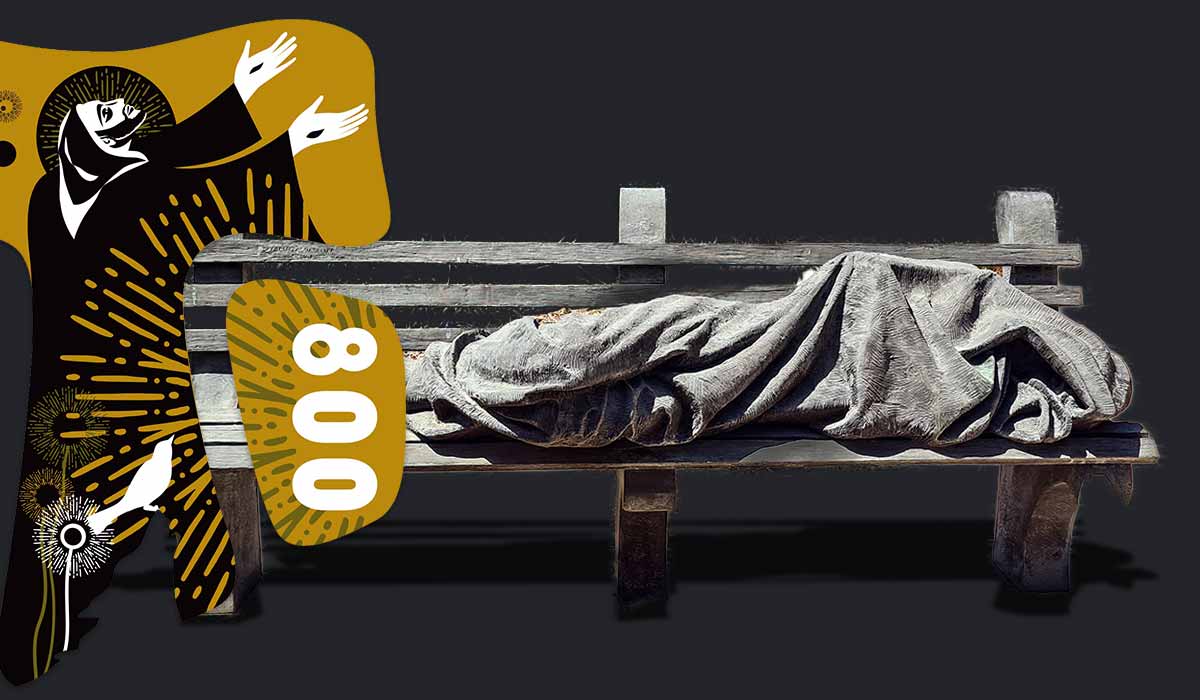
This year the Church marks the 800th anniversary of the death of St Francis of Assisi. In the second of a four-part series on different parts of the saint’s spirituality, Günther Simmermacher looks at why Francis’ radical poverty was key to his vision of God.
For St Francis of Assisi, poverty was not just about economics, nor was it an abstract ideal, or a protest against wealth for its own sake. For him, poverty was evangelical and profoundly Christ-centred, long before the Church proclaimed its preferential option for the poor.
Poverty was the way God had chosen to meet humanity in Jesus Christ, and therefore the way the disciple was called to meet God, neighbour and creation. A key to understanding Francis is to realise what he meant when he spoke of “Lady Poverty”.
Francis lived at a time when the medieval Church was widely entrapped by wealth and power. Bishops ruled as temporal princes, monasteries controlled vast estates, and ecclesiastical offices, right up to some popes, were often tied to privilege, patronage and political influence. The Church was still a spiritual authority but it also wielded major temporal, economic and social power.

Against this background, Francis’ insistence on absolute poverty was revolutionary — not as a social critique but through his contemplation of Christ that pointed back to the source of the faith.
Gospel Summons
Francis read the Gospel literally, as a voice to be obeyed, unequivocally. When he heard the Gospel passages in which Jesus sends out his disciples without any money, staff or even sandals, he saw it as a personal summons. “This is what I want,” he said. “This is what I seek with all my heart.”
He understood the poverty of the Incarnation. God did not enter the world clothed in splendid gladrags but as a vulnerable child, born in a borrowed shelter and laid in a feeding trough for animals. The angel announced the birth of the Messiah not to the king or the high priest but to shepherds — people on the margins of society. In Bethlehem, the Creator of All accepted dependence, exposure and fragility. For Francis, this was a theological revelation: God chose poverty deliberately!
Francis understood Christ’s public ministry in the same light. Jesus lived as an itinerant preacher, without property or security. He relied on hospitality, friendship and trust. He warned against storing up wealth, praised the poor, and identified himself with those who lacked food, clothing and shelter.
Above all, Francis returned time and again to the Cross, where Jesus was stripped of everything — of his possessions, reputation, dignity, and ultimately life itself — and gave himself entirely to the Father.
For Francis, poverty was an outward form of divine love. This conviction governed all aspects of Francis’ life — and also the Rule he gave to his followers. The friars were to own nothing, neither individually nor collectively. They were not to accumulate property, store wealth or seek institutional security. They were to work when possible, beg when necessary, and always trust in providence. Money was not just discouraged but forbidden. The friars were to live “as pilgrims and strangers” in the world.
An Alternative Way
Francis made his poverty intentionally visible, but it was not performative to impress or to create an image. He saw it as a public witness which might unsettle the privileged. The friars’ rough habits, bare feet and itinerant lives proclaimed that God alone is enough. In a society ordered around status, land and inheritance, their poverty was a sign that another way of living was possible.
This understanding of poverty demanded communal equality. Francis rejected distinctions of rank within the fraternity. He insisted that all were brothers, whether ordained or lay, educated or unlearned. Authority was to be exercised as service. Titles were avoided. Even the superior was called “minister”, meaning one who serves others (as in “ministering to”).
Francis himself resisted the status of clerical advancement. He was ordained a deacon but declined to become a priest, so as to remain close to the margins.
He emphasised obedience to the Church and reverence for the priesthood, while also modelling a radically non-possessive way of life within an ecclesiastical system that had become contaminated by the material world.
His response to the worldly corruption in the Church was prophetic but it was not confrontational. Protests against corrupted systems could easily be dismissed with disdain — we see this even today in our political discourse. But Francis’ prophetic witness, the constant reminder that another way is possible, could not be so easily ignored.
Importantly, Francis distinguished poverty from misery. He did not glorify suffering or romanticise destitution. He was acutely aware of the brutal realities faced by the poor, and his response was not an empty veneration of poverty but complete compassion. He instructed his brothers to show reverence towards those in need, seeing in them not lesser beings or objects of charity, but witnesses of Christ’s presence.
Almost 800 years after his death, a pope would take his name and preach the same message to a world ruled by mercenary self-interest which sees the virtue of empathy as a weakness.
Poverty, as Francis understood it, was meant to soften the heart, not harden it — a message that remains absolutely relevant today when the poor and marginalised are often met with hardness of heart. The life of poverty was intended to make the friar attentive, grateful and dependent. Any form of poverty that produced contempt, self-righteousness or indifference was a betrayal of its purpose.
New Demands
The Franciscan movement grew rapidly. What had begun as a small, itinerant fraternity soon attracted thousands. With growth came practical demands: places to live, books for study, structures for formation and ministry. Some friars argued, not unreasonably, for adaptations, legal arrangements and indirect ownership that would allow the order to function effectively while technically preserving poverty. Inevitably, tensions arose.
Francis watched these developments with increasing unease. He feared that legal innovation would contaminate his original vision. For him, poverty was not a condition to be managed but a spiritual mindset to be lived. He warned repeatedly against compromise, insisting that once possessions entered the fraternity, power and anxiety would follow.
In his final years, Francis withdrew from governance. Recognising his own limitations, he handed responsibility to others. But he remained a living reminder of the founding charism. His Testament, written near the end of his life, is both gentle and urgent, pleading with his brothers not to abandon the simplicity to which they had been called.
Even 800 years after his death, Francis’ understanding of poverty remains unsettling because it cannot be reduced to moderation nor easily reconciled with institutional comfort. Yet its appeal resides in its clarity. Poverty, freely chosen, unburdens the heart. It strips away illusions of control and reveals where trust truly lies.
In a world marked by accumulation, competition, power, material comfort, but also by anxiety and diminishing empathy, Francis issues all of us a challenge. He suggests, counter-intuitively, that simplicity is a profit, that security does not come from possessions, and that joy is born not of having more but of needing less. Importantly, his life proposes a freedom rooted in reliance on God, on others, and on grace. And this is a good starting point for our own liberation.
Eight centuries ago, Francis rejected the false promises of materialism and power by which the world seeks to secure itself. By choosing Lady Poverty, Francis lived a life that was uncluttered and radiant with joy — a life of freedom from the prisons of materialism to which he calls us even today.
Next: St Francis, Creation and Brotherhood
Published in the August issue of The Southern Cross Magazine

- Sydney Duval: We Call him Friend - October 8, 2026
- St Francis and Mission - October 6, 2026
- St Francis of Assisi: Creation and Brotherhood - September 28, 2026