By Claude Marie Bernard Kayitare – South Africa’s debate about asylum seekers, Home Affairs and xenophobia challenges Catholics to put the Gospel’s teaching on human dignity, solidarity and love of neighbour into practice.
South Africa is wrestling with difficult questions about migration, asylum, public safety and the functioning of the Department of Home Affairs. Communities are frustrated by unemployment, poverty, crime and pressure on public services. Many people are asking whether the country’s immigration system is working as it should.
These concerns deserve serious attention. Government has a responsibility to manage migration, administer the asylum system fairly, enforce the law and protect the public.
But as Catholics, we must also ask a question that goes beyond politics and administration: What does our treatment of the stranger say about our relationship with Jesus Christ?

In Matthew 25:35, Jesus says: “I was a stranger and you welcomed me.” These words should challenge every Christian who encounters hostility towards refugees, asylum seekers and migrants, whether expressed through violence, discrimination, dehumanising language or indifference to their suffering.
Our faith cannot be separated from how we treat the most vulnerable among us.
The human being behind the documentation
As a Rwandan refugee who has lived in South Africa since 2003, I write from personal experience as well as from my work in human rights and refugee advocacy.
For many refugees and asylum seekers, the struggle does not end when they reach a place of safety. It can continue through years of uncertainty, family separation, difficulties obtaining documentation and obstacles to rebuilding a stable life.
The Department of Home Affairs has a demanding responsibility. It must verify identities, prevent fraud, process applications and administer immigration law. Yet these responsibilities must be carried out in a manner that respects the Constitution, applicable legislation and South Africa’s international protection obligations.
When administrative delays or barriers prevent people from accessing the asylum process, the consequences are not merely bureaucratic. They affect real families, including children whose futures depend on the decisions and systems of adults.
A document may appear to be a small piece of paper, but for the person who needs it, it can represent security, recognition, access to opportunities and the possibility of planning for tomorrow.
We must therefore advocate for a Home Affairs system that is efficient, accountable, accessible and humane. Doing so does not mean opposing immigration controls. It means insisting that the administration of the law must itself be lawful and fair.
Catholic teaching leaves no room for xenophobia
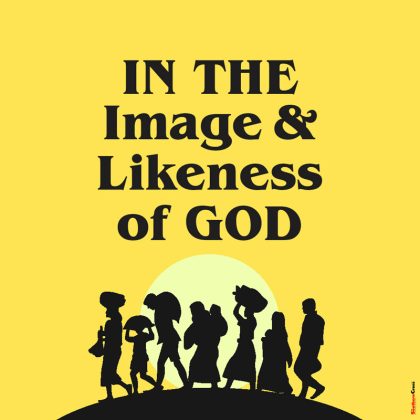
The Catholic Church teaches that every human being possesses inherent dignity because every person is created in the image and likeness of God (Genesis 1:27).
This dignity does not disappear at an international border. It is not granted by a passport, a visa, a refugee permit or a national identity document.
Pope Francis, in his encyclical Fratelli Tutti, calls us to recognise our shared humanity and resist attitudes that exclude people because of their origins. His teaching challenges us to move beyond fear and indifference towards fraternity and solidarity.
This does not mean that countries cannot regulate migration or that individuals should be exempt from the law. It means that laws must be administered justly and that no person should be subjected to collective blame because of nationality.
When a foreign national commits a crime, that individual should be investigated and held accountable through due process. When an asylum seeker commits fraud, the matter should be addressed through lawful procedures. But the wrongdoing of one person cannot justify threats against an entire community.
Equally, the economic difficulties experienced by South Africans cannot fairly be attributed to foreign nationals as a group. Unemployment, inequality, inadequate housing and shortcomings in public services require serious policy responses and accountable leadership.
We must be able to discuss these challenges honestly without turning our neighbours into scapegoats.
Defending the rights of refugees does not diminish the rights of South Africans. Rejecting xenophobia does not mean rejecting the rule of law. Both commitments are necessary for a just society.
The Good Samaritan and the stranger among us
In Luke 10:25–37, Jesus tells the parable of the Good Samaritan. A wounded man is ignored by two passers-by, while a Samaritan—someone from a community viewed with hostility by many of Jesus’ listeners—stops to help him.
Jesus asks which person acted as the neighbour to the injured man.
The answer challenges the boundaries we sometimes construct around compassion. Our neighbour is not simply the person who shares our nationality, language, culture or religion. Our neighbour is the person whose humanity calls us to respond.
In South Africa today, that neighbour may be a refugee whose business has been threatened, a mother afraid for her children’s safety, or an asylum seeker who cannot resolve a documentation problem. It may equally be a South African family struggling to survive, a young person unable to find employment or a community living with crime and inadequate services.
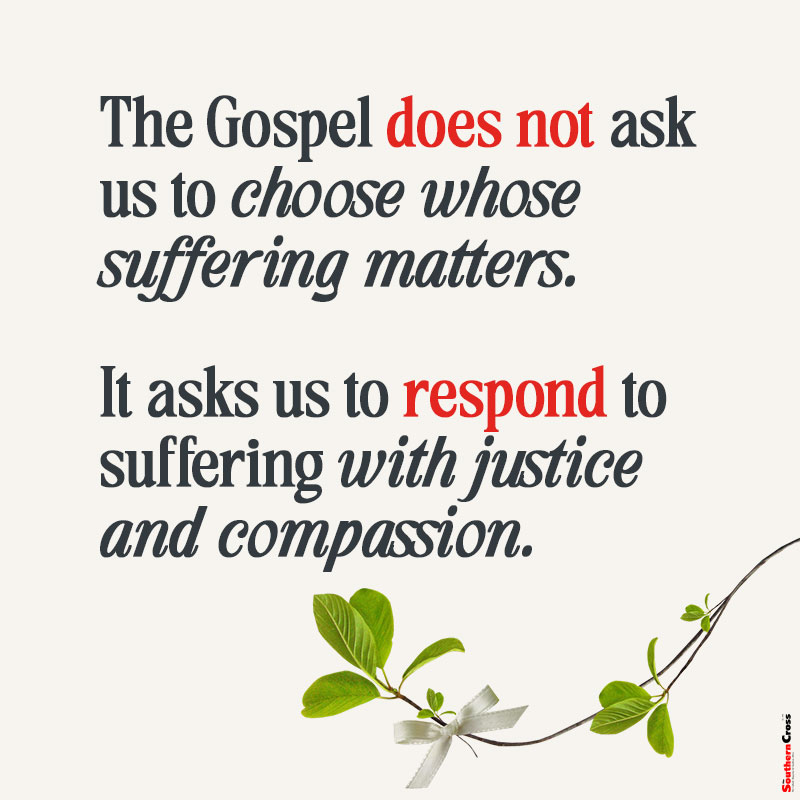
The Gospel does not ask us to choose whose suffering matters. It asks us to respond to suffering with justice and compassion.
This is why Catholic social teaching places such importance on human dignity, solidarity, the common good and the preferential option for the poor and vulnerable. These principles require us to stand alongside people facing exclusion while also working to improve the conditions affecting disadvantaged communities throughout South Africa.
From Sunday worship to everyday action
The Catholic Church has an important role to play in helping communities respond constructively to migration and xenophobia.
Our parishes should be places where difficult questions can be discussed honestly, where misinformation is challenged with reliable evidence and where people learn to distinguish legitimate concerns about immigration from prejudice against foreigners.
Priests, religious congregations, Catholic schools, Justice and Peace commissions and lay organisations can help communities understand asylum procedures, human rights and the responsibilities of citizens and migrants.
Parishes can also bring together local residents, refugee leaders, community organisations, police representatives and public officials to identify practical solutions to shared concerns about safety, documentation and social cohesion.
Where people face documentation problems or threats, Catholic communities can help them find appropriate legal assistance, support services and reliable referrals. Where violence occurs, the Church should stand with affected families, condemn intimidation and encourage lawful reporting and accountability.
Above all, we must examine our own attitudes. It is not enough to condemn xenophobic violence after people have been injured or killed. We must challenge the language and assumptions that can make such violence seem acceptable.
If we profess our faith in the Eucharist but remain indifferent to the suffering of a stranger, we must ask whether we are fully living the Gospel we proclaim.
A call to conscience
As South Africa addresses the challenges of migration, the Catholic community should advocate for two principles that must never be separated: the state’s responsibility to administer immigration law and its responsibility to respect human dignity and the rights protected by law.
We should demand efficient public institutions, safe communities and fair procedures. We should support efforts to combat crime and fraud. We should listen to South Africans who feel neglected and work towards solutions to poverty and inequality.
At the same time, we must reject vigilantism, collective punishment, discrimination and violence against people because they are foreign.
My appeal is to our bishops, priests, religious congregations, Justice and Peace commissions and every Catholic parishioner: let us make the dignity of refugees and migrants a practical concern of our Christian witness.
Let us teach our children that another person’s nationality does not make that person less human. Let us encourage respectful dialogue rather than hostility. Let us hold public institutions accountable without dehumanising those who depend on their services.
South Africa needs an immigration system that works. It also needs communities in which no person lives in fear simply because of where they were born.
In Matthew 22:39, Jesus commands us: “You shall love your neighbour as yourself.”
That command is not suspended at the border.
To defend the dignity of a refugee is not to diminish the dignity of a South African. To demand justice for an asylum seeker is not to abandon the rule of law. To reject xenophobia is to affirm the shared humanity of all God’s children.
The question before us is not simply how South Africa should manage migration. It is whether we, as Christians, are prepared to recognise Christ in the stranger and act accordingly.
Our faith must be visible not only in our prayers, but also in our courage to defend the dignity of every human being.
Claude Marie Bernard Kayitare is a refugee leader and human rights advocate, and Head of Partnerships and Programmes at the Southern Africa Network for Immigrants and Refugees (SANIR).

- When We Reject the Stranger, What Happens to Our Christian Faith? - October 13, 2026
- Mass Readings: 18 October – 25 October, 2026 - October 13, 2026
- Pope Leo on our Wedding Feast and Upcoming Surgery - October 12, 2026