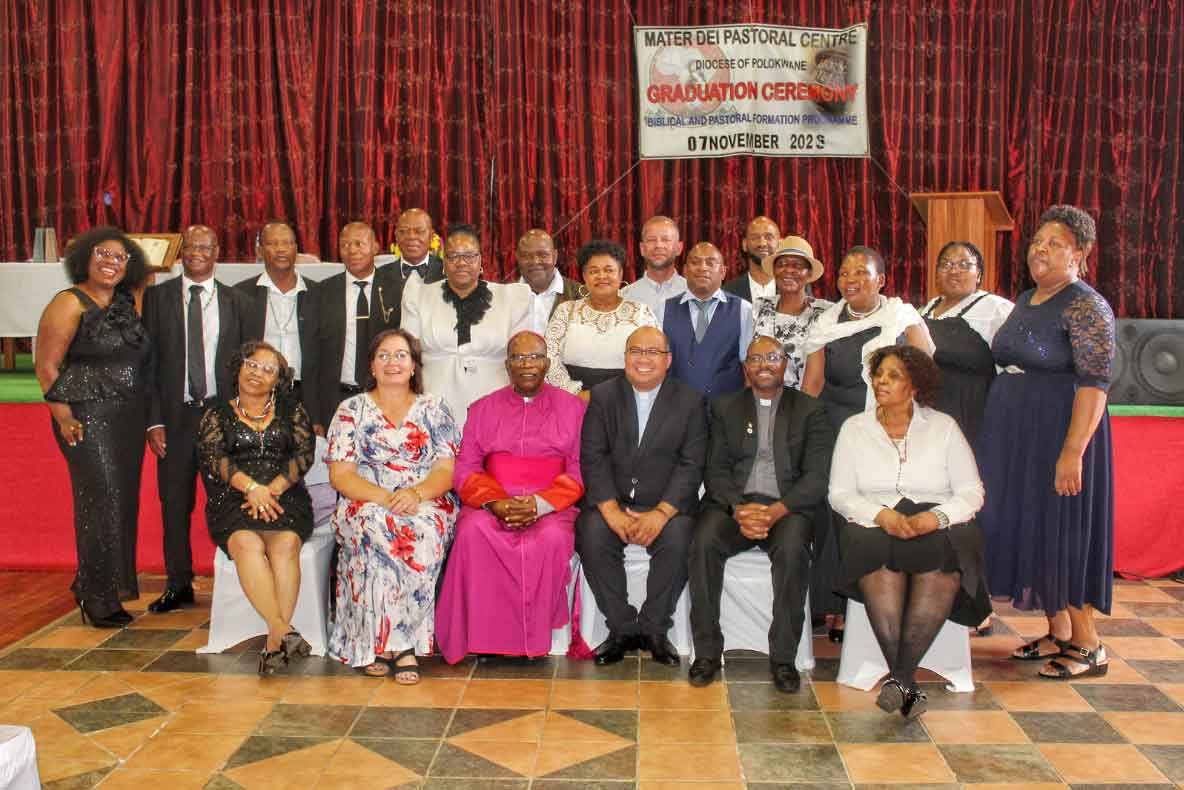
The diocese of Polokwane held a graduation ceremony at the Mater Dei Pastoral centre for eighteen graduates of this year’s Biblical and Pastoral Formation Programme on Saturday, November 7, 2026. Fifteen of the graduates were from different parishes within the diocese, and three were from the diocese of Witbank.
The programme was launched in 2008 by Fr Sunny John SVD, who serves as director of Mater Dei Pastoral Centre. The inaugural graduation ceremony took place in 2010. This means that for over ten years, the diocese of Polokwane has been carrying out the mission of bringing the lay faithful in communion with Christ and helping them to be active participants within the Church through the Biblical and Pastoral Formation Programme.
Objectives of the Programme
This programme, titled ‘A Journey Through Scripture’, is designed to assist everyday Catholics in deepening their knowledge, comprehension and affection for Sacred Scripture. Its goal is to provide participants with the knowledge and abilities they need to faithfully read, interpret and understand the Bible, while taking into account its historical context, literary genres and theological meaning.

Another key objective is to enable participants to see how Sacred Scripture relates to our faith — above all, how the whole narrative fulfills the narrative of salvation in Jesus Christ.
More than simply gaining biblical knowledge, the program motivates participants to put the Word of God into meaningful practice in their everyday lives, within their families, communities, and workplaces. It further aims to encourage them to take a more active role in their own parishes — through pastoral initiatives, liturgical ministries, Bible study groups, and catechetical work.
Who is it for?
The programme is designed for everyday Catholics who want to grow in their grasp of Sacred Scripture. It welcomes the laity who are members of parish pastoral councils, youth leaders, catechists, those working within Catholic organisations, and anyone eager to come to understand the Bible more deeply. The aim is to ensure that biblical formation is available to all people, not just to those with a background in biblical studies or formal theological training.
The Rationale of the Program
This programme addresses the demand among Catholic believers for more thorough biblical education. Even though the Bible stands at the heart of our Christian faith, numerous Catholics have few chances to explore it methodically and grasp its depth.
Many people know well-known Bible stories and verses, yet they might lack a full comprehension of the historical setting, theological meaning, and how these connect to the larger narrative of salvation. Some passages can be hard for others to understand, or they may depend on interpretations they have come across over time – and some interpretations might be misconstrued.
The vision of the Biblical and Pastoral Formation Program aligns with the vision set forth by the Second Vatican Council, especially in the Dei Verbum document that urges that Sacred Scripture be accessible to every member of the faithful in order for them to read it regularly, so that their knowledge of Christ may deepen.
Structure and Duration of the Programme
Spanning nine months, the programme brings participants together for a single weekend each month starting in January and continuing through October, concluding in November with a graduation ceremony where Mass is celebrated by Bishop Jeremiah Masela, Bishop of the diocese of Polokwane.
When we look back at what we’ve been doing in the past within our dioceses, we’ve always been a synodal Church – we’ve been walking together. The diocese of Polokwane has been making sure that the laity can be heard and can contribute to discussions where an in-depth knowledge of the Bible is needed.
The synod on synodality is about cleaning our ears and relistening to the Holy Spirit for further guidance on what the Church needs to do in the here and now. As society evolves, members of the Church have somewhere, somehow grieved, quenched, or insulted the Holy Spirit.
The synod on synodality gives us an opportunity to take part in an act of contrition – this time not through words but through actions as a collective.
- Living the Word: Mission and Communion in Polokwane - November 17, 2026
- One Church, Many Gifts: Synodality in Pretoria - October 27, 2026
- Catechists are the Backbone of the Church - October 26, 2026