His Excellency, Archbishop Henryk Jagodziński says the life of South Africa’s first beatified martyr offers an example of how laypeople can live the Gospel through the ordinary demands of family, work and community life.
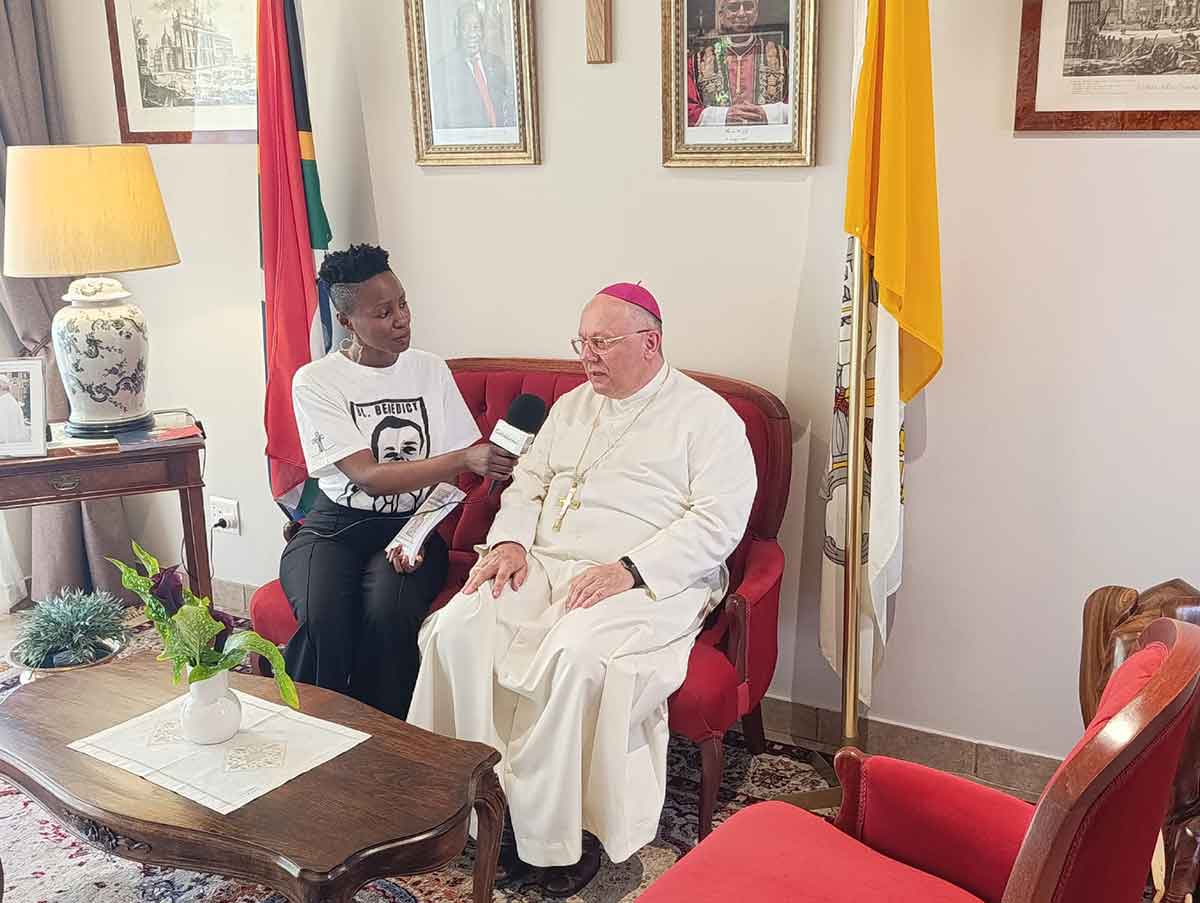
The Apostolic Nuncio to Southern Africa is launching his book, Tshimangadzo or Miracle: The Story of Blessed Benedict Daswa, today, 25 November 2026. The book reflects the nuncio’s growing interest in the life and witness of the South African martyr, whose example he believes has a message for Catholics and Christians today.
In an interview at the Apostolic Nunciature in Pretoria earlier this month, Archbishop Jagodziński explained that the inspiration for the book began shortly after his arrival in South Africa on 14 July 2024. In the chapel at the nunciature, he noticed an icon of Blessed Benedict Daswa positioned to the right of the cross.
Curious about the man depicted in the icon, the nuncio began reading about his life. What he discovered, he said, was a man whose holiness could not be understood only through the circumstances of his death, but through the way he lived each day.

“I discovered that this was a great saint, not only for this moment of his martyrdom, but his whole life is a lesson of the Gospel,” he said. Archbishop Jagodziński described Daswa as a blessed figure for our time, whose life offers answers to many of the questions facing people today.
A layman’s witness to the Gospel
The nuncio said that one of the most significant aspects of Daswa’s witness is that he was not a priest or a member of a religious congregation. He was a husband, father, teacher and school principal who sought to practise his faith in his family, professional and community life. Archbishop Jagodziński said that while it is heroic to profess one’s faith in a moment of danger, the daily commitment to living the Gospel through small decisions and ordinary responsibilities can be even more challenging.
“It is more difficult to read the Gospel every day in the small things, in family life, in professional life, and also in your community, in the Church,” he said. He hopes the book will encourage readers to recognise that holiness is not reserved for those in ordained or consecrated life. Daswa’s example, he said, can help people find a path towards their own sanctification.
A search for truth and respect for others
Asked what personally inspires him about Daswa, Archbishop Jagodziński pointed to the Blessed’s search for truth and the way he treated others.
Daswa converted to the Catholic faith at the age of 17. The nuncio said he was struck not only by Daswa’s conviction that he had found the fullness of truth in the Catholic Church, but also by the way he lived that conviction. He highlighted Daswa’s respect for his wife, children, neighbours, pupils, members of his community and even those who eventually killed him. Daswa, he said, did not force his beliefs on others, but remained clear about his own convictions.
Recalling the events that led to his martyrdom, the nuncio explained that Daswa refused to contribute money towards a community contribution intended to pay a traditional healer. His response was not to condemn those who chose differently, but to explain that, as a Catholic, he could not take part. “He respected the liberty and freedom of everybody, but he knew how to transmit and present his own conviction,” Archbishop Jagodziński said.
Writing as a way of reflecting
The book is the nuncio’s second publication since his arrival in Southern Africa. His earlier book, Southern Africa, My Love: Part One, brought together homilies and speeches delivered during his first two years in the region. He explained that the new book is an English translation of a Polish edition, published at the end of August 2026 and launched in Kraków, Poland. Although writing requires time and discipline, Archbishop Jagodziński described it as a way of relaxing during his free time. While some people unwind by listening to music or watching films, he said, writing is something he enjoys.
At today’s launch, the book will be presented by the Metropolitan Archbishop of Pretoria, Archbishop Dabula Mpako, with Bishop João Noé Rodrigues, the bishop of Tzaneen Diocese who write the preface of the English edition, also participating. A layperson and teacher is expected to share their reflections on the book, an inclusion the nuncio considers important because Daswa’s witness speaks particularly to the vocation of laypeople.
The Church in Southern Africa: signs of hope and a call to pray for vocations
The interview also offered Archbishop Jagodziński an opportunity to reflect on his experience of the Catholic Church in Southern Africa since his arrival. He acknowledged that his visits have given him only a partial picture of Church life, but said he had been deeply moved by the affection shown towards the Successor of St Peter. He recalled the expressions of sympathy following the death of Pope Francis in 2025, including the participation of people from other Christian communities and other faith backgrounds, as well as the interest surrounding the election of Pope Leo XIV. The nuncio also spoke positively about the presence and involvement of young people in parishes and communities, as well as the commitment of laypeople in catechesis, Church institutions and discussions about the future of the Church.
However, he identified vocations to the priesthood and religious life as an area of concern. He encouraged Catholics to pray for vocations and urged young men and women who sense a call from God not to be afraid to respond.
Referring to the Second Vatican Council’s Constitution on the Sacred Liturgy, Sacrosanctum Concilium, he emphasised the centrality of the Eucharist in the life of the Church, describing it as the source and summit of Christian life.
Archbishop Jagodziński’s message, like the story he hopes to share through the book, is that the vitality of the Church depends on people who are willing to live their faith with commitment. In Blessed Benedict Daswa, he sees a layperson whose fidelity to the Gospel was expressed not only in the final witness of martyrdom, but in the everyday choices that shaped his life.
Blessed Benedict Daswa: a brief account of his life
South Africa’s first person to be beatified by the Catholic Church, Daswa was a layman, husband, father, teacher and catechist whose commitment to his faith led to his martyrdom. Tshimangadzo Samuel Daswa was born on 16 June 1946 in Mbahe, in the former Venda region of what is now Limpopo. He was the eldest child in a Lemba family. After the death of his father, he helped support and educate his younger siblings. During his youth, Daswa encountered Catholicism through friends and religious instruction. He was baptised on 21 April 1963, taking the name Benedict. He later trained as a primary school teacher and began teaching in 1973. He eventually became principal of Nweli Primary School. In 1980, he married Shadi Eveline Monyai in the Catholic Church, and they had eight children. A committed Catholic, Daswa was actively involved in his parish and community. He served as a catechist, helped build the Catholic church at Nweli, supported the poor and encouraged children, particularly girls, to pursue their education.
His martyrdom
In January 1990, after lightning strikes damaged several homes in the village, some community members attributed the incidents to witchcraft. They decided to collect money to pay a traditional healer to identify the person they believed was responsible. Daswa refused to contribute, explaining that his Catholic faith did not allow him to participate in practices associated with witchcraft. He also maintained that lightning was a natural phenomenon. His refusal angered some members of the community. On 2 February 1990, while returning home after taking his sister-in-law and her sick child to seek medical attention, Daswa was ambushed by a group of men. He was beaten and stoned, and boiling water was poured over his head. He died at the age of 43. Accounts of his final moments recall that he prayed as he faced his attackers.
Beatification and legacy
The cause for his beatification was formally investigated by the Diocese of Tzaneen. On 22 January 2015, Pope Francis recognised Daswa’s death as martyrdom. He was beatified on 13 September 2015 at Tshitanini, near Thohoyandou, in Limpopo, during a Mass celebrated by Cardinal Angelo Amato on behalf of the Pope. His feast day is commemorated on 1 February. Blessed Benedict Daswa is remembered as a witness to the Gospel who demonstrated that holiness is possible in ordinary life. His example continues to inspire Catholics through his commitment to family, education, service to the poor, parish life and fidelity to Christ, even when that fidelity came at the cost of his life.

- Nuncio’s new book presents Blessed Benedict Daswa as a model of everyday holiness - November 25, 2026
- Archdiocese remembers departed clergy and religious at commemorative Mass - November 20, 2026
- Young adults commissioned to put their gifts at the service of the Church - November 19, 2026