Every month Fr Chris Chatteris SJ reflects on Pope Leo XIV’s prayer intention
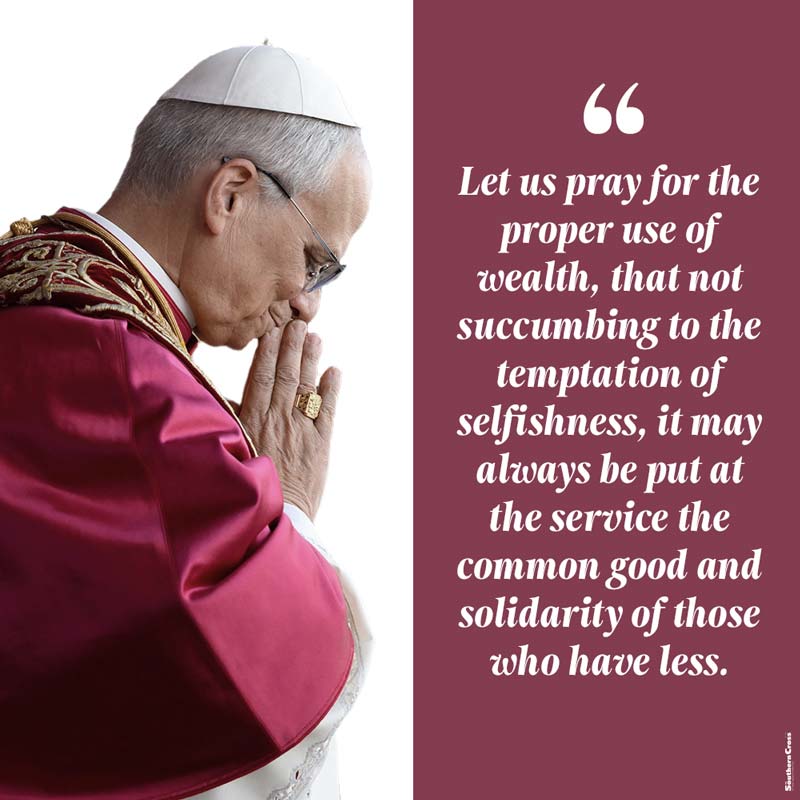
Intention: Let us pray for the proper use of wealth, that not succumbing to the temptation of selfishness, it may always be put at the service the common good and solidarity of those who have less.
We have become so used to the phenomenon of super-wealth that we forget that there was a time in Western society when the highest income tax rates were close to 100%.
The highest recorded income tax rate in history was 99,25% in Britain during World War II. In the United States in 1944, it was 94%. Obviously, these very high rates were imposed because of the demands of total war.

But even in peacetime, rates were once far higher than they are today, such as 98% in the United Kingdom between 1974 and 1979, combining an 83% top rate on earned income with a 15% investment surcharge. In the US, from the 1950s until 1963, the rate stood at 91%. From 1894 until 1913, a US Supreme Court decision had held that individual income tax was unconstitutional.
Taxation arguments
Now, there are debates about whether the higher rates of tax actually brought in more revenue for the government than lower rates. Some argue that, at times of lower rates, the rich declared more income and used fewer legal and illegal means of avoiding tax. The other classic argument for lower taxes is that they facilitate more investment, and therefore a higher rate of economic growth.
However, it is quite clear that the gap between the super-rich and the poor today is far wider than it was in those times of ultra taxation. Of course, there are all sorts of variations between different countries.
Today, the inequality gap is generally higher in the USA than in Western Europe, for example. We in South Africa are often reminded, rightly, that we live in one of the most unequal countries in the world. Incidentally, our lowest income tax rate is 18% and our highest is 45%, roughly the same as in the UK.
Countries like Norway, Spain and Colombia levy a recurrent tax on individual net wealth above a certain level. Such a tax has occasionally been suggested as one way to mitigate South Africa’s extreme inequality.
What the Church says
Catholic Social Teaching has never insisted on a goal of absolute equality, but it has argued that the common good is the first priority and takes precedence over the individual’s right to make as much money as possible. The Church has never argued that “property is theft” but has held that with property comes responsibility towards those who lack property, particularly those who lack the basic requirements for a life of human dignity.
In concrete terms, while there are children going hungry, families lacking shelter and workers not earning a living wage, the rich and super-rich bear a responsibility to share their wealth much more seriously.
I sense an interesting recent change in the way the super-rich are being perceived. Not too long ago, billionaire inventors and entrepreneurs generally used to be treated as celebrities. This is shifting to a more critical stance, especially as society becomes uneasy with the immense political and economic power they have acquired — and are intent on acquiring through the development of AI. The new hard-hitting documentary on trillionaire Elon Musk by Alex Gibney, titled Musk, is an indication of this shift in public opinion.
Perhaps shifting public opinion may persuade the super-rich to share more of their astounding wealth voluntarily. If not, there is a good (common good) argument, and good historical precedents, for using fairer taxation to ensure that they do so.

- Pray with the Pope: Let wealth work for everyone - November 3, 2026
- On All Souls’ Day, Pope prays that mothers’ tears may silence weapons - November 3, 2026
- Pope: Let us Feel United in the Communion of Saints - November 2, 2026