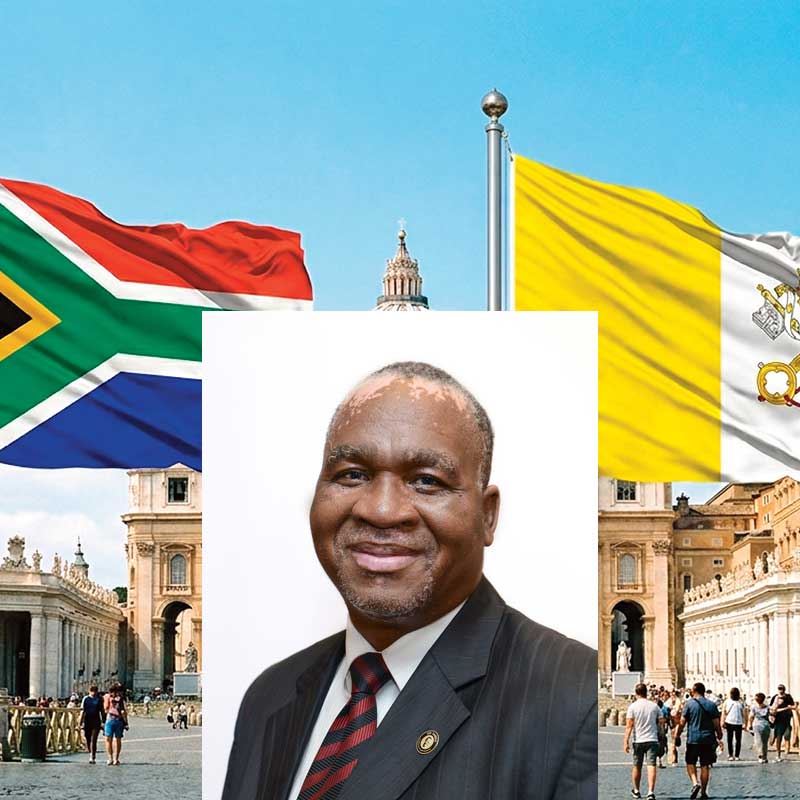
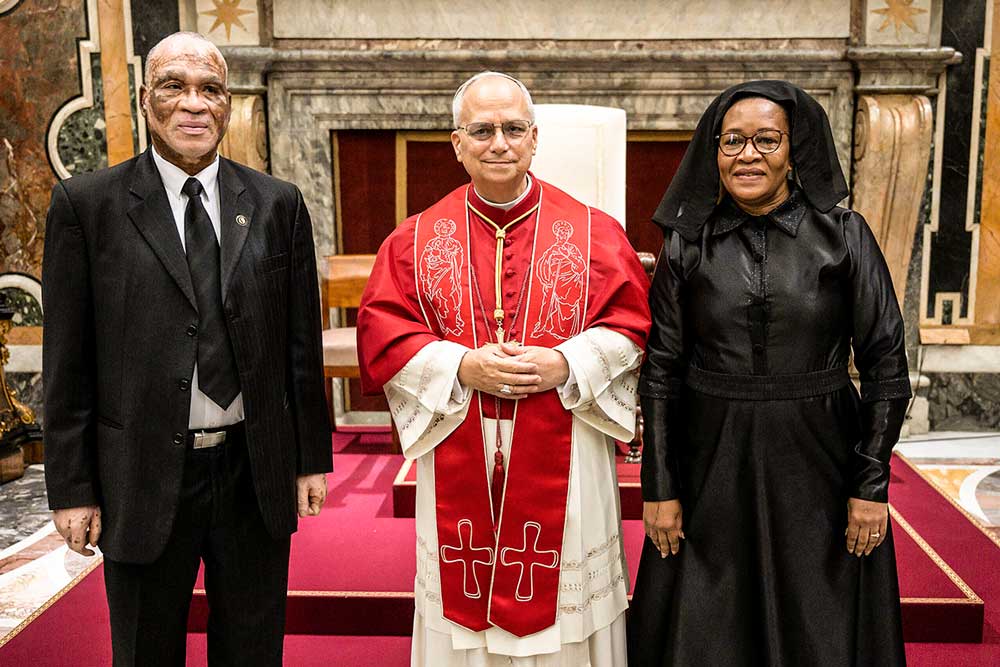
In January, Sello Moloto presented his credentials to Pope Leo XIV as South Africa’s ambassador to the Holy See. David Capel spoke to the ambassador about this position, and looks at what diplomatic relations with the Holy See entail.
As South Africa’s ambassador to the Holy See, Sello Moloto performs an unusual role in the often hurly-burly world of international diplomacy.
When he is in the quiet confines of Vatican City, the 61-year-old is “far from the madding crowd” (apologies to Thomas Hardy) as he represents a country often at war with itself, and that still struggles to overcome one of the worst injustices in modern history — apartheid.
Moloto was active in fighting that system. He was born on August 27, 1964, in Claremont, a village near Bakenberg in what is now Limpopo province. Growing up in a poor rural family, he started primary school late, but matriculated at Bakenberg High School (now Lephadimisha Secondary) in 1984. He entered the University of the North in 1985 and graduated with a bachelor’s degree in pharmacy.

Moloto became politically active while at university, and in 1989 he served as president of the local branch of the South African National Students’ Congress.
In the early 1990s, he worked as a pharmacist in the rural Northern Transvaal, first at Groothoek Hospital in Lepelle-Nkumpi and then, from 1992, at Mokopane Hospital in Mahwelereng. At the same time, Moloto was elected chairman of the regional African National Congress branch in Waterberg.
A rising figure within the newly-unbanned movement, Moloto entered national politics in South Africa’s first post-apartheid elections in 1994, when he was elected to an ANC seat in the Senate, representing Limpopo (initially still known as the Northern Transvaal). He was later deployed to serve in the Limpopo provincial legislature.
Premier of Limpopo
In 2004 he was elected premier of Limpopo. Seen as a supporter of President Thabo Mbeki, Moloto faced strong opposition from Zuma loyalists in Limpopo, especially the young ANC Youth League leader Julius Malema. Moloto resigned shortly before the 2009 elections and left the ANC to join the Congress of the People (COPE).
It was a difficult time for Moloto, who also had to contend with private struggles after his wife, Ramokone, a teacher, was diagnosed with liver cancer in 2006. She died on July 24, 2009, at the age of 40. They had three children.
After resigning from COPE in 2011, due to frustration with internal power struggles, and leaving active politics, Moloto was appointed South Africa’s high commissioner to Mozambique — the first in a series of ambassadorial postings.
Subsequently, he served as ambassador to Finland and Estonia (2012–15); high commissioner to Lesotho (2016–22); and ambassador to the Swiss Confederation (since 2022). As ambassador to Switzerland, based in the capital Bern, he is also accredited to the Principality of Liechtenstein.
On December 6, 2025, he presented his credentials to Pope Leo XIV as South Africa’s ambassador to the Holy See (the Vatican City State), succeeding George Johannes, who died suddenly in office at the age of 78 on November 30, 2022.
“As a non-resident ambassador, I visit the Vatican if and when there are important occasions and/or there is an important message to pass on from our president to the Holy Father,” Moloto told The Southern Cross.
Vatican’s diplomatic net
He pointed out that the Vatican operates as a fully-fledged independent state, maintaining formal diplomatic relations with more than 180 countries, ranking third after the United Nations and the European Union.
Speaking in his personal capacity, Moloto noted that it is not surprising that the Holy See enjoys “such huge diplomatic relations, as the Catholic Church boasts a membership of more than 1,4 billion believers across the world. This constitutes a population bigger than the most populous nations on Earth, such as India and China.”
The other point of significance, he says, “is that these members wield huge influence and hold important positions in many nations”.
Moloto had the privilege of meeting and shaking hands with Pope Leo XIV on two occasions last year. “The first was on the occasion of President Cyril Ramaphosa’s working visit to the Vatican on November 7, and the second was during the presentation of my letters of credence to the Holy Father,” he recalled.
“Pope Leo appeared to me as a simple, warm and affable leader — the same as his predecessor, Pope Francis.”
The Holy Father is continuing Pope Francis’ legacy of speaking out about injustice being committed throughout the world, Moloto said. Pope Leo “argues that the Holy See can’t be a silent bystander to the grave disparities, injustices, human rights violations and conflicts taking place in many parts of the world”.
Variety of cultures
Moloto recalled that, on the occasion of the presentation of his credentials at the Vatican, ambassadors from 13 nations as diverse as Lesotho, Pakistan, Finland, Micronesia, Sri Lanka, Uzbekistan, Latvia and Thailand were represented.
“These nations observe and practise various cultures and follow various religious persuasions. The plural nature and character of Holy See diplomacy does not necessarily require anyone to be a practising Catholic in order to be accredited as an ambassador to the Holy See.” Moloto himself is a Christian.
“My opinion is that in this era of social media and fake news, the positive information about the Vatican is likely to be believed if it is related by a non-practising Catholic or a person from a different faith or religious persuasion.”
Moloto subscribes to the Catholic belief that the process of electing a new pope “is guided by the Spirit”. Asked if he thinks we will ever see an African pope, his reply was simple: “The time for an African pope is still coming. It will happen at its own right time.”
“The Vatican,” he said, “is a holy place. The atmosphere prevailing in the Vatican is different from many places. The atmosphere is generally peaceful.” The feeling of walking the grounds of the Vatican is “very difficult to explain. It is a feeling like no other.”
Moloto said it is a privilege for him to represent his country as ambassador to the Holy See. “It is definitely overwhelming to meet any world leader of the pope’s stature. The mere fact that it is the wish of more than 1,4 billion Catholics — as well as that of many non-Catholics around the world — to meet the pope, is deeply humbling.”
A state like no other
Diplomatic relations with the Holy See are unlike those with any other state. Represented internationally by the Holy See, the Catholic Church engages in diplomacy not for economic or military advantage, but to advance peace, human dignity and the common good.
The work of ambassadors to the Apostolic See extends beyond conventional bilateral relations. The Holy See speaks on issues such as conflict resolution, migration, religious freedom, development and environmental responsibility.
Ambassadors engage these positions, explaining their own government’s policies while also receiving and conveying the Holy See’s concerns. This exchange often takes place through the Secretariat of State, the Vatican’s central diplomatic office.
Ambassadors serve as a visible link between their country and the universal Church. In countries with significant Catholic populations, this role can carry particular weight, as it touches on both public policy and the life of the faithful. This dimension is less pronounced in the case of South African ambassadors.
Cooperation is typically marked by continuity and discretion. The Holy See maintains one of the world’s oldest diplomatic networks, with apostolic nuncios — papal ambassadors —
serving in capitals around the globe. These nuncios, in turn, interact with civil authorities and local Churches, ensuring a two-way flow of information.
Relations since 1994
South Africa and the Holy See established diplomatic relations in June 1994, shortly after South Africa’s transition to democracy. The Holy See’s ambassador to South Africa is the nuncio, with offices in Pretoria. The current incumbent is Archbishop Henryk Jagodziński, who is also nuncio to Botswana, Eswatini, Lesotho and Namibia.
For an ambassador to the Holy See, the focus is on dialogue, values and long-term relationships. The aim is mutual understanding in the service of the common good.
In his work, Ambassador Moloto therefore has a dual function: the customary diplomatic responsibilities of representing South Africa in Switzerland and Liechtenstein, and the unique privilege of being afforded a close-up, insightful view of the Catholic faith in diplomatic action — embodied in the person of the pope himself.
Published in the July 2026 issue of The Southern Cross magazine

- Mass Readings: 22 November – 29 November, 2026 - November 16, 2026
- Sello Moloto: SA’s Representative to the Holy See - November 16, 2026
- Pope in Peru: Proclaiming Jesus Christ is a crucial task - November 14, 2026