A new translation of the Old Testament
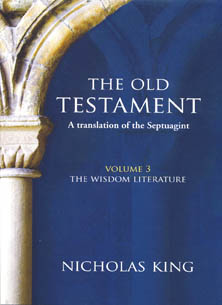
THE OLD TESTAMENT: A Translation of the Septuagint. Volume 3: The Wisdom Literature. By Nicholas King. Kevin Mayhew, Suffolk. 2008. 388pp.
Reviewed by Michael Shackleton
 Readers of this newspaper will know the author’s weekly column, Scriptural Reflections, in which he unfailingly provides refreshing comments and insights about each Sunday’s liturgical readings.
Fr King may occasionally raise the odd eyebrow when his translation of a verse seems off-beat in comparison with the conventional, but his purpose is to contemporise the text, using his extensive scriptural scholarship and familiarity with the original languages as skilfully wielded tools.
After the success of his translation of the New Testament in 2004, the first of four volumes of the Old Testament has recently been published. The work will be in these four quarters so that Fr King can get each off his chest before finalising the next. The last of them is due out in 2013.

Volume 3, The Wisdom Literature contains the Book of Job, Psalms, Proverbs, Ecclesiastes, Song of Songs, the Book of Wisdom and the Wisdom of Jesus ben Sira (Ecclesiasticus).
Don’t let it pass your notice that the author has translated the Septuagint, the Greek version of the early Hebrew Bible, which was completed three centuries before Christ. It was the Septuagint that was used in the synagogues of the dispersed Greek-speaking Jews who outnumbered the Jews living in the Holy Land at the time.
Also, it was the version of the Old Testament that was familiar to the early Christians, not to mention the New Testament writers who freely quote from it. It is for this reason especially that this translation is significant for us today, so that we can, as far as possible, understand in words that suit our times, those words that suited the times of past generations of Jews and Christians.
Fr King is not shy to be bold, as he cuts into verses that might have been obscure in the older texts, and places before us a set of readings which, he says, belongs to a Jewish tradition that has directly influenced the New Testament.
It is also significant that the Septuagint antedates the official Hebrew canon of Scriptures, which had its origin only in the first century AD, and which ditched a number of the books of the Septuagint version, because they were either not first written in Hebrew or on the soil of the Holy Land.
Fr King favours inclusive language; that is, he refuses to translate in a way that ignores half of humanity. Those who have memorised psalms, for instance, in which the subject is man, will find that the author prefers to use an inclusive word. The text: “What is man that you should spare a thought for him and the son of man that you should care for him?” (Psalm 8:4), becomes: “What are humans that you remember them, or their children that you take account of them?”.
However, in texts that clearly are not inclusive, especially in Proverbs and Ecclesiasticus, Fr King preserves the content, for example in Proverbs 1:8, which he renders: “Son, pay attention to your father’s instruction, and do not reject your mother’s commands”.
It is this kind of breath of everyday language that is the virtue of this new translation. Also, footnotes are provided at a minimum but they are loaded with trenchant comment.
The text is faithful to the original Greek yet flows in a reader-friendly way, and is easily grasped intellectually and emotionally.
Bible translations come and go. This one holds the promise of being widely read and applied by both the academically and non-academically inclined.

- The Day a Saint Shoved Me - November 11, 2025
- Is the Doxology Part of the Lord’s Prayer? - September 25, 2025
- Can a Christian Doubt Heaven? - June 24, 2025