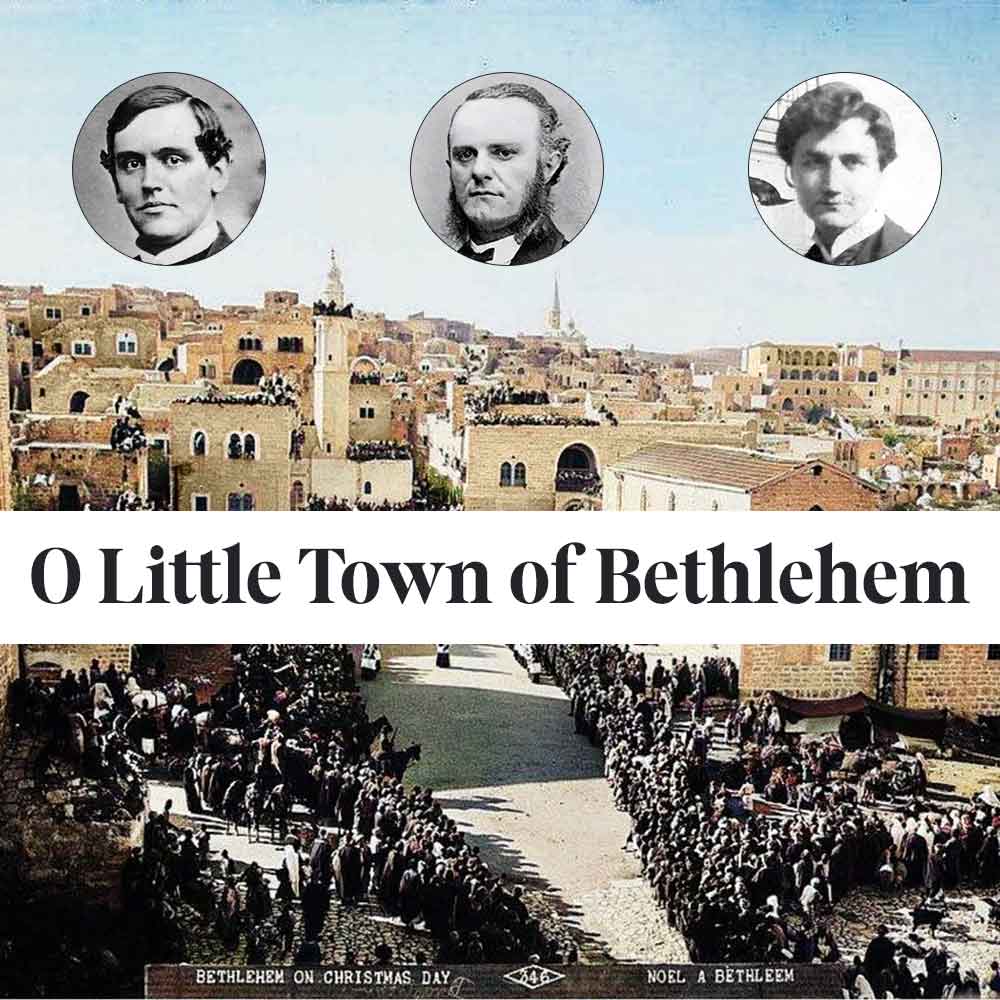
In his annual feature on the background of a popular Christmas hymn, Günther Simmermacher looks at a carol that involves two tunes and a composition that came in a dream.
As so often with Christmas hymns written in the United States, “O Little Town of Bethlehem” has two popular melodies. One, a stirring melody, is sung mostly in countries of the Commonwealth; the other, a gentler affair, is popular in the United States.
Like many hymns, “O Little Town Of Bethlehem” was first a poem, written in 1868 by the 29-year-old Episcopalian (US Anglican) minister Phillips Brooks, a dynamic preacher of impressive build and a committed anti-slavery campaigner. The wonderful words of his poem show that he was a man of spiritual and theological substance.
Three years earlier, the rector of Holy Trinity church in Philadelphia had been on a pilgrimage to the Holy Land. On Christmas Eve 1865, Brooks travelled on horseback from Jerusalem to nearby Bethlehem.

He later recalled: “Before dark we rode out of town to the field where they say the shepherds saw the star… Somewhere in those fields we rode through, the shepherds must have been. As we passed, the shepherds were still ‘keeping watch over their flocks’, or leading them home to fold.”
Later Brooks took part in the Christmas Eve service in the church of the Nativity, running from 10pm to 3am. In the grotto of the ancient church he touched the silver star which marks the spot of Jesus’ birth, and prayed at the place where the manger stood that very first Christmas.
A tune that came in a dream
Now, in 1868, Rev Brooks decided to write a poem about that profound experience, with the idea that it would be introduced with musical accompaniment at the Sunday school Christmas service. The thankless task of coming up with a tune at the short notice of a few days fell to the organist of Holy Trinity, a 37-year-old real estate agent named Lewis Redner.
The deadline for delivery of the tune was the Sunday before Christmas, so it could be practised. On Friday, Brooks approached the harried organist: “Redner, have you ground out that music yet to ‘O Little Town Of Bethlehem’?” He hadn’t. On Saturday, still nothing. Redner later reported: “I was roused from sleep late in the night hearing an angel-strain whispering in my ear, and seizing a piece of music paper, I jotted down the treble of the tune as we now have it, and on Sunday morning before going to church I filled in the harmony.”
Neither Redner nor Brooks thought the carol or the music to it “would live beyond that Christmas of 1868”, the composer said. But in 1874, a bookstore owner in Philadelphia published the hymn as a leaflet. Rev Huntington, a minister in Worcester, Massachusetts, discovered it and, with permission, included it in his Sunday-school hymnbook The Church Porch. For some reason, Huntington gave the tune the unseasonal title “St Louis”.
The English adaptation of a hymn
The tune which scores “Oh Little Town of Bethlehem” in Britain and the Commonwealth may sound suitably festive, but it is actually an adaptation of an old English folk ballad called “The Ploughboy’s Dream”, adapted and retitled “Forest Green” by Ralph Vaughan Williams, who was yet to become a famous composer of symphonies, operas, choral music, stage shows and film scores, as well as the editor of the Anglican English Hymnal.
It was as a historian of folk music that Vaughan Williams had learnt the tune in 1903 from an old labourer, Mr Garman, who lived near Forest Green in Surrey (hence the title). Vaughan Williams’ adaptation was first published in the 1906 English Hymnal, and was widely adopted as the standard melody for “O Little Town Of Bethlehem” in Britain and its dominions and colonies. Even in the US Episcopalian Church it is the preferred version.
Life after a great Christmas carol
Rev Phillips Brooks went on to have an impressive ministry. He published widely, preached to Queen Victoria in Westminster Abbey, and led the famous Helen Keller to Christianity. In 1891, he was elected bishop of Massachusetts but died in 1893 at the age of 57, after only 15 months in office. He was widely mourned, with even the Catholic Church honouring a great man.
Lewis Redner continued to play the organ, eventually having served four churches. He was also involved in charities for the homeless and hungry. Like Brooks, he never married. Redner died in 1908 at the age of 76.
Ralph Vaughan Williams went on to study under the French composer Maurice Ravel and is now regarded as one of Britain’s greatest composers. He died in 1958 at the age of 86.
Hear the Redner version of “O Little Town Of Bethlehem”, performed by the Catholic singer Aaron Neville at https://t.ly/gl67O
Hear the Vaughn Williams version, performed at King’s College in Cambridge at https://t.ly/cABPz
For more stories behind popular Christmas carols see scross.co.za/category/features/biography-of-hymns/
Published in the December 2024 issue of the Southern Cross Magazine

- Sydney Duval: We Call him Friend - October 8, 2026
- St Francis and Mission - October 6, 2026
- St Francis of Assisi: Creation and Brotherhood - September 28, 2026