Stability, Mission, and the Church We Are Being Called to Be
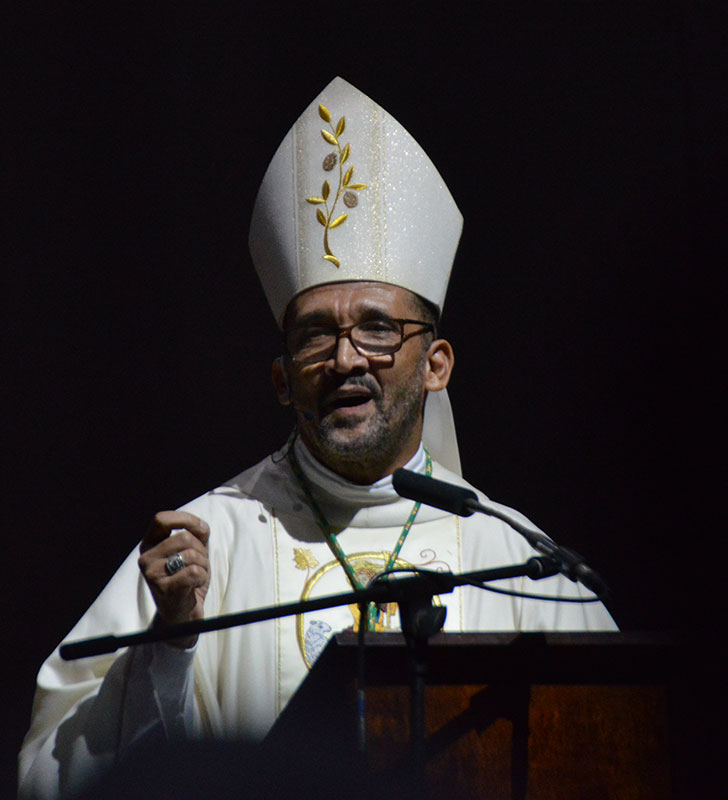
By Sithembele Sipuka, Archbishop of Cape Town
As I write this short reflection on the first year of Pope Leo’s service as the universal pastor of the Church, I cannot help think of how providence has personally connected me to him.
He was appointed bishop in Peru while Archbishop Green was the Apostolic Nuncio there, the same Archbishop Green who had previously served as Apostolic Nuncio to the Southern African Catholic Bishops’ Conference, during whose time I was appointed bishop in 2008. He was named and made a Cardinal together with our own Cardinal Stephen Brislin. Last July, he appointed me to the Dicastery for Interreligious Dialogue, and early this year he appointed me as Archbishop of Cape Town, making me his first appointment in the SACBC territory. So, when I ask what kind of pope he is proving to be, I am not asking from a distance.
“Peace be with You”
Even before these coincidences that personally link me to him, something about him touched me from the moment of his election. When he emerged at the window of the Papal Palace as the new Pope, I felt for him; he appeared so overwhelmed by what had just happened. He did and said nothing dramatic, as Pope Francis had done when he let go of the Mozzetta and asked the people to bless him before he blessed them.

Visibly overcome by emotion, and perhaps to the point of tears, he said “Peace be with you” – the very words the Risen Christ spoke when he first appeared to his disciples gathered together.
After those words, he kept a low profile, making few public statements, which made some wonder whether he was sufficiently in touch with a world that seemed to demand an immediate papal response. Reflecting on him a year later, one phrase comes to mind: “a firm but steady pope.” I think he personally felt the need to find his footing after an election he had not expected, to understand and come to terms inwardly with what had just happened to him. As he is gradually coming to terms with the reality of his election, he appears to be settling into the papacy. As he does, several priorities are emerging that I find deeply relevant to Africa and the broader southern hemisphere.
The Pope’s Name
Much was made of the historical novelty of the first American-born pope in the Church’s two-thousand-year history. But what struck me, watching from Mthatha, was less the nationality than the name he chose. Leo.
The deliberate choice of the name after Leo XIII, whose 1891 encyclical Rerum Novarum positioned the Church as a moral actor amid the upheavals of industrial capitalism, indicated that this papacy would not be a papacy of institutional self-absorption. It would instead be a papacy that invites the church to engage with the world in its hopes and dreams and its struggles and failures, finding expression in its inequalities, conflicts, and displacements. The choice of the name appeared to be an invitation to recover and practice Catholic social teaching, rather than to adopt nationalistic, profit-making and geopolitical interests.
In choosing this name, he placed himself in deliberate continuity with Pope Francis, who in Fratelli Tutti pointedly asked why the death of a homeless person on the street barely registers in public consciousness, while a drop in the stock market makes front-page headlines across the world.
Pope Leo’s First Words
Then there were his first words – “Peace be with you” – which he has been gradually proving were not uttered merely as a conventional greeting but as something thoughtfully prioritised. In the months since his election, he has been consistent in calling for peace over and against war, again in continuity with Pope Francis, who called war “a defeat for humanity” and “a failure that condemns us all.”
In his appeals against armed conflict, Pope Leo has consistently highlighted the human suffering that results from wars driven by strategic interests, placing the Church firmly on the side of protecting human dignity rather than choosing sides in geopolitics. In a world where religious leaders are increasingly pressured to provide moral justification for nationalism, Pope Leo has acted for the common good of all humanity, in the spirit of Fratelli Tutti.
Calling for AI Governance
This same concern for human dignity has been a guiding principle in his engagement with artificial intelligence. In a world rapidly reshaped by AI-driven systems, Pope Leo has insisted that technological development must serve the human person rather than reduce or replace human dignity, agency, and relationships. He has raised particular concern about AI systems that entrench inequality, concentrate economic power in fewer hands, automate away livelihoods in already vulnerable economies, and enable forms of surveillance and social control that threaten the freedom and privacy of ordinary people.
For communities in Africa and the Global South, these are not abstract concerns. When poorly regulated AI-driven platforms displace workers in informal economies, or when algorithmic systems make decisions about credit, healthcare or justice without transparency or accountability, the consequences fall heaviest on those who are already marginalised.
Pope Leo has called for AI governance frameworks anchored in ethics rather than profit, and for a global conversation that includes the voices of the poor and vulnerable, not merely the technologically powerful. Like his predecessor, he has reminded us that technology without conscience is not progress; it is a new form of the same old indifference.
Concern for Migrants
In light of fierce anti-immigration rhetoric and restrictive legislation emanating from the North, including from his own country of birth, Pope Leo has continued Pope Francis’ call to see migrants not as statistics but as people with dreams and with families. His assertion that “in every rejected migrant, it is Christ who knocks at the door of the community” (Dilexi Te) carries particular resonance here in South Africa, where immigrants are too readily made scapegoats and told to “go back” for failures of governance, for the inability of the state to deliver essential services, and for the consequences of corruption that predates any migrant’s arrival.
His language about development, inequality, and the responsibilities of wealthier societies toward vulnerable populations reflects a sensitivity drawn not from theory but from personal experience, born of years of living alongside the poor in Peru. In confronting this inequality, in his Apostolic Exhortation Dilexi Te, he repeats the words of his predecessor Pope Francis, “the dictatorship of an economy that kills, where the wealth of a few grows exponentially while the majority are left behind.”
This concern for the marginalised should find a ready echo across Africa, where, even as we rejoice in the growth of the Church, we carry the weight of unemployment, inequality, food insecurity and the social consequences of political instability. It is consoling, as we agonise over these realities in the south, to know that the universal pastor is awake to them and speaks to them.
Working to keep the Church Together
Within the Church, Pope Leo appears to be leading with deliberate restraint. He has resisted the labels of progressive and conservative, choosing instead to be what the Gospel of Matthew calls the wise scribe of the Kingdom – one “who brings out of his treasure nova et antiqua, what is new and what is old” (Mt 13:52). He is continuing the synodal process inherited from Pope Francis while remaining cautious about developments that could fracture ecclesial unity, and in this way, he is working to keep the whole Church together.
His Augustinian formation is quietly present throughout. The spirituality of the Order of Saint Augustine, marked by interiority, communal discernment, humility before truth and restlessness before God, shapes both the texture of his public addresses and the measured quality of his governance.
Whether his approach is fully adequate to the depth of the challenges the Church faces, one year is too short a time to conclude. What can be said is that Pope Leo XIV appears to be a man for this moment, enabling the Church to engage meaningfully with the urgent questions of our time while holding it together in unity. For those of us facing our own local versions of the very same challenges, he is a source of both encouragement and direction.

- Blasphemy Warning Needed - October 10, 2026
- Where Should the Tabernacle be Located? - October 8, 2026
- Over 50 Young People Evangelise on the Streets of Mbombela - October 7, 2026