The painter best-known for his “Girl with a Pearl Earring” painting, decided to become a Catholic in strictly Protestant Holland. On the occasion of the 350th anniversary of Johannes Vermeer’s death, Daniel Beaumet looks at the artist’s faith journey.
Best known today for his serene, light-filled paintings of life in Holland, especially the portrait “Girl with a Pearl Earring”, Johannes “Jan” Vermeer was an outsider whose Catholic faith was barely tolerated in the Protestant Netherlands of the 17th century.
Vermeer’s Catholicism shaped his life in both practical and profound ways, even if it almost never found reflection on his canvases.
Vermeer was born in Delft in 1632, the son of a middle-class innkeeper and art dealer. He was baptised in the Dutch Reformed Church, the dominant Protestant confession in the newly independent Dutch Republic. But around the time of his marriage to Catharina Bolnes in 1653, he converted to Catholicism.

Catharina’s mother, Maria Thins, came from a wealthy Catholic family in Gouda and was a devout woman with strong views. Vermeer’s reception into the Church was likely a prerequisite for his marriage — but his conversion was genuine and lasting.
The couple lived in the Papenhoek, or “Papists’ Corner”, a Catholic enclave in Delft centred around the hidden Jesuit church of St Ignatius.
Public Catholic worship was banned in the Netherlands after the Reformation, but the authorities tolerated it in private chapels. These schuilkerken, or clandestine churches, were hidden in plain sight. Living in the Papenhoek allowed the Vermeer family to practise their faith relatively freely, but not openly.
Under Jesuit influence
That Vermeer was an observant Catholic is clear from the record of his children: he and Catharina had 15 (four died young), and all were baptised in the Catholic Church. He remained within the orbit of Jesuit influence, and some scholars argue that the Jesuit spirituality subtly shaped his art.
It is tempting to overstate the case, however. Vermeer painted few overtly religious subjects, nor did he accept ecclesiastical commissions. His oeuvre consists largely of domestic interiors, portraits, and genre scenes. But religion, like so much in Vermeer’s work, is present in quiet ways.
There is a biblical scene of Jesus with Martha and Mary in Bethany, and a painting of the early Roman martyr St Praxedes.
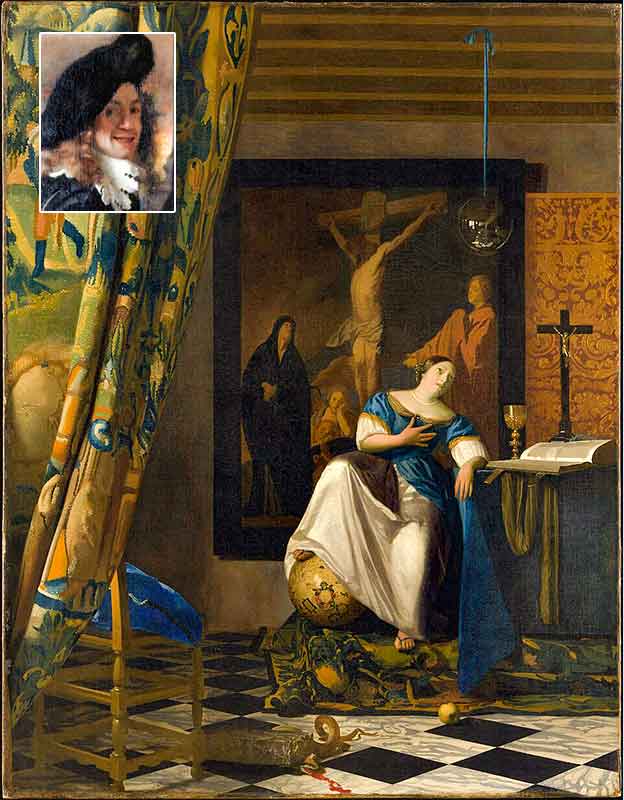
But it is in “The Allegory of Faith” (c.1670–74) where Vermeer makes his one explicit foray into Catholic symbolism: a chalice, a crucifix, a serpent crushed beneath a stone, a curtain pulled back to reveal a heavenly orb. A woman gazes upwards in contemplation, echoing traditional representations of faith.
Some art historians see in this work the influence of Jesuit iconography, but others argue that the painting was made to order, perhaps for a Catholic patron. Either way, it reveals a painter capable of theological depth.
Grace in the ordinary
More broadly, Vermeer’s paintings reflect a worldview in which the sacred suffuses the everyday. His treatment of light — diffuse, luminous, dignifying — suggests a quiet reverence for the ordinary. His women read letters, pour milk, play the harpsichord, sit at open windows that let us feel the air and sounds of a scene four centuries ago. These are not explicitly Catholic scenes, but they reflect the belief that grace operates not only in churches and on feast days but also in kitchens and quiet moments.
Vermeer’s Catholicism did not earn him favour in a society where Protestants dominated civic and commercial life. Indeed, his faith might have limited his market, though the downturn in his fortunes had more to do with the economic crash of the 1670s.
When he died suddenly on December 15, 1675, at the young age of 43, he left Catharina and their surviving children in debt. She attributed his death in part to the financial stress of the time — “Ruined,” she said, “by the burden of his business.”
Today, the 34 known paintings by the financially ruined Vermeer are considered invaluable. One, “A Young Woman Seated at the Virginals”, sold for $29,9 million in London in 2004 (adjusted for inflation, that’s the value of R520 million today). And if “The Girl with a Pearl Earring” was sold today, it would be valued at around $300 million, or R5,2 billion!
Published in the December 2025 issue of The Southern Cross magazine

- Over 50 Young People Evangelise on the Streets of Mbombela - October 7, 2026
- Pope: God Transforms Evil into Redemption - October 6, 2026
- Mass Readings: 11 October – 18 October, 2026 - October 5, 2026