What is it good for? Exposing bad theology.
War is everywhere. And with war comes people talking about war — more specifically, people defending it. The United States launched a war against Iran. The Pope condemned it. The American Vice President, who declined to kiss the papal ring when he met the Holy Father earlier this year, subsequently took to a political stage in Georgia to advise Pope Leo XIV to “be careful” when he discusses theology. He argued that the Pope’s Palm Sunday assertion — that God does not hear the prayers of those who make war — failed to account for the Americans who liberated Nazi concentration camps. “Was God on the side of the Americans who liberated France from the Nazis?” he asked. “I certainly think the answer is yes.”
It is worth sitting with that argument for a moment. A sitting Vice President — one whose country had just launched a war — chose, as his rebuttal to the Pope, an event from 1945. He did not argue that the Iran war meets the criteria for a just war. He cited the Second World War. One notes, gently, that the Second World War did not take place in Iran.
The Holy Father was not pronouncing on 1945. He was applying to the present a tradition that the Vice President does not appear to have read. That tradition has a name. It is called just war theory. And it is considerably more demanding than its modern defenders assume.
Where It Comes From
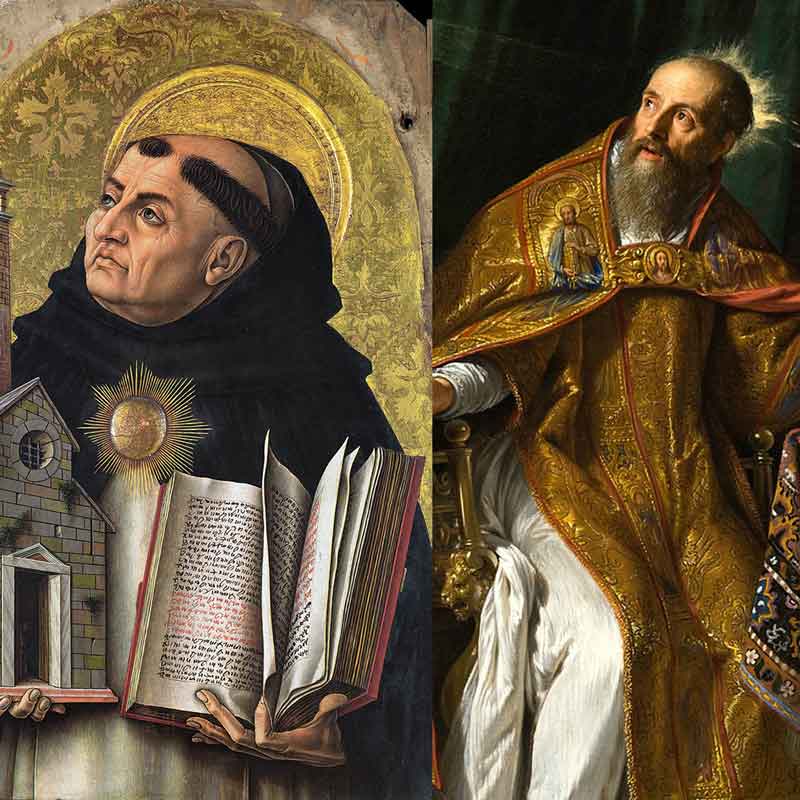
The Catholic moral reasoning on war begins with Augustine of Hippo in the fifth century. Rome had been sacked by the Visigoths in AD 410. The empire was dissolving. A Roman general named Boniface, defending North Africa from Vandal incursion, wrote to his bishop to ask whether a Christian soldier could kill without sin.

Augustine did not give him the pacifist answer. Writing in Letter 189, he told Boniface:
“We do not seek peace in order to be at war, but we go to war that we may have peace. Be peaceful, therefore, in warring, so that you may vanquish those whom you war against, and bring them to the prosperity of peace.”
Peace is the end. War is, at most, the instrument. Any war that inverts that relation has already failed the test.
In Contra Faustum, Augustine further identified the interior dispositions that condemn any war in which they are present: the passion for inflicting harm, the cruel thirst for vengeance, and the lust for power. The test is not external. It is applied to the soul of the sovereign who orders the war, the commander who conducts it, and the soldier who fights it.
The Criteria
Eight centuries later, St Thomas Aquinas gave Augustine’s judgements the architecture they lacked. In Question 40 of the Secunda Secundae of the Summa Theologiae, he established three conditions that must be simultaneously present for a war to be just:
Legitimate authority. The war must be declared by those who bear the care of the common good — not by private interests or executives acting beyond their constitutional mandate.
Just cause. There must be a grave wrong, proportionate to the full cost the war will inflict.
Rightful intention. The war must be fought for the advancement of good and the avoidance of evil — not for revenge, advantage, or the domestic satisfaction of appearing strong.
And then Aquinas adds the sentence that has embarrassed every belligerent since:
“It may happen that the war is declared by the legitimate authority, and for a just cause, and yet be rendered unlawful through a wicked intention.” — Summa Theologiae, IIa–IIae, q. 40, a. 1
The authority can be right. The cause can be right. The war can still be unjust.
The Catechism of the Catholic Church codified these principles in paragraph 2309, adding that all other means must first have been shown impractical; that there must be a serious prospect of success; and that “the use of arms must not produce evils and disorders graver than the evil to be eliminated.” The Catechism calls these “rigorous conditions of moral legitimacy.” Not guidelines. Rigorous conditions. Many believe that none of these were applied to the Iran war before it was launched.
The Theory In Practice
Looking back at the last hundred years, it is difficult to identify a single major conflict that satisfies all the criteria without remainder.
The First World War fails comprehensively: dynastic cause, imperial intentions on every side, seventeen million dead for borders redrawn within a generation. The Second World War is more complex — the Allied response to Nazi aggression satisfies several criteria, though the deliberate targeting of civilians at Dresden and Hiroshima raises proportionality questions that tend not to feature in political speeches. Korea, Vietnam, Iraq, Afghanistan, Libya — each fails on different grounds, and the failures are well documented for those willing to look.
The closest example in recent memory is the Spanish Civil War of 1936, despite the atrocities that followed. The Republican government had aligned itself with Soviet-backed movements, presided over the slaughter of priests, the rape and murder of nuns, and the systematic destruction of churches — all before a single shot was fired in organised response. The Spanish bishops judged that the criteria for just cause and last resort had been met. The tradition does not require us to endorse, or even defend, everything that followed in order to acknowledge that judgment.
The Pope’s Point
Pope Leo XIV, asked about just war by journalists recently, said this:
“Ever since the entrance into the nuclear age, the whole concept of war has to be re-evaluated. And I always believe that it is much better to enter into dialogue than to look for arms and to support the arms industry, which gains billions and billions of dollars each year, instead of sitting down at the table, solving our problems.”
This is not a repudiation of just war doctrine. The Catechism already states that “the power of modern means of destruction weighs very heavily” in the proportionality calculation. The Pope is applying the same tradition Aquinas applied — to the world as it actually is.
The Vice President asked whether God was on the side of the Americans who liberated the Nazi death camps. It is a revealing question — not for what it establishes about the Second World War, but for what it assumes about everything since. The logic appears to be that a nation which once fought a just war has accumulated permanent moral credit, redeemable at will. The tradition does not work that way. The liberation of Dachau does not consecrate Iraq. It does not consecrate Afghanistan. It does not consecrate Iran. Each war is tried again, from the beginning, against the same criteria.
The tradition was invented to discipline Christian kings. It was wielded by Dominican theologians against the Spanish Crown — then the greatest military power on earth — in the sixteenth century. It is now being applied by the Holy Father to the wars of his own fellow-countrymen. The reply that he should mind his own business mistakes his business entirely. His business is precisely this.

- Why I Chose Catholicism: 7 Reasons - October 7, 2026
- Why I Am Not an Atheist: The Three M’s - September 28, 2026
- “Help, the Pope said something I disagree with” - July 20, 2026