The Catholic Church in Botswana is entering a historic and grace-filled moment as Bishop-Elect Monsignor Lawrence Ofentse Pheto prepares for his episcopal ordination on 27 June 2026 as the new Bishop of Francistown.
His appointment has been welcomed with joy not only in Botswana but also across the Southern African Catholic community, where many see in him a humble servant, a compassionate pastor and a leader deeply rooted in prayer and pastoral care.
During a deeply personal one-on-one interview, the bishop-elect reflected on his vocation journey, his years in seminary formation, the challenges facing modern families and the enormous responsibility of leading a diocese.
From altar server to bishop
Like many priests whose vocations begin in the ordinary rhythms of parish life, Monsignor Pheto’s journey to the priesthood started as a young altar server. Serving at Mass planted a seed within him, a quiet desire that would continue to grow over time.

Reflecting on those early years, he described vocation as something deeply mysterious and personal. According to him, the priesthood is not always accompanied by dramatic signs or sudden revelations. Instead, he says, it is often experienced as a gentle but persistent invitation from God.
“Though one may look at priesthood from afar and see it as a challenging vocation, there is something inside the heart that keeps drawing you towards it,” he explained.
He acknowledged that fear, doubt and feelings of inadequacy are common among those discerning a vocation. Yet, despite those fears, God continues to call.
“Sometimes you even try to resist it,” he said with a smile, “but God continues to place people and experiences in your life that guide you towards the vocation.”
For Bishop-Elect Pheto, the role of the Church community is essential in nurturing vocations. Families, parish priests, catechists, religious sisters, youth leaders and even fellow young people all play a role in helping someone discern God’s call.
“Sometimes even people who are not related to you will say, ‘We feel you can try this path.’ God uses others to help confirm the vocation,” he reflected.
To the youth, he said, “If God has chosen you among others, then you must realise it is not about you, but about Him who created you and calls you,” he said.
Seminary formation: Building spiritual fathers
Ordained to the priesthood on 8 October 2005, Bishop-Elect Pheto has now served the Church for two decades. Over the years, he has ministered in several parishes, worked in seminary formation and accompanied countless faithful in their spiritual journeys.
Looking back on his seminary years, he spoke warmly about the importance of formation in shaping future priests and leaders.
“The seminary is truly a seedbed for leadership,” he explained. “It builds the spiritual, human and pastoral dimensions of a person.”
He emphasised that priestly formation goes far beyond academic studies. It is about helping a person become emotionally mature, spiritually grounded and pastorally available to God’s people.
“The Church knows it is preparing someone who will eventually guide and accompany people from all walks of life,” he said.
At the same time, he noted that many of the values strengthened in seminary are first learned at home. Families and communities often shape the character and faith foundations of future priests long before they enter formal formation.
“The family contributes a great deal to the kind of person one becomes,” he explained. “Sometimes people around you already notice certain qualities and say you are somehow different.”
Throughout his priesthood, one principle has remained central to his ministry: presence.
“My understanding of priesthood has always been about being there for God’s people,” he said. “People must feel that they have a shepherd among them who accompanies them and helps them experience the love of Christ.”
Ministering to wounded families
One of the most impactful aspects of Bishop-Elect Pheto’s ministry has been his work within the Church’s marriage tribunal. Having obtained a licentiate in canon law, he has spent years accompanying couples and families facing some of life’s most painful realities, including broken marriages, separation and emotional wounds.
His tribunal ministry exposed him to the growing crisis affecting marriage and family life today.
“Marriage is under attack,” he said frankly. “Many people now feel that marriage no longer works or has lost its value.”
For him, this crisis goes beyond individual relationships. It touches the very heart of society and the future of the Church.
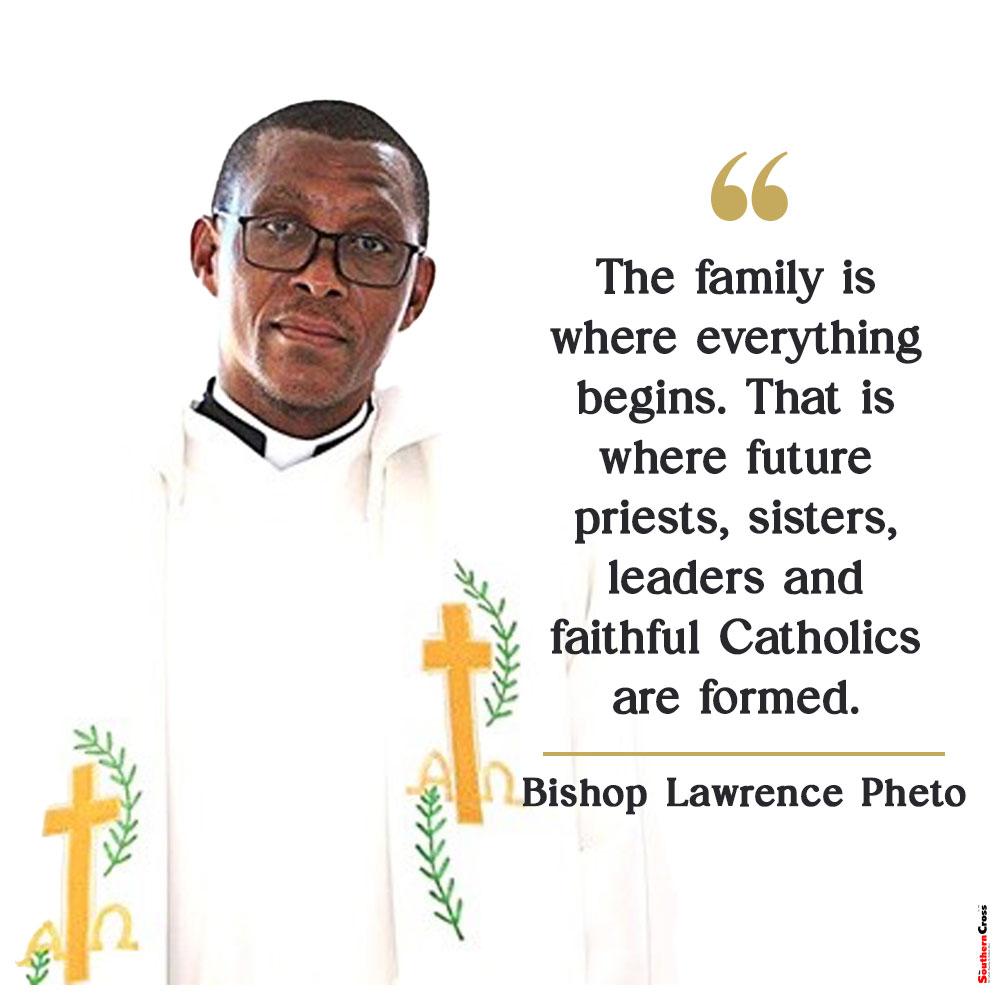
“The family is where everything begins,” he explained. “That is where future priests, sisters, leaders and faithful Catholics are formed.”
Drawing inspiration from the Holy Family, he reflected on the challenges faced by Mary and Joseph: poverty, uncertainty, displacement and hardship, yet their family remained rooted in faith, commitment and love.
“The Holy Family was not free from suffering,” he said. “Joseph and Mary embraced their responsibilities with courage and faithfulness.”
From his experience in tribunal work, Bishop-Elect Pheto believes the Church must invest more deeply in preparing couples for marriage long before wedding day preparations begin.
“We need proper formation from childhood, youth ministry, marriage preparation and even after couples are married,” he explained.
He also spoke passionately about the pain experienced by children growing up in broken homes.
“When parents are constantly fighting or separated, children carry those wounds with them. They become victims of circumstances they did not create,” he said.
The call he never expected
Despite his years of experience, Bishop-Elect Pheto admitted that he never imagined himself becoming a bishop.
“When the nuncio called me, I was actually busy with a tribunal interview,” he recalled. “When he told me that the Holy Father had appointed me Bishop of Francistown, I was shocked.”
“I immediately felt fear and inadequacy,” he admitted. “I kept asking myself, ‘Why me? Could there not be somebody else?’”
He revealed that his first instinct was to decline the appointment. The enormous responsibility of episcopal leadership weighed heavily on his heart.
“Being a bishop is not easy,” he said. “You carry the struggles of many people. Humanly speaking, one cannot do it alone.”
Yet through prayer and reflection, he gradually recognised that God’s call often leads people beyond their comfort zones.
“The more I prayed, the more I realised that if God calls you, He also gives you the grace and strength to serve,” he said.
His acceptance of the appointment became, for him, an act of surrender and trust.
“It is about service, sacrifice and carrying the cross,” he reflected. “If God increases the cross, He also increases His presence.”
A vision for Francistown
As he prepares to take leadership of the Diocese of Francistown, Bishop-Elect Pheto speaks with hope and optimism about the future. He praised the foundations laid by his predecessors and described Francistown as a lively and promising local Church.
“I see a Church that has the potential to grow even more,” he said.
His vision is centred on evangelisation, unity and collaboration among clergy, religious and lay faithful.
“There are places where the Catholic Church is still absent and where people have not yet heard the Gospel,” he explained. “We must continue reaching out.”
He also expressed a desire to reconnect with Catholics who may have drifted away from the Church.
“There are many who are longing for hope, healing and belonging,” he said.
Most importantly, he believes the mission of the Church can only succeed through teamwork and shared responsibility.
“I trust in the support of the priests, religious and laity of Francistown,” he said. “Together we can continue building the Kingdom of God.”
A shepherd for the people
As Botswana prepares for the episcopal ordination of Bishop-Elect Lawrence Ofentse Pheto on 27 June 2026, many of the faithful see in him a shepherd formed by humility, prayer, compassion and service.
His story from altar server to priest, canon lawyer, tribunal minister and now bishop reflects the quiet yet powerful ways God continues to call ordinary people into extraordinary missions.

- SECAM Seeks African Participation in World Youth Day 2027 - September 24, 2026
- ‘Carlo is an instrument of God’: His mother reflects on the first year of her son’s sainthood - September 11, 2026
- Durban youth urged to keep their lamps burning for Christ - August 31, 2026