Jason Scott’s weekly review of Pope Leo XIV’s audiences –
Sunday, 17 May: Ascension Sunday — A Living Bond With Heaven
On the Solemnity of the Ascension of the Lord — celebrated this year on the Sunday — Pope Leo XIV reflected on what the Ascension actually means for Christian life. It is not, he said, a farewell. Christ’s entire life, he noted, is “a movement of ascent”, from his Incarnation through his Passion and Resurrection. His humanity now embraces and involves the whole world, elevating and redeeming it. The Ascension does not speak of a distant promise but of a living bond.
He reminded the faithful that this path of ascent is not walked alone. Christ is the way; and the way is also marked out by the Blessed Virgin Mary and the saints — including, he added, those “saints next door” of whom Pope Francis spoke in Gaudete et Exsultate: ordinary fathers, mothers, grandparents and neighbours who live sincerely according to the Gospel.
“The Ascension does not speak to us of a distant promise, but of a living bond, which draws us also toward heavenly glory, already elevating and expanding our horizon in this life and directing our way of thinking, feeling and acting more closely to the measure of God’s heart.”

The Pope also marked the beginning of Laudato Si’ Week, running until the following Sunday, dedicated to care for creation. In the Jubilee Year of Saint Francis of Assisi, he called for renewed attention to our responsibility for the common home. After the prayer, he appealed for peace in ongoing conflicts, with particular concern for the civilian populations of Gaza and Sudan.
Sunday, 17 May: 60th World Day of Social Communications — Preserving Human Voices and Faces
This year’s World Day of Social Communications — the 60th — fell on the same Sunday as the Ascension, and Pope Leo XIV used the occasion to deliver one of his most substantive statements yet on artificial intelligence and human dignity. The theme he chose, “Preserving Human Voices and Faces”, is rooted in a theological claim: our faces and voices are not incidental features of human beings, but sacred ones. They are the imprint of God’s love, given to us when the Creator called us into existence through the Word.
He drew particular attention to the dangers of deepfakes, content manipulation, and the artificial simulation of human voices and faces, warning that when machines begin to imitate the very things that make us human, the threat is not merely technological but anthropological. The challenge, he stressed, is not to halt digital innovation but to guide it.
“God, who created us in his image and likeness, gave them to us when he called us to life through the Word he addressed to us… Preserving human faces and voices, therefore, means preserving this mark, this indelible reflection of God’s love.”
Leo XIV called for the introduction of media literacy, information literacy, and AI literacy into education systems at every level, including for elderly and marginalised communities. He also warned against “oligopolistic control of algorithmic and AI systems” capable of subtly orienting human behaviour — and even, he noted, rewriting the history of the Church.
Monday, 18 May: Encyclical Announced — Magnifica Humanitas
The Vatican announced on Monday that Pope Leo XIV’s first encyclical, Magnifica Humanitas (“Magnificent Humanity”), will be published on 25 May 2026. The document, which addresses artificial intelligence and the protection of human dignity, was signed by the Pope on 15 May — the 135th anniversary of Rerum Novarum, Pope Leo XIII’s foundational 1891 social encyclical on labour and capital written during the first Industrial Revolution. The date was not accidental: Leo XIV has consistently framed the challenge of AI as a “second industrial revolution” requiring the same moral clarity the Church brought to the first.
A presentation event, at which the Pope himself will speak alongside various experts and commentators, is scheduled for the same day at the Vatican. The encyclical is the most anticipated papal document in several years, given the scope of the AI question and the clarity with which Leo has signalled his intentions since his election.
Wednesday, 20 May: General Audience — The Liturgy in the Mystery of the Church
Having concluded his catechesis series on Lumen Gentium the previous week, Pope Leo XIV opened a new series at Wednesday’s General Audience: a treatment of the documents of the Second Vatican Council, beginning with Sacrosanctum Concilium, the Constitution on the Sacred Liturgy. He described the liturgy as the very heart of the Church’s life — not merely a rite to be performed, but “the space, the time and the context in which the Church receives her very life from Christ.”
The Council Fathers, he explained, did not seek merely to reform the rites. They sought to lead the entire Church to contemplate the living bond that constitutes and unites her: the mystery of Christ. The liturgy accomplishes the work of redemption, making the Church a chosen lineage and a royal priesthood. Crucially, it does not close the community in on itself.
“The liturgy daily builds up those who are within into a holy temple of the Lord… it is inhabited by the Holy Spirit, it introduces us into the life of Christ, it makes us His Body and, in all its dimensions, it represents a sign of the unity of the entire human race in Christ.”
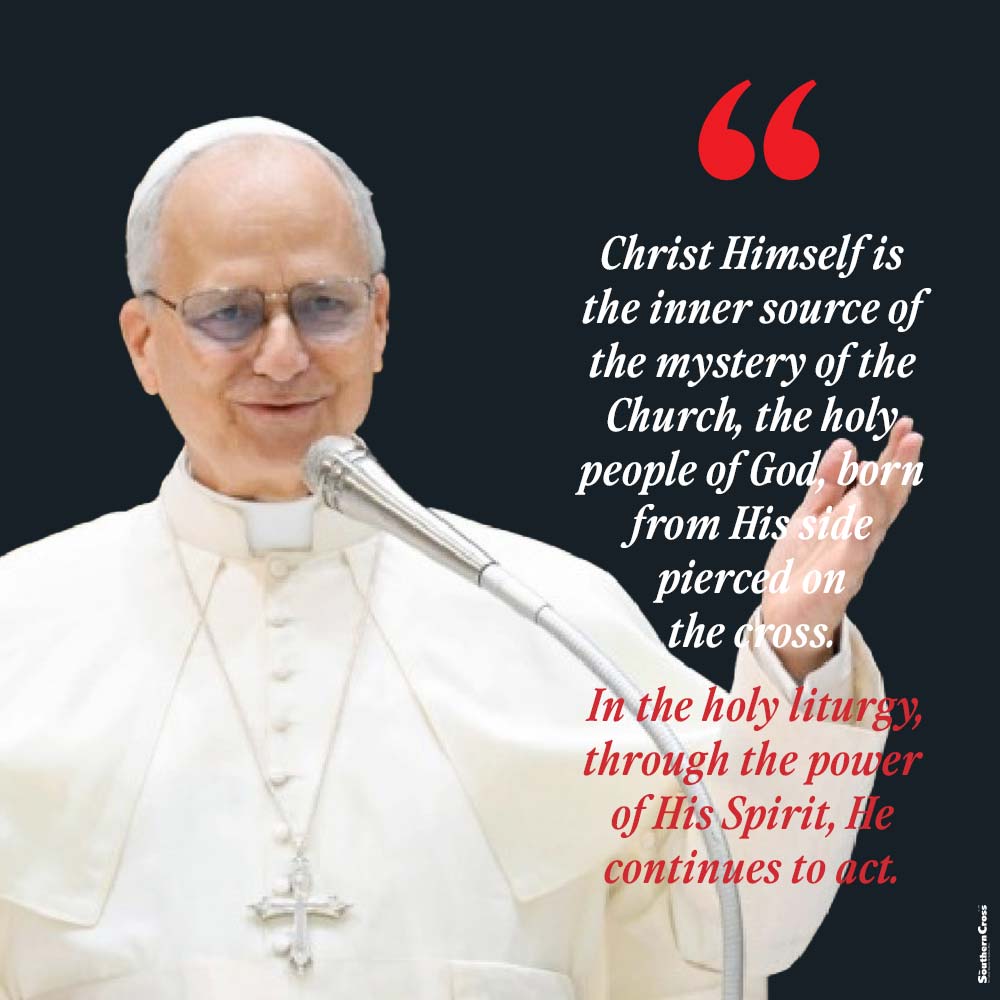
“Christ Himself is the inner source of the mystery of the Church, the holy people of God, born from His side pierced on the cross. In the holy liturgy, through the power of His Spirit, He continues to act.”
The audience was given added significance by the presence of His Holiness Aram I, Catholicos of Cilicia of the Armenian Apostolic Church, whom Pope Leo welcomed to St Peter’s Square with particular warmth. He called the visit an important opportunity to strengthen the bonds of unity already existing between their Churches, and invoked the Holy Spirit upon the delegation in the days of preparation for Pentecost.
Take-Away Points
- “A movement of ascent” — Christ’s Ascension is not a departure but a living bond drawing all humanity toward heavenly glory.
- “Preserving human voices and faces” — our faces and voices are sacred, bearing the indelible reflection of God’s love; AI that simulates them raises not merely technological but anthropological concerns.
- The challenge is not to halt digital innovation but to guide it — Leo XIV calls for AI and media literacy at every level of society.
- Magnifica Humanitas drops on 25 May — signed on the 135th anniversary of Rerum Novarum, framing AI as the second industrial revolution the Church must now address.
- The liturgy is “the space, the time and the context” in which the Church receives her life from Christ — Leo begins a new catechesis series on Sacrosanctum Concilium.
- The Armenian Apostolic Church — the Pope’s welcome of Catholicos Aram I signals continued momentum toward full communion between the Churches.
Sources
2026-05-17 – https://www.vatican.va/content/leo-xiv/en/angelus/2026/documents/20260517-regina-caeli.html
2026-01-24 – https://www.vatican.va/content/leo-xiv/en/messages/communications/documents/20260124-messaggio-comunicazioni-sociali.html
2026-05-18 – https://catholicreview.org/pope-leo-xiv-to-publish-encyclical-on-artificial-intelligence-may-25/
2026-05-20 – https://www.vatican.va/content/leo-xiv/en/audiences/2026/documents/20260520-udienza-generale.html

- Why I Chose Catholicism: 7 Reasons - October 7, 2026
- Why I Am Not an Atheist: The Three M’s - September 28, 2026
- “Help, the Pope said something I disagree with” - July 20, 2026