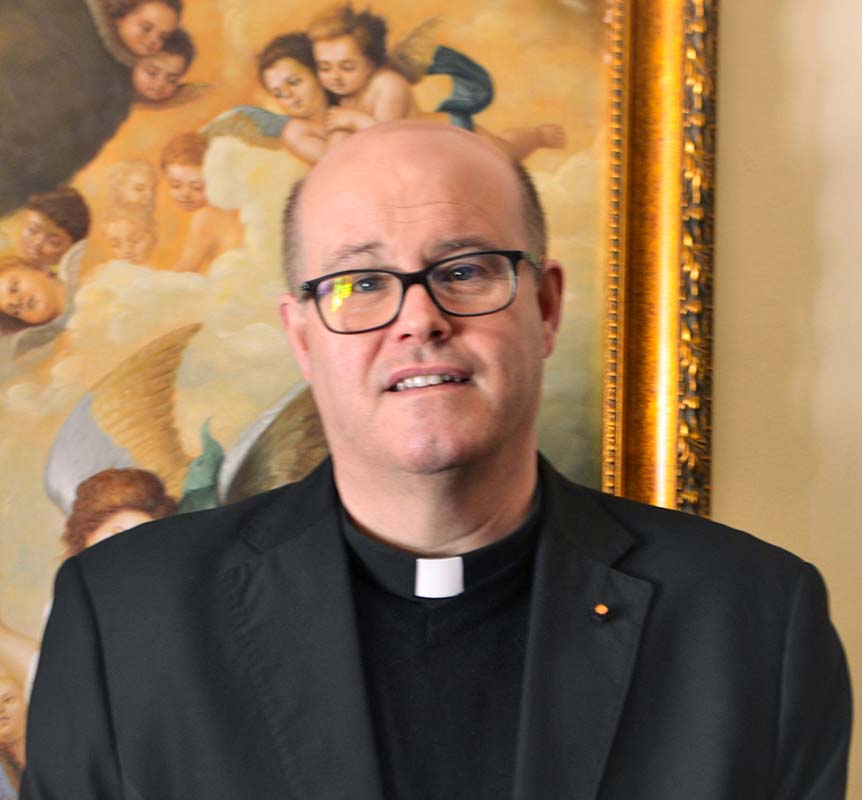
Most Catholics have heard of annulments. Fewer understand them. Fr Robert Bissell, a Doctor of Canon Law, is the Judicial Vicar of the Cape Town Interdiocesan Tribunal and the man most likely to be sitting across from you if your marriage has ended and you want to know what the Church can do about it.
He spoke to The Southern Cross about a process that is widely misunderstood and nothing like what most people assume.
Question: People come to you when their marriages have broken apart. Before we get into the process — what is an annulment, and is that even the right word?
Answer: The correct word is certainly an annulment — you apply for an annulment — but it is worth understanding the concept first. Marriage is a sacrament within the Church, and because it is a sacrament, the law first defines what marriage is: a covenant of life and love between one man and one woman for the whole of life, for the good of the spouses and the procreation and education of children. That is a developed understanding that comes out of the Second Vatican Council.

Every marriage is presumed to be valid — whether the parties are Catholic or not. We believe that understanding is informed by divine law, and because God is the creator of all things, all marriages are at least on some level informed by divine law. So every marriage is presumed valid unless the contrary is proven.
An annulment is the process of proving the contrary — of proving that the marriage was invalid. It is a legal process, and at the end of it a declaration is made as to whether or not that marriage existed from the beginning.
This is where the difference between a divorce and an annulment matters. A divorce recognises that a marriage has broken down and the two parties legally separate themselves from each other. An annulment declares that on the day of marriage, one or both parties could not or did not consent to the Catholic understanding of marriage — so the marriage never actually took place. That is why it is an annulment.
How does the process actually work? If someone walks into your office, can you take me through it?
People generally apply through their parish priest, though some come straight to the tribunal, and some even apply through the webpage. Once we receive an application, the tribunal secretary makes contact and explains which documents are needed — the divorce decree, the marriage certificate, the prenuptial enquiry form from the parish where they married, a baptism certificate, and so on.
Then a preliminary interview is set up with one of the canon lawyers. At that interview we explain what an annulment actually is, precisely to avoid the confusion with divorce. A number of people have sat in this office and asked me for their ‘Catholic divorce.’ There is no such thing. We then show them the more common grounds and talk them through them, so they can see how the law might apply to their own situation, and they briefly tell us their story — how they met, what the courtship was like, when the problems became visible.
The person who comes to us is the petitioner; their ex-spouse is the respondent. The petitioner completes what we call the libellus — the petition — along with a fact sheet and what we call the short story: seventeen open-ended questions, usually five or six pages. Having been a judge many times, I find the short story very useful — it tends to reveal things we can pick up on later. We also ask them to nominate witnesses, up to three or four — people who knew them before, at the time of, and after the marriage. Their purpose is to corroborate the petitioner’s account.
Only once the petitioner returns all the completed documents does the notary formally open the case. Interestingly, only a percentage of preliminary interviews become opened cases. When people hear what an annulment actually is, or how much of a process it involves, some realise they don’t have grounds, and some decide not to proceed. It is not a matter of coming in at nine and leaving with a certificate at ten. It takes months.
And the cost?
We cost an annulment at a nominal 8,500 rand — honestly an understatement of the hours and staffing involved — but we only ask the petitioner to pay 3,500. The petitioner’s diocese pays the other 5,000. We are also open to reducing that in cases of limited income. We don’t like to make it entirely free — we believe someone should offer something — but a lack of finance must never be the reason someone cannot apply. The fee will always be waived if it needs to be. It is not about the money.
You mentioned there are two kinds of process.
Yes. There is the ordinary contentious process, which is the normal process the Church has always had. In 2015 Pope Francis issued Mitis Iudex, which introduced changes. He reduced the requirement from two conforming tribunal decisions to one, and he introduced what is called the briefer process — the processus brevior.
The briefer process is widely misunderstood. It can only be used when both the petitioner and the respondent are involved and fundamentally agree on the facts of the case. If the respondent is not involved, or vehemently disagrees, you cannot use it. That is the biggest misconception: you have to have both parties involved.
In a briefer process, the case file is compiled and presented to the diocesan bishop, who alone is the judge — it has to be the diocesan bishop himself, not an auxiliary or an administrator, because it draws on his episcopal authority. That is why, for the last year and a half, Cape Town could not conduct briefer processes: we had no diocesan bishop. Now that Archbishop Sipuka is installed, we can again.
Tell me about how the tribunal is structured.
There are five interdiocesan tribunals in this country, one for each metropolitan see. Our Cape Town Interdiocesan Tribunal looks after Cape Town and its suffragan dioceses, and because the Namibian bishops have no tribunal of their own, we also cover the whole of Namibia.
In Cape Town, we always sit as a collegial court — three judges: a presiding judge and two associates, one of whom is the ponens, the one who writes the decision. Every case also has a defender of the bond, whose role is to argue in favour of the validity of the marriage. He can never argue that the marriage is invalid. The three judges reach a decision, and the ponens writes the definitive sentence.
Is there a right of appeal?
Yes. Each party, including the defender of the bond, has the right to appeal. Once the time for appeal has lapsed, the decree of nullity is issued, and the party is free to remarry in the Catholic Church. We notify their place of baptism, with the protocol number, so it can be noted on the baptism record that they are free to marry.
When a decision is made, it is determined who could not or did not consent — you don’t simply say the marriage is null; you say the petitioner or the respondent lacked discretion of judgement, or could not assume the obligations of marriage, or simulated, or acted under duress. Even the innocent party is free to remarry, because a marriage needs both parties to consent. But the party on whose part the annulment was granted may receive a further restriction — a monitum, requiring careful instruction before they marry again, or the more serious vetitum, which can only be lifted by the diocesan bishop.
What is the most common reason a marriage is declared null?
Probably the most commonly applied ground is a lack of discretion of judgement — canon 1095. It has three parts, and only one needs to apply. The first is immaturity: that one or both parties was simply too immature to understand, let alone accept, the obligations of marriage. Age can be indicative but is not proof — older people can be immature too.
The second concerns the ends of marriage. Marriage has to be an end in itself — you intend to marry that person, on that day, to be married. Sometimes people use marriage as a means to an end: a pregnancy and the social pressure to marry before the child is born; a way out of an abusive or impoverished situation; or marrying a wealthy person for the security it brings. In Latin, it is a finis operantis rather than a finis operis — the purpose must be the covenant of life and love itself, not an escape or an advantage.
The third is more complex and concerns the cognitive and critical faculties. Your cognitive faculty is your thinking; your critical faculty is where you give your consent, your will to marry. What sometimes happens is that an intelligent person sees the red flags — the witnesses often saw them too, and even pointed them out — but suppresses their thinking so it doesn’t influence their decision. ‘I thought they would change.’ They don’t allow the cognitive faculty to inform the critical faculty. That is probably the most common ground.
What do you wish more Catholics understood about your work?
That it is a service to the Church, and a legal process, and that we really are here to help. People often arrive with anger, frustration and hurt, and we understand that — but they do have to comply with the legal requirements.
As Pope Leo said to the Roman Rota at the beginning of this year, there must always be charity, but there must also be justice — and justice requires truth. That is what we try to establish: what was the truth of the situation? We don’t declare a marriage null simply because we have the faculty to. It is a declaration that a sacrament did not happen, so we have to take it seriously, be prayerful and honest — always in charity, because these are very often vulnerable and hurt people — but always seeking truth and justice.
Have you seen more requests in recent years?
Yes — markedly since COVID. We’ve come close to doubling our cases, including some quite historical ones, marriages that ended back in the 1970s and 80s. It puts the tribunal under real pressure, because the limiting factor is staffing — the number of hours and trained people we have.
It is difficult for a layperson in South Africa to obtain a canon-law degree. In Italy you can study it at several universities; in the whole of Africa there is essentially one place, in Kenya. There is the cost of the degree, and then the reality that civil legal professionals are paid far more than a tribunal can offer. For this tribunal we currently have only two trained canon lawyers, with a third we hope returning next year.
And the children of a marriage that is later declared null — are they affected?
The Church is very emphatic that the children are never illegitimate. Because it is presumed that at least one party acted in good faith, the children are never illegitimate, and Church law declares that clearly. It is a fairly common misconception among people coming to the Church that the children somehow become illegitimate. It is simply not true.

- Why I Am Not an Atheist: The Three M’s - September 28, 2026
- “Help, the Pope said something I disagree with” - July 20, 2026
- Mayor Geordin Hill-Lewis: Faith, the Archdiocese, and the City - July 10, 2026