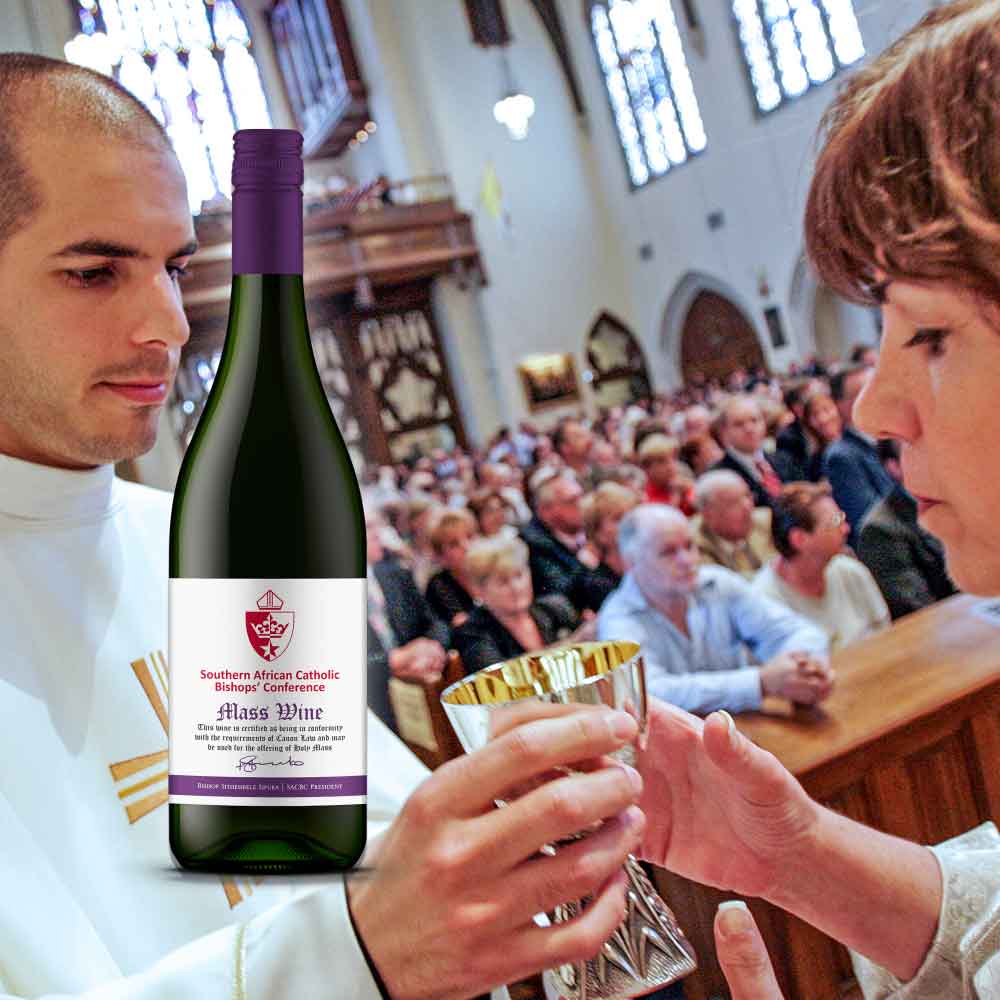
At first glance, it may seem to be a technicality. After all, wine is wine — and surely the Eucharist does not hinge on the label on a bottle. Yet the Catholic Church has always been strict on what wine may be used in the Mass.
Christ took bread made from wheat and wine made from grapes, blessed them, and commanded his disciples: “Do this in memory of me.” In Catholic theology, the sacraments work through real, created things.
The wine used at Mass must therefore be real grape wine, natural and unadulterated, and not just any wine bought in a bottle store. Canon Law states that Eucharistic wine must be “natural, made from grapes of the vine, and not corrupted” (924 §3). The General Instruction of the Roman Missal (322) and the 2004 instruction Redemptionis Sacramentum (50) reinforce the same requirement.
This generally rules out fortified wines such as sherry or port, which have added alcohol. It also excludes wines with additives, flavouring agents, preservatives beyond what is naturally necessary, or processes that alter the wine’s essential nature.

Many commercially available wines cannot be verified as canonically compliant as modern winemaking often involves additives, stabilisers or processing techniques.
Labels don’t always tell the full story, which is why parishes are best advised to use certified Mass wine, as many are already doing.
To this end, five years ago, the Southern African Catholic Bishops’ Conference introduced the SACBC Mass Wine. The locally produced, canonically certified Mass wine is made specifically for the Church and supplied under episcopal authority, and produced under the label of the SACBC. The wine received the official endorsement of Archbishop Sithembele Sipuka, at the time president of the bishops’ conference.
According to Archbishop Mandla Siegfried Jwara of Durban, “the SACBC Mass Wine is certified and conforms to the requirements of Canon Law and is approved for the offering of Holy Mass. This decision was made to ensure that canonically compliant Mass wine is used at all Eucharistic celebrations in the SACBC region.”
At their January plenary session this year, the bishops of the region resolved that only SACBC-approved Mass wine should be used in Eucharistic celebrations, rather than any other brand.
Rob Paul, who manages the production of the SACBC Mass wine through the Catholic Vine, said that the project’s purpose is as much educational as it is practical. “Our goal is not merely to promote a product, but also to drive awareness, education and liturgical integrity in line with the guidance of the bishops of the region.”
Cheaper is not better
Cost is often cited as a reason for not using the SACBC wine. But the price difference is far smaller than many assume. The SACBC Mass wine costs only R62 per 750ml when ordered in the three-litre box. It is “not for resale” and produced exclusively for Eucharistic celebration.
The SACBC Mass wine, a muscadel, is produced by the largest Fairtrade-accredited winery in South Africa.
The wine is:
– Made exclusively from grapes of the vine;
– Natural and unadulterated;
– Canonically certified and fully compliant with Church law;
– Fairtrade and organically certified;
– Produced sustainably, with attention to soil health, biodiversity and water management;
– Export-quality premium wine;
– Produced specifically for the Catholic Church and distributed directly to parishes.
“We are very proud of the SACBC Mass wine,” said Paul. “It is produced to the highest standard and fully compliant with Canon Law.”
Ordering SACBC-approved Mass wine is straightforward. Orders are placed via an online portal, accessible on smartphones or desktop computers. Payment can be made securely by card or EFT, and a support line assists parishes at every step.
The ordering portal is at www.sacbcwine.org.za

- Walking in the footsteps of Blessed Joseph Gérard: Missionary Associates renew their missionary call - October 15, 2026
- Congratulations to Navi Pillay on Peace Prize - October 14, 2026
- 170 Years of Serving the Poor in South Africa! - October 14, 2026