The CRL Rights Commission wants to regulate the country’s churches. The Catholic Church has a better answer — and has had it for eight centuries.
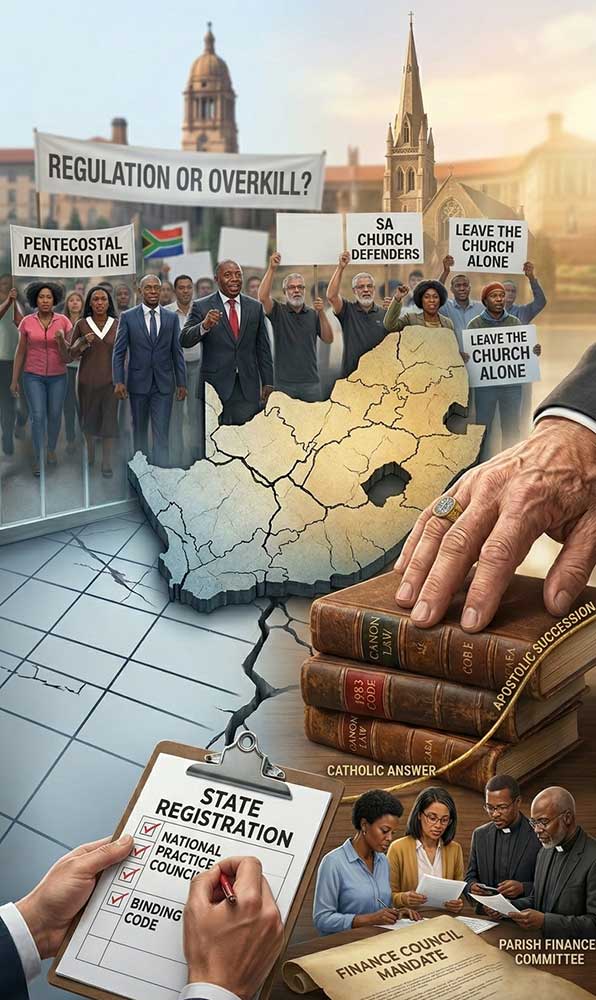
The Commission for the Promotion and Protection of the Rights of Cultural, Religious and Linguistic Communities — the CRL Rights Commission — wants to regulate South Africa’s churches. Its Draft Self-Regulatory Framework proposes mandatory registration of all religious leaders and institutions, a state-supervised National Practice Council, and a binding Code of Conduct enforceable by deregistration. Its chairperson, Thoko Mkhwanazi-Xaluva, has said publicly that an Act of Parliament must determine where religious freedom ‘starts and ends.’ Whether the Commission has the constitutional mandate to do any of this is now before the Gauteng High Court.
The Commission’s concern has a legitimate origin. South Africa has a documented problem with unaccountable religious leaders: pastors who have compelled congregants to eat grass, drink petrol, and hand over their wages to men presenting themselves as instruments of divine will. These are not isolated eccentrics. They lead large, active congregations, and when they abuse their position, there is no internal mechanism to remove them, no body to hear complaints, and no structure through which affected members can seek redress. The CRL has taken this as its mandate. In response to this pattern of abuse, it has proposed the Framework described above, reasoning, not unreasonably, that if churches will not govern themselves, the state must govern them.
The reaction has been considerable. Tens of thousands of South African Christians — charismatics, Pentecostals, independents and evangelicals — have marched in Durban, Pretoria, and Cape Town under the banner of the SA Church Defenders Group. The Commission’s own first Committee chair resigned, alleging a predetermined agenda to control religious activity. Cardinal Stephen Brislin, president of the Southern African Catholic Bishops’ Conference, put it plainly: “The recommendation that new laws be introduced to enforce registration of pastors and ministers is overkill and a response one would expect more from a totalitarian state than a constitutional democracy.” Freedom of Religion South Africa, representing some six million believers, argues that existing laws already cover every category of harm the CRL cites, and that enforcement — not new legislation — is what is lacking.

Both are right. Neither has asked the more interesting question: why do these particular churches have no internal accountability in the first place?
The Theological Problem
The independent charismatic or Pentecostal congregation is, by design, a flat institution. There is no bishop above the pastor, no canon law governing his conduct, no finance committee with standing to question his administration of parish funds, no tribunal to which an aggrieved congregant can appeal. The congregation may own its building. The pastor, in practice, owns the congregation. When he goes wrong, there is nothing inside the system to stop him. The system was built, theologically, to have no such mechanism — because any authority above the individual pastor was understood as a human imposition on the movement of the Spirit.
This is a relatively recent innovation. It is the cumulative result of five centuries of ecclesiological fragmentation. Every rupture from Rome, every rejection of episcopal authority, every new denomination founded on the conviction that the previous one had accumulated too much institutional weight, produced communities slightly more exposed to this particular failure. At the end of that trajectory, you get a pastor with fifty thousand followers, unlimited access to their finances, and no one in a position to call him to account. The CRL is not wrong to find this alarming. It is wrong about the remedy.
Imposing accountability structures from outside, by statute, substitutes the government bureaucrat for the bishop and the statutory council for canon law. It mimics the form of what is required while misunderstanding the substance entirely. The bishop’s authority is not merely administrative. It is sacramental, derived from apostolic succession, and does not depend on an Act of Parliament to function. A state-appointed council can register a pastor and levy a fine. It cannot do what a bishop does.
What Canon Law Requires
Canon 492 of the Code of Canon Law mandates that every diocese establish a Finance Council: lay members expert in financial affairs and civil law, appointed by the bishop, required by law to prepare annual budgets and review annual accounts for the entire governance of the diocese. Canon 537 mandates a Finance Council in every parish, governing the administration of parish goods under the authority of the diocesan bishop. For transactions above a certain value, the pastor or priest requires the bishop’s consent. For extraordinary administration, the bishop requires the consent of both the Finance Council and the College of Consultors. For the largest transactions, the Holy See must give permission.
These are not aspirational guidelines. They are binding law, enforceable within the Church’s own juridical system, with a tribunal structure for disputes and an appeals process extending to Rome. There is no level of Catholic financial life at which a single person operates without oversight. The chain runs from the parish finance committee through the pastor, the bishop, the College of Consultors, and the Holy See — continuous, mandatory, and not of recent invention. It has been developing since the early Church councils, codified in the 1917 Code, and refined in its present form in 1983. For readers wanting to learn more about the topic, I’d highly recommend Dr Perrier’s recent article “Church Rights and Obligations,” which covers Canon 537 and the practical duties it places on Catholic communities. What his analysis opens up, though he does not pursue it in that direction, is a wider point: the accountability structure the CRL is trying to construct by statute, for communities that have nothing of the kind, already exists in the Catholic Church. It has existed in recognisable form for the better part of a millennium. When Mkhwanazi-Xaluva compares her proposed Council to the governing bodies of the legal and medical professions, she is describing — without the vocabulary to say so — something the Church built in the thirteenth century.
Two Sides of the Same Problem
There is something instructive about the shape of this controversy. The CRL Rights Commission is led by and largely composed of figures from the same charismatic and Pentecostal tradition as the protest movement it has enraged. Neither the Commission nor the SA Church Defenders Group has access to the institutional vocabulary of the Catholic tradition, because neither has the Catholic tradition. They are arguing, with genuine passion, about how to solve a problem using only the tools that produced it.
The state reaches for external authority because it does not understand internal authority. The protesters reject external authority because they do not have internal authority. Both positions follow naturally from a theology that abandoned the episcopate five centuries ago and has been managing the consequences ever since. The Catholic Church is not the primary target of the CRL’s framework, because it already has what that framework is trying to mandate. The placard that reads “Leave the Church alone” carries considerably more weight coming from a bishop who stands before a Finance Council, a College of Consultors, and eight centuries of binding juridical tradition.
That is not a comfortable thing to say in an ecumenical climate. It is true nonetheless.
United and Sent
Archbishop Sithembele Sipuka, installed as Archbishop of Cape Town in March 2026, chairs the SACBC Finance Committee, serves as President of the South African Council of Churches — the first Catholic bishop to lead that ecumenical body in Southern Africa — and sits on Pope Leo XIV’s Dicastery for Interreligious Dialogue. His episcopal motto is three words: United and Sent.
The CRL controversy is precisely the kind of moment those words were made for. The Catholic contribution to this debate is not simply to defend its own institutional interests, though those are worth defending. It is to offer what it actually has: a model of ecclesial governance, developed over centuries, tested under pressure, that protects the faithful from corrupt or deluded leaders without appealing to the state. The Church solved this problem with the bishop. The bishop answers to canon law. Canon law is older than the South African Constitution by approximately sixteen hundred years.
The protesters are right that the state should keep its hands off the Church. The question they have not yet answered — and that the Catholic tradition has been answering since the Council of Nicaea — is what the Church puts in the state’s place.
It is the bishop. It has always been the bishop.

- Why I Chose Catholicism: 7 Reasons - October 7, 2026
- Why I Am Not an Atheist: The Three M’s - September 28, 2026
- “Help, the Pope said something I disagree with” - July 20, 2026