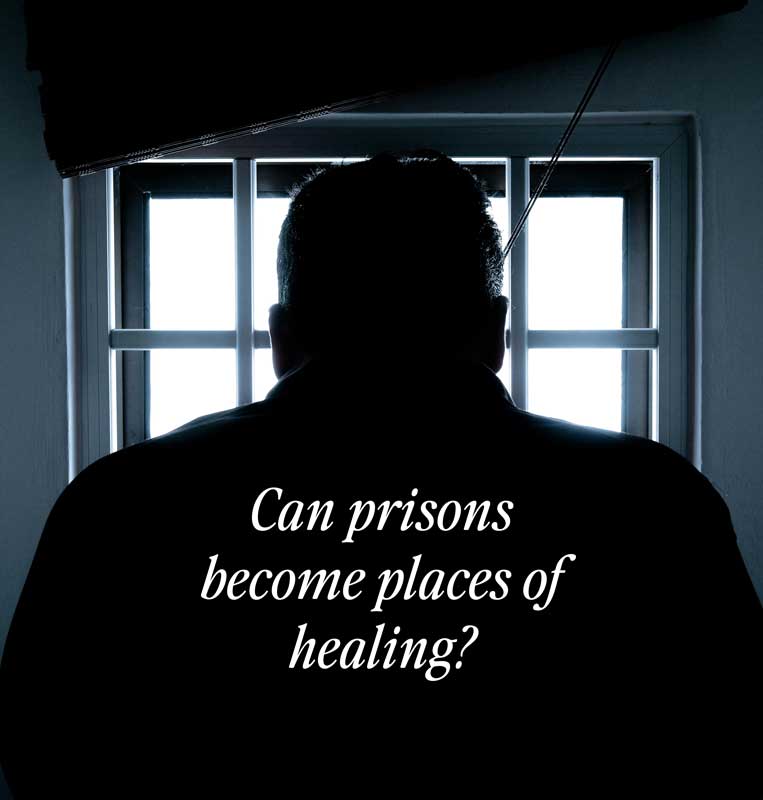
What if prisons became places of healing instead of despair? Nathanael Siljeur shows how restorative justice, deeply rooted in the Gospel, offers hope for victims, offenders and communities.
One of the most unsettling lines in the Gospel is this: “I was in prison and you visited me” (Matthew 25:36). We hear it read at Mass, nestled among Jesus’ list of “least of these” — but how often do we truly pause at that line? The sick, the hungry, the stranger? We can understand these; perhaps we volunteer, donate or pray. But prisoners? Many Catholics still flinch at the thought.
Let’s be honest. In our parishes, prison ministry often feels like the distant, gritty edge of Church life, left to a handful of brave volunteers, priests and deacons, rarely part of our Sunday homilies or catechesis. There’s an unspoken view: those behind bars are getting what they deserve. Our task is to pray for them, perhaps. But visit them? Restore their dignity? Stand up for their rights? That’s… radical. Isn’t it? Yes, and that’s the point.
The Gospel is not comfortable. To believe in the Gospel is to embrace discomfort. Jesus Christ, crucified between criminals, did not shy away from society’s condemned. He did not distance himself from sinners. He dined with tax collectors and prostitutes. He halted an execution with the words: “Let the one without sin cast the first stone.”

The early Church was born in prison cells, from Joseph in Egypt to Peter and Paul in chains in Rome — and, of course, Jesus in the dungeon of the Sanhedrin before his trial by Pontius Pilate.
But what about today’s prisoners? Many of them are poor, addicted, traumatised, and abandoned. Some are guilty of serious harm; others are victims of a harsh system that imprisons poverty more than it prevents crime. Overcrowded cells, systemic racial injustice and cycles of violence expose a truth many Catholics prefer not to face: our justice systems are often more punitive than fair.
Yet the Church cannot look away. She talks increasingly about “restorative justice”.
The Gospel call to heal
Restorative justice is not a “soft” alternative to punishment. It is a Gospel-rooted practice of healing. It asks: What harm was done? Who was affected? And how can we make things right?
Unlike retributive systems that merely punish, restorative justice aims for reconciliation between victims, offenders and communities. It does not neglect accountability but actually enhances it. Offenders are not excused; they are encouraged to confront the human repercussions of their actions and, where feasible, make amends. Victims are not marginalised but recognised as central to the healing process, including their own.
This mirrors our Catholic sacramental understanding. Consider the sacrament of Reconciliation: we confess, accept responsibility, receive absolution, and are called to penance and restorative action. Forgiveness is never without transformation.
Restorative justice, therefore, is not a secular invention. It flows directly from the heart of Catholic social teaching.
The Compendium of the Social Doctrine of the Church states that punishment should always aim at the rehabilitation of the offender (see also the Catechism of the Catholic Church, 2843-2845). Pope St John Paul II stated that modern societies ought to rely on “non-lethal means” of ensuring security, particularly when rehabilitation is possible (Evangelium Vitae 56). Pope Francis went even further, declaring the death penalty “inadmissible” and calling on the Church to lead the way in reforming global prison systems (CCC 2267).
Pope Francis, who made it a point to visit jails often, told prison chaplains in 2019: “We must not place ourselves on the pedestal of our assumed righteousness and judge others… The Lord waits for us with open arms, just as he waits for those in prison.” To be Catholic is to believe that no one is beyond redemption.
What about the victims?
But what about justice for victims? This is a real and necessary question.
Restorative justice is never about minimising harm or excusing evil. It starts by listening to victims — deeply, respectfully, and on their terms. Many victims of crime do not feel heard or healed under our current systems. When done well, restorative practices provide space for survivors to share their pain, ask questions, and participate in shaping accountability. That does not erase harm, but it begins to restore humanity, for both victim and offender.
The African context
In South Africa and throughout the continent, we possess a powerful cultural value: ubuntu (“I am because we are”). This principle reminds us that justice is never solely about the individual. Crime damages the fabric of the community — but so can systems of endless punishment.
Many of our prisons are remnants of colonial and apartheid-era control, disproportionately populated by black and poor men. Restorative justice urges us to face these legacies — not with blame but with truth and reconciliation, the same tools that helped heal our nation.
As Catholics in Africa, we have the chance to spearhead a distinctly local, culturally rooted restorative justice movement based on both ubuntu and the Gospel.
We may hear the objection: “But they deserve to be punished!” Yes. However, punishment should always aim to foster hope. If we believe in a God of mercy, then even the most hardened criminal remains a beloved child of God.
Recall St Dismas, the “Good Thief”, who was crucified alongside Jesus. His appeal, “Remember me when you come into your kingdom”, is a plea from the margins. And Jesus replies: “Today you will be with me in paradise.” He didn’t ask Dismas to prove his worth or remind him of his sins. He restored him.
When tears flow
Some of the most powerful moments in my ministry have been in family-offender mediations where tears, not excuses, flowed. Where a wife or child spoke of her struggles, shame and hurt, and a trembling man said the words our systems rarely require: “I am sorry. I did this. I carry it every day.”
The Church must lead. We cannot leave prison ministry to a select few. Every parish and every Catholic must answer the call to radical mercy. That may include:
• Supporting prison chaplaincy or restorative programmes;
• Advocating for sentencing reform, especially for juveniles;
• Accompanying families of prisoners;
• Creating reintegration programmes for parolees;
• Hosting healing circles or victim support initiatives;
• Preaching boldly about God’s mercy, not as an abstract doctrine but as a lived mission.
Pope Francis reminds us: “A society can be judged by how it treats its prisoners.” The early Church was not sceptical about prison outreach; it was born in prison cells. The saints preached to jailers, ministered to the condemned, and some were prisoners themselves. Today we are invited to be just as bold.
Catholics cherish stories of miraculous conversions, like those of St Paul and St Augustine, or the Prodigal Son of Jesus’ parable. But what about the Pauls and Augustines behind bars today? Do we believe God is still performing miracles?
Ultimately, restorative justice is not solely about repairing systems. It concerns personal transformation — including ours. Are we willing to see Christ in the incarcerated? Are we prepared to replace judgment with compassion, indifference with solidarity?
Jesus is still in prison. The question is: Will we visit him?
Nathanael Siljeur is the chairperson of the Prison Care and Support Network of the Archdiocese of Cape Town.
Published in the December 2025 issue of The Southern Cross magazine

- Mass Readings: 25 October – 1 November, 2026 - October 20, 2026
- Is St Peter’s Tomb Authentic? - October 19, 2026
- Pope: Seek the Kingdom of God - October 19, 2026