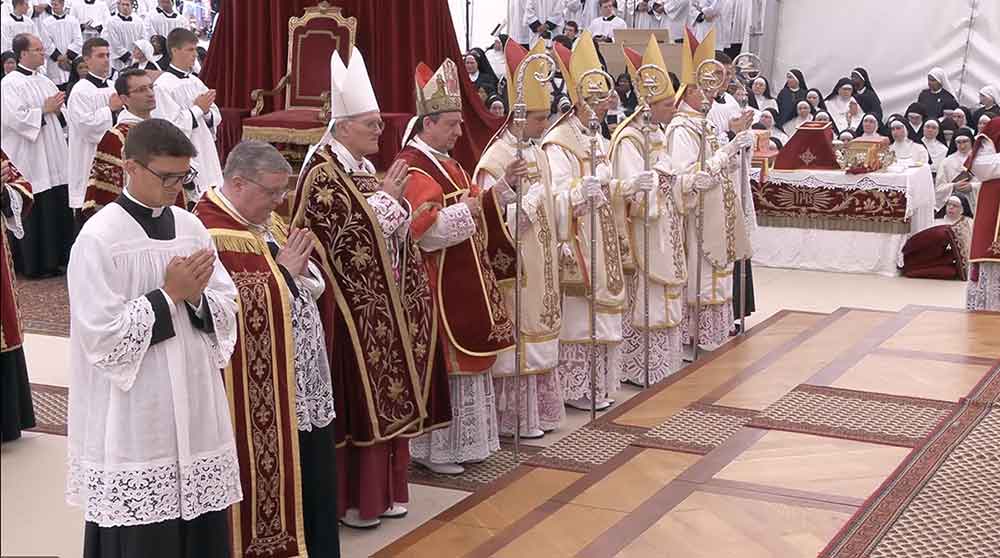
On July 1, 2026, at Écône, Switzerland, Bishop Alfonso de Galarreta of the Society of St Pius X consecrated four priests as bishops, with Bishop Bernard Fellay assisting as co-consecrator. Some 15 000 faithful and 1 300 priests and religious were reported to have travelled for the ceremony. None of the six men had a mandate from Pope Leo XIV.
The Law that Does Its Own Work
That is enough to incur excommunication automatically. The Code of Canon Law is unambiguous on the point:
Canon 1382 — “A bishop who consecrates some one a bishop without a pontifical mandate and the person who receives the consecration from him incur a latae sententiae excommunication reserved to the Apostolic See.”
Latae sententiae means the sentence is incurred by the act itself, with no decree required to impose it. The Church holds Bishops de Galarreta and Fellay, and the four new bishops, to be excommunicated.

Those four are Fr Pascal Schreiber, 53, of Switzerland; Fr Michael Goldade, 46, of the United States; Fr Michel Poinsinet de Sivry, 42, of France, until now superior of the Society’s Benelux district; and Fr Marc Hanappier, 36, also of France, who taught dogmatic theology at the Society’s seminary in Virginia.
Écône, Again
Today is also an anniversary. On 30 June 1988, at the same seminary, the Society’s founder, Archbishop Marcel Lefebvre, consecrated four bishops against the explicit instruction of John Paul II, and was excommunicated within days.
Lefebvre founded the SSPX in 1970 in rejection of several reforms of the Second Vatican Council; the 1988 consecrations were his answer to what he judged a state of emergency for a traditionalist priesthood inside the Church. That today’s ceremony again consecrated four men, in the same place, is unlikely to be coincidence.
Rome’s position has been stated plainly for months. Cardinal Víctor Manuel Fernández warned on 13 May that the consecrations would constitute “a schismatic act”. On the Solemnity of Ss Peter and Paul, Pope Leo XIV wrote to the Society’s Superior General, Fr Davide Pagliarani, appealing to him to “turn back”. It changed nothing.
The Protocol Lefebvre Signed and Abandoned
There is a detail from 1988 worth recalling, because it undercuts the claim that no path back to Rome ever existed. On 5 May that year, Lefebvre signed a protocol with the Holy See, negotiated with the future Benedict XVI, then Cardinal Ratzinger. Its terms:
- “Promise always to be faithful to the Catholic Church and the Roman Pontiff, its Supreme Pastor, Vicar of Christ, Successor of Blessed Peter in his primacy as head of the body of bishops.”
- “We declare our acceptance of the doctrine contained in §25 of the Dogmatic Constitution Lumen Gentium of Vatican Council II on the ecclesiastical Magisterium and the adherence which is due to it.”
- “Regarding certain points taught by Vatican Council II or concerning later reforms of the liturgy and law, and which do not appear to us easily reconcilable with Tradition, we pledge that we will have a positive attitude of study and communication with the Apostolic See, avoiding all polemics.”
- “We declare that we recognise the validity of the Sacrifice of the Mass and the Sacraments celebrated with the intention of doing what the Church does, and according to the rites indicated in the typical editions of the Roman Missal and the Rituals of the Sacraments promulgated by Popes Paul VI and John Paul II.”
- “Finally, we promise to respect the common discipline of the Church and the ecclesiastical laws, especially those contained in the Code of Canon Law promulgated by Pope John Paul II, without prejudice to the special discipline granted to the Society by particular law.”
Lefebvre repudiated his own signature the next day and proceeded with the consecrations regardless. Twelve priests who held to what he had signed broke from the Society and founded the Priestly Fraternity of St Peter (FSSP) on the protocol’s terms, with the Vatican’s approval.
The FSSP today numbers nearly 370 priests in almost 150 dioceses across 35 countries, celebrating the same Latin Mass as the SSPX, in full communion with Rome, standing proof that reconciliation never required surrendering the old liturgy, and that the document Lefebvre signed and then abandoned was, in fact, a workable one. The problem is not that the SSPX are traditional. It is that they are schismatic.
The Fundamental Error
One of the main errors of the SSPX is its denial of the indefectibility of the Church.
Indefectibility is the doctrine that the Church, guided by the Holy Spirit, cannot fail in her mission or defect from the truth she has been given to guard. She may be wounded, poorly governed, or scandalised in her members, but she cannot teach error as binding doctrine, and she cannot cease to be the Church Christ founded. This is not a council’s opinion but a defined dogma, running from the Fathers through Trent to Vatican I.
The SSPX does not formally deny this. But its entire practical position depends on the premise that the Church’s ordinary teaching authority — as exercised through Vatican II and its aftermath — went so badly wrong that a society of privately consecrated bishops must preserve the faith against it.
That is precisely what indefectibility rules out. You cannot hold both that the Church is indefectible and that she has taught error serious enough to justify operating outside her visible communion. One of those positions has to give. The SSPX chose which one.
The Church, as she has done since 1988, leaves the door open for those who wish to choose differently.
- Why I Chose Catholicism: 7 Reasons - October 7, 2026
- Why I Am Not an Atheist: The Three M’s - September 28, 2026
- “Help, the Pope said something I disagree with” - July 20, 2026