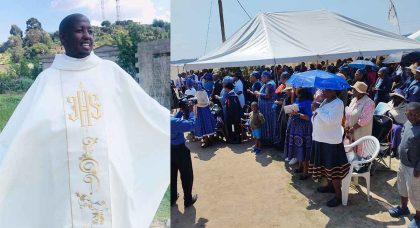
Sermon by Emmanuel Suntheni OSB, The Twentieth Sunday Of Ordinary Time, Year A
Sermon And Christian Act In The Word
Theme: “The Universality of Christ-centredness! Inclusivity standard! We are all one in Christ!
Point of Reflection: What actions can I take to combat the ever-present danger of tribalism and ethnic discrimination in my community, my country, my parish? How can I foster and live out the experience of an all-inclusive community in my life? In the scriptural readings of today we encounter the spirit of inclusion, not the spirit of division and tribalism or xenophobic elements!
First Reading: Isaiah 56:1, 6–7
Psalm: Psalm 67:2–3, 5–6, 8
Second Reading: Romans 11:13–15, 29–32
Gospel: Matthew 15:21–28

Sermon (Reflection): The liturgy of this Sunday focuses on the theme of the inclusion of all races and nationalities among God’s people. This view, while certainly correct, hides an even deeper message contained in the readings, thus, the message that this all-inclusive community is formed through the application of a single and universal standard of belonging, the validity of which is not restricted by race or ethnic origin.
The most apparent division between peoples reflected in the Bible is the difference between the Israelites, also called “the Jews”, and the non-Israelites, known as “the Gentiles”. This division was simultaneously ethnic and religious, as it was assumed that only those born as Israelites could truly be counted among God’s people, while the non-Israelites are “the Gentiles” or “the pagans” who cannot be considered as God’s people. It was also assumed by many Israelites that they had exclusive access to God, and occupied a privileged position in the human family because of their ethnic origin.
However, contrary to what many at the time assumed, the prophet Isaiah taught that membership of the covenantal community is not restricted to any ethnic group, not even the Israelites. In the first reading according to Isaiah, what truly matters is the practice of justice and righteousness, combined with adequate religious observance. Thus, right relationship with fellow human beings and the appropriate worship of God will make even a foreigner a member of God’s people. The prophet identified a single set of practices necessary for such membership: a single and universal standard applicable to all human beings with no distinctions and no exceptions.
The second reading of last Sunday came from the opening section of the letter to the Romans, where Paul considered the issue of Israel’s rejection of Jesus. Today’s passage comes from the conclusion to the same section.
Having stated that his fellow Israelites were wrong in rejecting Jesus, Paul concluded his arguments reminding the Gentiles that they should not feel superior, or special, because of their own acceptance of Jesus. Rather, he reminds the Gentiles that Israel’s rejection of Jesus made it possible for them to be counted among God’s people; they benefited from Israel’s downfall. However, Paul also emphasises that the Israelites’ rejection of Jesus is not final, but temporary; they will eventually accept the Gospel and inherit eternal life together with the Gentiles. In the final line of today’s reading Paul indicates that the Gentiles and the Israelites shared equally in the condition of “disobedience”. Prior to their conversion, the Gentiles did not follow God’s ways and were strangers to the Gospel, they lived in a state of disobedience. The Israelites, for their part, did not accept Jesus and the Gospel, hence, they were also in the state of disobedience.
What these two groups have in common is the need for God’s mercy. The Gentiles had already experienced it because they were privileged to hear the Gospel and, accepting it, became believers and members of God’s people. The Israelites, while temporarily disobedient, will be shown the same mercy and, in the end, accept Jesus and have eternal life. Paul recognises that eternal life does not depend on being an Israelite or a Gentile. He stated earlier in the letter that there is no difference between these groups because “all have sinned and lack God’s glory” (Rom 3:23). But, just as they share the condition of disobedience and sinfulness, so also they will be offered God’s mercy upon which God’s offer of eternal life rests. There are no double standards or criteria when it comes to inheriting life eternal.
The Gospel of Matthew was written specifically for the Jewish Christians and reflects a distinctively Jewish perspective. Today’s Gospel passage shows Jesus venturing into the territory of “Tyre and Sidon”. These are the names of two important cities located outside Israelite territory and inhabited by non-Jews. It was a foreign land, the land of the Gentiles. While there, Jesus was approached by a woman identified only as “a Canaanite”. Canaanites inhabited the land of Palestine before the Israelites had settled there after coming from Egypt. For centuries the Israelites and the Canaanites fought over the possession of the land and the two groups became mortal enemies.
As a true Jew, Jesus initially refused to help this foreign woman, stating that his mission was intended only for his fellow Israelites. Even more, he seemingly insulted the woman by referring to the non-Jews as “dogs”. Dogs were considered unclean animals. Thus, Jesus’ answer reflects the view that foreigners were “unclean” in the religious sense and, therefore, not members of God’s people.
However, Jesus’ refusal and harsh words were a test of the woman’s resolve and faith. In reality, Jesus always intended to bring the good news to foreigners and religious outcasts. If he were only concerned with Israel, he would not have gone into the Gentile territory in the first place. Second, as an Israelite he would never have spoken to an unclean Gentile, the traditional enemy of the Jewish people, unintentionally. Finally, as a Jew he would have never talked to an unknown woman because it was forbidden for Jewish males to openly speak with women in public.
Engaging the woman and responding to her persistence, Jesus granted her request and healed her daughter. Then, he praised this Gentile woman’s faith, the faith that many of his fellow Israelites lacked. This reading also shows that there are no double standards when it comes to receiving Jesus’ healing action and grace. There is only one single and universal response to Jesus, required of all – unreserved and persistent faith. Faith in Jesus is, therefore, a universal condition for the Israelites and the Gentiles to receive God’s salvation offered to humanity through Jesus.
Christian Act in Word of God “God’s inclusivity and never block others”
Two distinct lessons emerge from the liturgy of this Sunday. First, Jesus did not confine his mission to the Israelites. Rather, he wanted all to know and enjoy the goodness of God. When one accepts the message of Christ and is baptised, the boundaries created by social and ethnic differences are no longer of value and importance. Since a Christian has put on Christ and became new creation, the differences no longer matter; there is no Jew or Gentile, man and woman, slave or free. That is the ideal.
However, an objective look at our world, shows how racism, tribalism, ethnicity and cultural prejudices damage not only the development of our countries but also seriously undermine Christian identity and testimony. Christians tend to conform easily to the standards of this world, which rely on making distinctions and divisions. When differences are highlighted, it becomes very easy to forego the search for the common good, and to pursue perverse personal or national interests while harming others. In doing so, we are becoming ever less Christian. Conforming to the message about the single standard, is required of all Christians for an adequate response to Jesus, is a great exhortation to find the way past differences, in the search to be a true Christian.
As Christians we have a vital responsibility to carry that message of essential equality to our often troubled societies.
The second message which comes from today’s reading is that of patient waiting for God’s action rather than seeking shortcuts in life. While contemporary society has made it a common and quite normal way to seek and take shortcuts in life, the Canaanite woman sets a model for all of us to follow. Unemployment, poverty, family issues have led many people, particularly the youth to join secret societies and engage themselves in immoral practices taught and demanded by these groups. Also, the “Gospel of prosperity” preached in many parts of the world is causing much harm to many by taking advantage of personal dreams and ambitions, and promises of easy success. Such groups insist on performing certain rites, paying tithes to the preachers, attending special revivals or belonging to illuminati groups to achieve quick and effortless success. Such beliefs are nothing but distortions of Jesus’ teaching. The expectation of an immediate reward for religious devotion are unreasonable, and false in the light of the Gospel. The one single response to God’s promises, demanded of all, is faith and commitment to God’s ways. There are no quick ways or shortcuts to bypass God’s ways.
Whenever we feel impatient with God, we ought to follow the example of the Canaanite woman, who did not give up on seeking help from Jesus, even though he seemed reluctant to respond. She waited patiently for his amazing intervention in her life. Her example teaches us that one cannot remain discouraged, or idle, when things do not go as expected. Rather we should engage in prayer, and work that will make the reception of God’s favour possible, whenever it comes. The Canaanite woman did this in following Jesus, and crying out to him for help. She waited in persistent prayer and supplication. This persistence in faith and prayer are, therefore, the attitudes that a true Christian nourishes in life, realising that these are the standards God sets for all humanity to follow in order to receive his blessing and grace.
Action: I will be attentive to my instinctive perceptions and judgments about others and seek to rise above my cultural bias and prejudice guided by the message of today’s liturgy.
Prayer: O Lord, let your light shine in every part of my life so that I may be able to embrace all kinds of people as your son Jesus Christ did. May my life bring hope, joy and peace to those who need it most. I ask all these through Christ our Lord. Amen.

- God is Inviting Us: 28th Sunday in Ordinary Time - October 9, 2026
- Good or Bad Fruit? 27th Sunday in Ordinary Time - October 2, 2026
- No Excuses: 26th Sunday in Ordinary Time - September 25, 2026