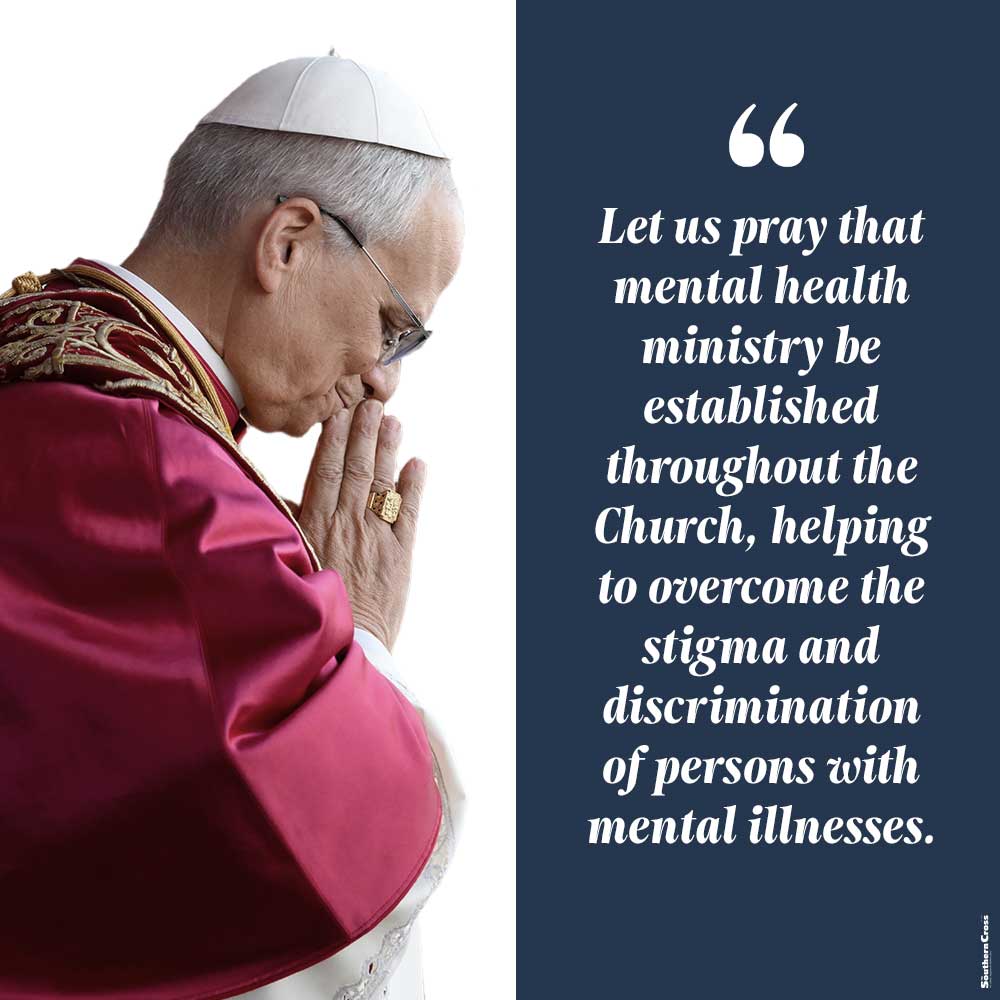
Intention: Let us pray that mental health ministry be established throughout the Church, helping to overcome the stigma and discrimination of persons with mental illnesses.
A major obstacle to the treatment of mental ill-health is financial. Psychotherapy is expensive, and its expense, it seems to me, is driven by the law of supply and demand. There are clearly a large number of sufferers from mental illness in modern society — that’s the demand — but therapists are not as numerous as, say, general practitioners — that’s the supply.
Thus, a Church ministry to serve those suffering from mental health problems would be a boon for the poor, and even the not-so-poor, who cannot afford or access mental health professionals.
Such a ministry would also include spiritual support for sufferers of mental conditions. This would require that priests and spiritual directors be trained to provide pastoral care to the mentally ill in the same way that they are trained in pastoral care of the physically ill.

Training our priests
A fairly standard component of pastoral formation of budding priests and pastors is a supervised, assessed internship in a hospital. An implication of this is that a similar immersion in a psychiatric unit would be highly desirable.
Such an initiative should, as the pope’s prayer intention suggests, help overcome the stigma around mental illness. It would not, however, be a silver bullet. The stigma of mental illness is probably less prevalent in society than it used to be, but it still persists stubbornly.
This begs the question: Why? After all, it is a common human experience to suffer from mental issues such as stress and depression, even if these are not severe. So why would we cling to the tendency to stigmatise those who suffer from severe and chronic forms of these conditions?
The fear factor
Fear may be one of the reasons. As with contagious diseases, we may be afraid of getting “infected” by certain mental disorders. We may think that being around depressed people may draw us into depression too. We also fear what we do not really understand, and mental illness is indeed often very difficult to grasp. Is it genetic or situational? Is it somehow connected to the patient’s culture, or to something else I may not really understand?
The Western scientific approach to physical illness provides us with a very clear way of understanding physical disorders. But when it comes to issues of the mind, things are by no means as clear.
Furthermore, when a mental illness is proving difficult to diagnose and treat, this can elicit a suspicion that the “mystery illness” is “all in the mind”, a phrase that actually implies the sufferer is just imagining the ailment and could simply “snap out of it”. None of this is a helpful or caring response.
Finally, it is often harder to be around the mentally ill than around the physically ill. The physically ill person normally appreciates being visited, whereas the mentally ill person might not be so receptive. If the patient is suffering from, say, paranoia, they might be hostile to the visit of a well-meaning and compassionate friend or family member.
So, a more general education about the nature of mental health issues might also be needed, in addition to professional and pastoral care, to help us appreciate that mental illness truly is an illness, not something imaginary or shameful or contagious.

- Pray with the Pope: Beat the Stigma! - October 6, 2026
- Pray with the Pope: Life is Sacred - July 1, 2026
- Pray with the Pope: God Provides, We Squander - May 9, 2026