Livestreamed Masses are convenient but no substitute to being actually present during the liturgy. But greater dangers loom in how people may see the Eucharist in a new digital age, warns Dr Dimakatso Michelle Polokelo.
Disneyland, a French philosopher once argued, is not an escape from the real world but its truest expression: a simulation so powerful that it becomes preferable to the world it mimics. The virtual Mass, livestreamed and accessible from the comfort of our armchairs, is at risk of becoming the Church’s spiritual Disneyland.
It may feel more engaging, more accessible, and even more emotionally fulfilling than the parish experience. The camera’s focus on the chalice, the clarity of sound, the comfort of participation from one’s living room — all these can create an illusion of participation that feels deeper than the reality of hard pews in churches, with the sound of coughing congregants and crying children.
In hyperreality — a term coined in 1981 by the French philosopher referred to above, Jean Baudrillard — the sacred sign detaches from the sacrament. The digital Eucharist becomes an image of holiness without the material mediation of grace. The “presence” perceived through a screen or headset is not the Real Presence of Christ but its representation, an image that satisfies the senses while bypassing the ontology of the sacrament.

A challenge like none before
The Church, which has always adapted to new means of communication, now finds itself confronting a challenge unlike any before. The digital age does not merely transmit the faith; it reshapes the meaning of presence, of reality itself. Nowhere is this tension felt more sharply than in the Eucharist — a sacrament that depends on embodied encounter, material elements and gathered community. What happens when this most physical of mysteries is drawn into a world of virtual proximity?
At the heart of this question lies an unresolved tension: sacrament versus simulation, communion versus connection, presence versus projection. Baudrillard’s concept of hyperreality describes a condition in which representations no longer point to reality but replace it. The sign becomes more compelling than the thing itself. Applied to worship, the danger is not that the sacred disappears, but that it is subtly displaced by its image.
Yet, Catholic theology insists that the Eucharist is not symbolic but substantial. In the consecration at Mass, the bread and wine truly become the Body and Blood of Christ, not metaphorically but ontologically. This Real Presence forms the heart of Catholic worship. The Eucharist is not simply a memorial; it is participation in the Paschal mystery, a tangible encounter between the divine and the believer, who is in the actual presence of the Lord.
This incarnational logic matters. Sacraments are not ideas but actions. They require matter, form and a minister; gestures performed in time and space; a community physically gathered. The believer does not merely observe the Eucharist but also receives it.
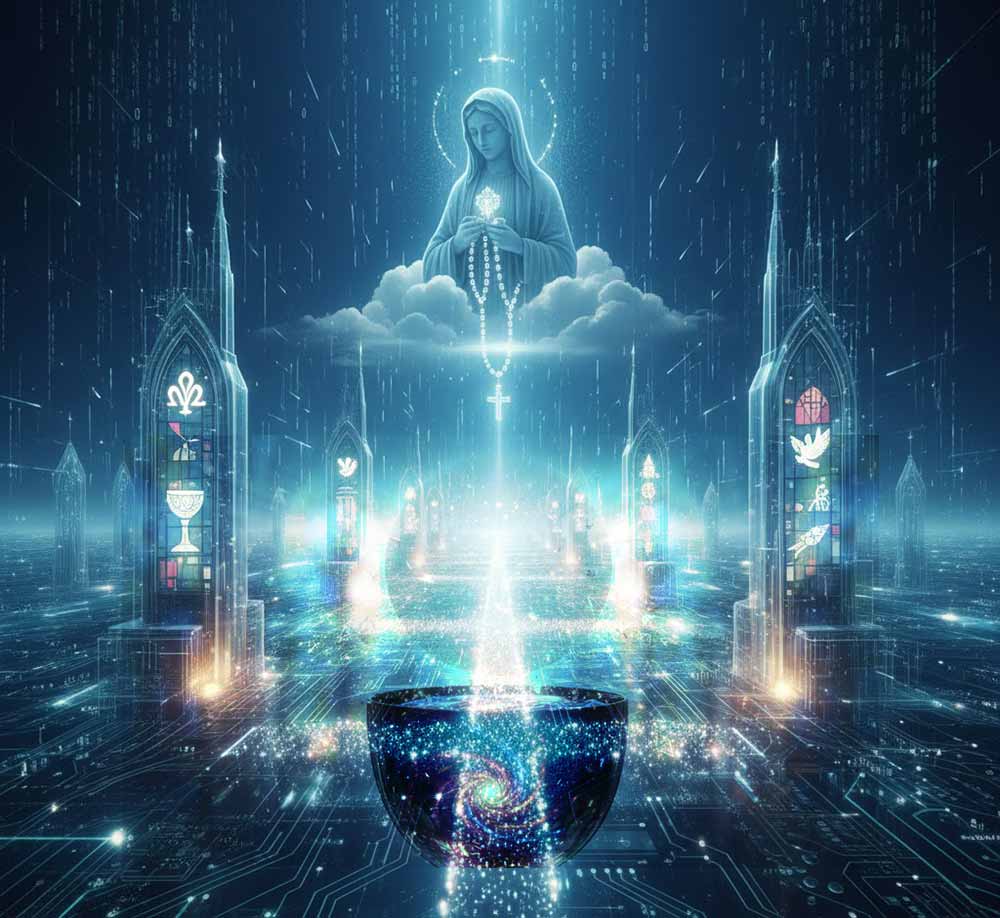
The Church’s digital migration has involved genuine pastoral creativity. Livestreamed liturgies, online catechesis and even 3D renderings of sacred spaces have helped sustain spiritual connection, especially for the homebound or geographically isolated. In emerging virtual environments, or the Metaverse, believers may find themselves standing as avatars beside others in digital sanctuaries, listening to virtual choirs, and watching priests consecrate the host through virtual reality headsets.
Advocates see this as an inclusive evolution, extending access to those who are homebound, geographically isolated, or spiritually seeking. A virtual Mass, they argue, is better than no Mass at all. The logic is one of pastoral accessibility, echoing Pope Francis’s encouragement in Christus Vivit (2019) that “the digital world can be an environment rich in humanity”. Used wisely, technology can indeed extend pastoral reach.
What the virtual Mass lacks
Yet, the new technology raises a fundamental theological concern: if our presence can be simulated, can it still be sacramental? The risk lies not in the Church’s use of technology, which it has always embraced cautiously, but rather in mistaking digital mediation for sacramental participation. In a virtual Mass, the worshipper’s attention may be engaged, but their physical presence — the very condition of sacramental participation — remains absent.
Herein lies the danger. The sacred sign detaches from the sacrament itself. The digital Eucharist becomes an image of holiness without the material mediation of grace. What feels like “presence” is, in fact, representation. The Real Presence of Christ cannot be transmitted through bandwidth.
Unlike preaching or prayer, the Eucharist cannot be reduced to information. Its essence is incarnational. Bread must be broken, wine poured, a body gathered. When a priest consecrates the host on a livestream, the consecration is real — but the mediation through a screen does not make the viewer a sacramental participant. To consume the Eucharist is to be drawn into the Body of Christ, an act that requires the body to be present.
Online Masses may nourish devotion, but they do not constitute sacramental acts for those watching. They do not fulfil the Sunday obligation, except in cases of grave impediment (Canon 1248).
The deeper problem emerges when believers begin to prefer the simulation to the sacrament.
The heart of Christianity is not abstraction but Incarnation: “The Word became flesh and dwelt among us” (John 1:14). The mystery of salvation unfolds not through code but through contact. Jesus touches the blind, eats with sinners, and breaks bread with his disciples. God reveals himself not as data but as flesh.
Digital culture subtly reverses this logic. When worship becomes digital, the meaning of presence shifts. This mirrors the broader cultural transformation in the digital age. Bodies are replaced by profiles, communities by networks, and relationships by algorithms. In such a world, the Eucharist is one of the last bastions of embodied meaning, a defiance of the digital logic that everything can be simulated. It insists that grace involves flesh.
Pope Benedict XVI warned of this danger in The Spirit of the Liturgy (2000): “When liturgy becomes show, we no longer see the divine but only ourselves.” Virtual worship could unintentionally fulfil that warning, transforming worship into a mirror of human design rather than divine encounter.
Church must be counter-cultural
Yet the Church cannot simply reject technology. The challenge is discernment: how to inhabit digital spaces without surrendering to their logic. Pope Francis warned that “media and the digital world can create a sense of virtual proximity that conceals the deeper reality of human alienation” (Laudato Si’, 47). The Church must therefore become a countercultural witness, embracing digital outreach while also reaffirming that grace is not bandwidth-dependent.
In an age of avatars and algorithms, gathering physically becomes a radical act. To kneel, to receive, to share space — these become radical acts of defying hyperreality.
The task, then, is not to abandon technology but to frame it correctly. Virtual spaces can support catechesis, prayer and evangelisation. They can serve as a digital Areopagus (cf Acts 17:22-31) where seekers encounter the Gospel before entering embodied faith communities. But they must remain a means, never the medium of grace itself. They must remain thresholds, not substitutes.
As technology continues to shape how people experience and interpret reality, the Church’s response must remain rooted in the tangible and the human — to proclaim that in an age of infinite copies, only the real can truly save.
Dr Dimakatso Michelle Polokelo is a digital transformation expert and author with three books. She is a parishioner at Christ the King cathedral in Gaborone, Botswana.

- Beware a Spiritual Disneyland - November 5, 2026
- Mass Readings: 8 November – 15 November, 2026 - November 3, 2026
- Pray with the Pope: Let wealth work for everyone - November 3, 2026