There is something about seeing the altar of a church covered, draped and transformed into a backdrop for entertainment that does not sit comfortably with me. Perhaps I am old-fashioned in my thinking, but I believe there are certain things in our faith that should never lose their sacred character.
I have witnessed church spaces being transformed for concerts and drama productions, complete with elaborate decorations, Christmas lights hanging from ceilings and the altar hidden beneath coverings. I understand that the intentions may be entirely innocent. There may be a desire to bring people together, encourage participation, celebrate talent and make the Church more accessible. None of those intentions is necessarily wrong.
But somewhere along the way, I believe we need to pause and ask ourselves: Are we bringing people closer to the sacred, or are we gradually making the sacred resemble the secular?
The Altar is not a Stage
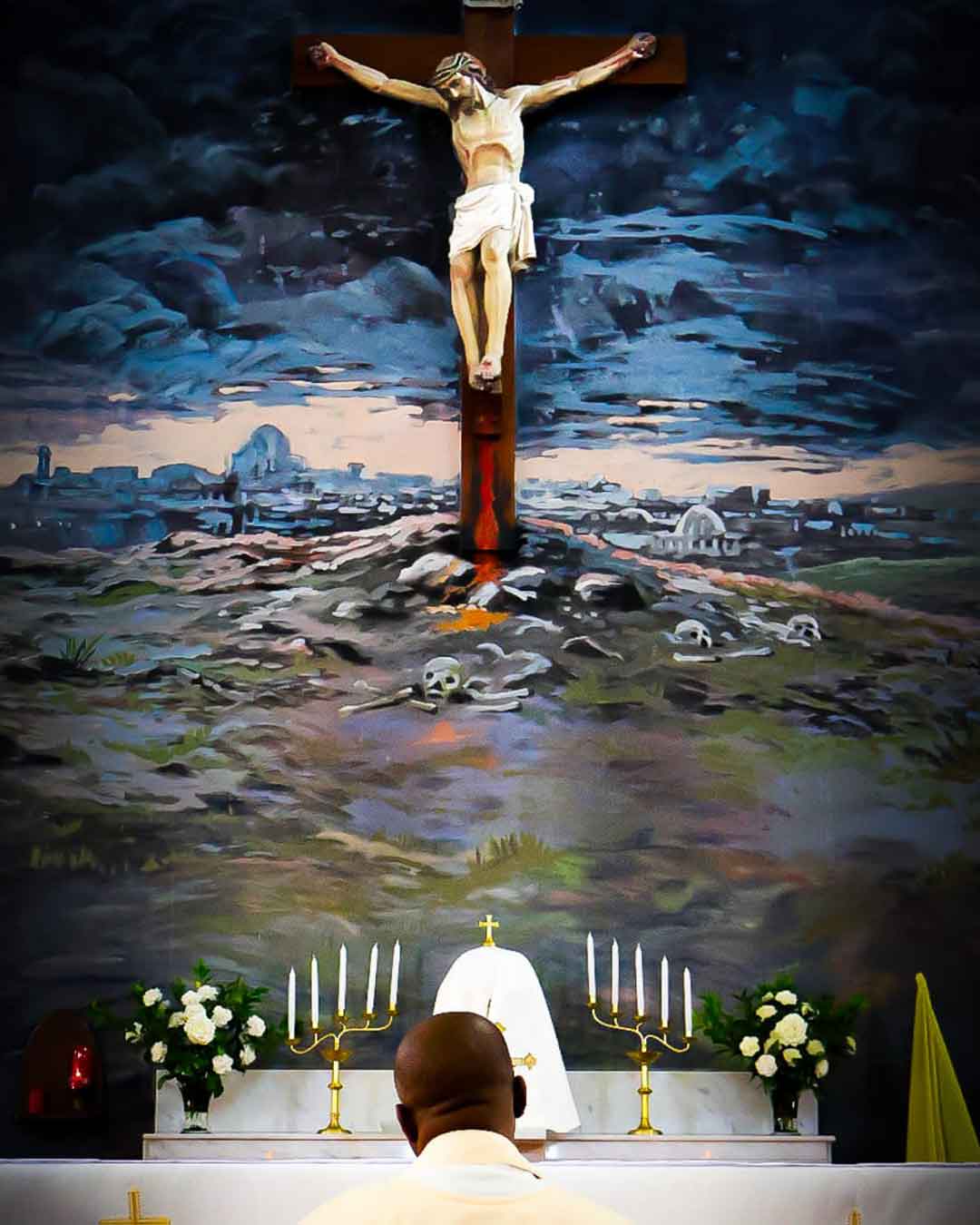
For Catholics, the altar is not simply a beautiful piece of church furniture. It is at the very heart of our Eucharistic celebration. It is where the Sacrifice of the Cross is made present under sacramental signs. It is where we gather around the table of the Lord to celebrate the greatest mystery of our faith.

The General Instruction of the Roman Missal (GIRM), in paragraph 296, leaves little room for ambiguity. It describes the altar as the place where the Sacrifice of the Cross is made present under sacramental signs. It is also the table of the Lord and the centre of thanksgiving accomplished through the Eucharist. This is not merely symbolic language. It speaks to the very heart of what we believe as Catholics.^
Paragraph 295 further describes the sanctuary as the place where the altar stands, where the Word of God is proclaimed and where the priest, deacon and other ministers exercise their respective functions. It specifically calls for the sanctuary to be appropriately distinguished from the rest of the church. There is a reason for this distinction. We kneel before the Eucharistic Lord. We genuflect. We bow our heads. We observe moments of silence. We approach the altar with reverence because we understand that what takes place there is far greater than anything we could manufacture ourselves.
How, then, can we become so casual about the very space that represents the heart of our worship?
The GIRM, in paragraph 292, also reminds us that church decoration should contribute towards noble simplicity rather than ostentation. Paragraph 305 calls for moderation in the decoration of the altar, while paragraph 306 specifies what may be placed on the altar itself during the celebration of Mass. These are not insignificant instructions. They reflect the Church’s understanding that the arrangement and appearance of our sacred spaces should foster devotion and direct our attention towards the mysteries being celebrated.
A Lesson from the Holy Of Holies
Throughout Scripture, we encounter a profound understanding of sacred space. In the Old Testament, the Holy of Holies was separated from the rest of the sanctuary by a veil. It was the most sacred place within the Tabernacle and later the Temple in Jerusalem. Entry was strictly restricted. According to Leviticus 16, the high priest entered the Most Holy Place once a year, on the Day of Atonement, and only according to the prescribed ritual. The message was unmistakable: the presence of God was not something to approach casually.
In Exodus 26:31–33, we read about the veil that separated the Holy Place from the Most Holy Place. This was a physical reminder of the holiness of God and the distinction between the sacred and the ordinary. Of course, Christ’s sacrifice transformed our relationship with God. At the moment of His death, as recorded in Matthew 27:51, the veil of the Temple was torn in two. Through Christ, we have been given access to the Father.
The Letter to the Hebrews, particularly chapters 9 and 10, develops this understanding beautifully. Christ is the great High Priest who enters the heavenly sanctuary once and for all, offering Himself for our salvation. But here is where I believe we must be careful not to misunderstand that freedom of access. The tearing of the veil did not make God less holy. It did not make worship less sacred. It did not give us permission to approach the things of God without reverence. If anything, our understanding of what Christ has done should deepen our reverence. We no longer stand outside, separated from God by the limitations of the old covenant. We approach the Father through Jesus Christ. What an extraordinary privilege that is!
Perhaps this is precisely why we should be even more conscious of the sacredness of our churches, particularly the sanctuary and altar.
What can we learn from Cardinal Sarah?
Cardinal Robert Sarah has consistently reminded the Church of the importance of recovering the sacred, particularly in our liturgical celebrations. In his writings, especially The Power of Silence: Against the Dictatorship of Noise, he draws attention to the importance of silence, contemplation, adoration and the need to rediscover God at the centre of our lives. His reflections on the liturgy challenge us to remember that worship is not about entertaining ourselves or putting on a performance. It is about encountering God.
Our churches should therefore communicate something different from the world outside. They should be places where the noise of everyday life gives way to silence, where our distractions become prayer and where we are reminded that we stand on holy ground.
There is a place for music, drama, artistic expression and cultural celebrations in the life of the Church. I am certainly not suggesting otherwise. Sacred music, in particular, has an important place in our worship. But surely there must be a distinction between what belongs in the sanctuary and what can comfortably be accommodated in our parish halls.
Interestingly, GIRM paragraph 297 makes an important distinction. It states that the celebration of the Eucharist in a sacred place is to take place on an altar, while outside a sacred place it may take place on a suitable table, with the appropriate liturgical furnishings. This reminds us that the Church understands the distinction between sacred places and other venues. Our parish halls have a valuable purpose. They provide spaces for fellowship, concerts, drama, community gatherings and celebrations. Why must every activity find its way into the church itself? Have we confused accessibility with accommodation?
I fully appreciate that the Church must reach people where they are. We cannot expect younger generations to engage with the faith if we are unwilling to listen, accompany and welcome them. But reaching people does not mean imitating everything the world offers. We do not have to turn our churches into modern-day multi-entertainment centres to make Christianity relevant. We have something infinitely greater to offer.
Bishop Robert Barron has also raised concerns about the use of sacred church spaces for entertainment, questioning whether the Church is surrendering too readily to secular culture. His concerns deserve consideration, not because every cultural event in a church is automatically inappropriate, but because we must never lose sight of the distinction between a sacred space and an entertainment venue. There is a difference between welcoming the world into the Church and allowing the Church to become a reflection of the world.
Where does Synodality come into all of this?
This is where I believe synodality becomes particularly important. Synodality is not about challenging the authority of our priests, nor is it about allowing everyone to dictate how the Church should operate. It is about listening, discerning and walking together as the People of God. Our priests carry enormous responsibilities. They lead our communities, administer the sacraments and guide us spiritually. But they are not expected to walk this journey alone.
There are elders in our congregations. There are people who have spent decades serving at the altar, proclaiming the Word, teaching children, preparing the liturgy and quietly sustaining parish life.
Their “old voices” matter, so as to speak.
Sometimes those who have served the Church for many years notice things that others may overlook. They carry experiences, traditions and a deep appreciation for the sacred that deserve to be heard. We must create spaces and places where faithful concerns can be expressed without people being labelled difficult, resistant to change or out of touch.
Perhaps we need to ask whether, in our enthusiasm for new initiatives, we sometimes become worship-blind. We can become so occupied with organising an event, attracting an audience and ensuring everything looks impressive that we overlook the very sacredness of the space in which we are gathering. Listening to the faithful may help us recognise that.
Synodality should not simply be about listening when we agree with one another. It must also mean having the humility to listen when someone raises an uncomfortable question. In this specific instance, an elderly voice could ask, “have we forgotten the sacred? “
Let us not lose our Sense of Awe
I am not calling for a Church that closes its doors to creativity, culture or the wider community. I am calling for a Church that knows what it is, what it represents and what must be protected. There should be something profoundly humbling about entering a Catholic church. Something that makes us lower our voices, quieten our hearts and become conscious of the presence of God.
I often think that our sense of reverence should be so deeply rooted that we would almost feel compelled to take off our shoes before approaching the sanctuary. Not because we are commanded to do so, but because we recognise that we are standing on holy ground.
We should never become so familiar with the sacred that we begin treating it as ordinary. Our churches are not stages. Our altars are not backdrops. Our sanctuaries are not exhibition spaces. They are places set apart for the worship of Almighty God.
And perhaps, before we plan our next concert, drama production or spectacular display, we should pause and ask one simple question:
Are we still keeping the sacred sacred?
- The Altar Is Not a Stage: Have We Forgotten the Sacred? - November 24, 2026
- Workplace Prophets - November 17, 2026
- She Did Not Vandalise — She Venerated - October 27, 2026