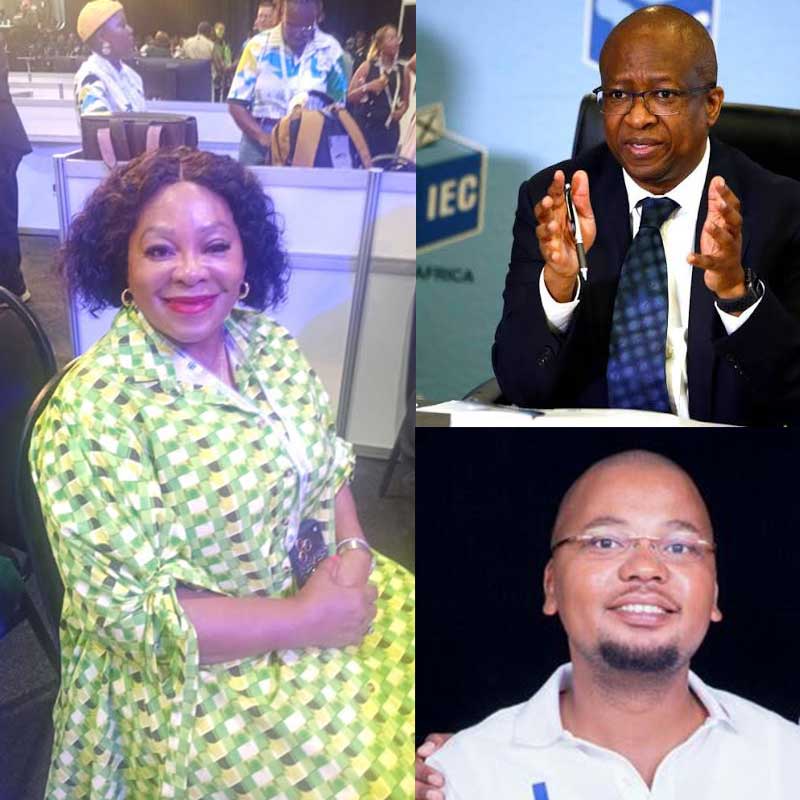
The first day of the announcement of South Africa’s 2026 local government election results was marked by a considerable Catholic presence, with individuals whose faith and professional lives intersect with the country’s democratic process featuring prominently. Among them were IEC Chief Electoral Officer (CEO) Deacon Sy Mamabolo, African National Congress (ANC) First Deputy Secretary-General Nomvula Mokonyane and attorney Tlouyatiba Moeti Kanyane.
The three spoke to The Southern Cross at the National Results Operation Centre at Gallagher Convention Centre in Midrand, Gauteng, on Thursday, 5 November.
Deacon Sy Mamabolo
For Sy Mamabolo, who was ordained a permanent deacon in 2018, the successful administration of elections represents the culmination of extensive preparations and cooperation between the IEC and its stakeholders.
Appointed Chief Electoral Officer in October 2017, Mamabolo previously served as Gauteng Provincial Electoral Officer and Deputy Chief Electoral Officer responsible for Electoral Operations. Reflecting on the preparations, he expressed satisfaction with the work undertaken to ensure that the elections proceeded successfully.
“I am very happy with the process and the effort that has gone into ensuring that these elections are conducted successfully,” Mamabolo said.
His role brings together his work at the IEC and his commitment to his faith, with his faith forming part of how he approaches the responsibility of overseeing the country’s electoral processes. This was particularly evident in his reflection on the elections through the lens of Catholic Social Teaching, especially the principle of the common good. His role brings together his work at the IEC and his commitment to the Catholic faith, with his faith forming part of how he approaches the responsibility of overseeing the country’s electoral processes.
“I’m happy that the outcome of the elections, although we are still at an early stage, represents an expression of the common good,” he said.
Nomvula Mokonyane
While Mamabolo’s reflections centred on the administration of elections, Nomvula Mokonyane emphasised the responsibility of citizens to participate in the democratic process.
Her Catholic formation dates back to her upbringing in Kagiso on the West Rand, where she was involved in the Young Christian Students movement. Her involvement in the anti-apartheid struggle brought her into contact with church activists, including the late Catholic religious sister Sr Bernard Ncube, who played an important role in organizing women and mobilizing communities against apartheid.
Mokonyane referred to the pastoral letter issued by the Southern African Catholic Bishops’ Conference (SACBC) ahead of the elections, which encouraged South Africans to participate in the democratic process, regardless of political affiliation.
“The bishops reminded us that every South African has a responsibility to come out and vote, irrespective of political affiliation. Participation in the democratic process is also about building cohesiveness,” Mokonyane said.
She emphasised that voting should be understood as more than a political exercise. It is an expression of citizenship and a responsibility towards fellow South Africans, particularly those whose lives are affected by decisions made at municipal level.
Her reflections also recalled the contribution of Church organisations and Christian activists to South Africa’s struggle for democracy, justice and human dignity.

Tlouyatiba Moeti Kanyane
The legal dimension of the electoral process was highlighted by attorney Tlouyatiba Moeti Kanyane, director of Moeti Kanyane Incorporated, whose firm has represents the IEC in various electoral disputes and court proceedings. A product of Catholic education in Limpopo, Kanyane is also a parishioner of St Thomas More Catholic Church in Centurion, Gauteng.
His work involves addressing disputes between political parties and other stakeholders concerning electoral procedures and the interpretation of electoral legislation. Some matters ultimately require determination by the Electoral Court or the Constitutional Court.
For Kanyane, his Catholic faith provides an important moral foundation for his professional responsibilities.
“On a personal and professional level, I am guided by my Catholic faith and its principles. In my work as a legal practitioner, Catholic Social Teaching is particularly important because it speaks to justice, human dignity and solidarity,” Kanyane said.
As the counting and verification of votes continued, the conversations offered a glimpse of how Catholic faith continues to find expression in South Africa’s public life. They also underscored the Church’s enduring call to promote the common good, encourage responsible citizenship and uphold justice and human dignity in the service of society.

- Catholics bring faith perspectives to SA’s electoral process - November 6, 2026
- Two Catholic leaders join hands in ensuring elections readiness - November 2, 2026
- A Proud Moment for Pax College Alumni as Historic MoU Is Signed - October 30, 2026