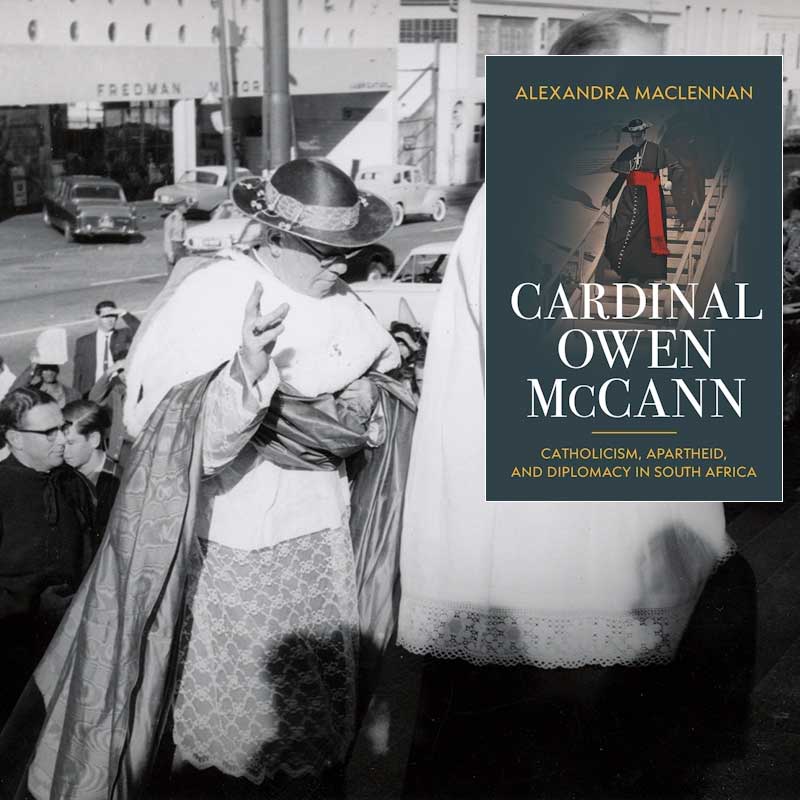
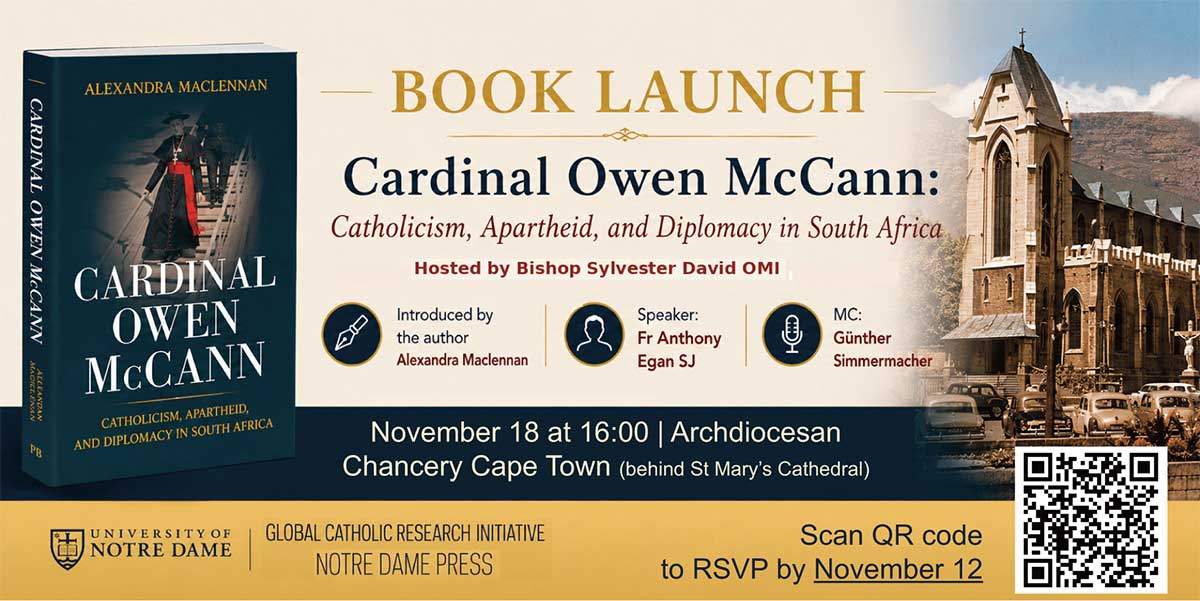
CARDINAL OWEN McCANN: Catholicism, Apartheid, and Diplomacy in South Africa, by Alexandra Maclennan. University of Notre Dame Press (2026). 527pp. Reviewed by Fr Anthony Egan SJ
As I read Alexandra Maclennan’s ground-breaking biography of former Archbishop of Cape Town, Cardinal Owen McCann, I was reminded of lines from T.S. Eliot’s poem “Little Gidding”:
We shall not cease from exploration
And the end of all our exploring
Will be to arrive where we started
And know the place for the first time.
In this case, of course, the person.
Cardinal Owen McCann was my archbishop when I was growing up. He was my editor when, in my early twenties, I was an occasional contributor to The Southern Cross. My limited perceptions of him were further affected by comparison, particularly in the 1970s and ’80s, with South Africa’s most famous non-cardinal, Archbishop Denis Hurley of Durban. For a certain type of progressive Catholic at the time, the comparison, though not hostile, put McCann in Hurley’s shadow. By comparison with Hurley, McCann seemed too cautious, even a bit conservative.

Hinted at in the book’s subtitle, Alexandra Maclennan’s biography presents us with a far more nuanced picture of McCann, which substantially reframes one’s understanding of the public role of the archbishop — indeed, of the Catholic Church’s role during the apartheid era.
Drawing on McCann’s personal papers and, significantly, on recently released Vatican Archives, the book adds depth to how we “read” him — and South African Catholic history.
Owen McCann (1907-94) grew up in the religiously and culturally diverse suburb of Woodstock, Cape Town. Of Irish ancestry, he went through the Catholic school system, became an altar server, worked for the railways and completed a commerce degree at the University of Cape Town, before entering the seminary, completing his studies at the Urbaniana University in Rome. Ordained in 1935, he worked for a while in District Six and Mowbray. He was editor of The Southern Cross from 1941-48, and again following his retirement as archbishop in 1984, from 1986-91.
Made a bishop in 1950 and, with the establishment of the Southern African hierarchy a year later, archbishop of Cape Town, he participated in the bishops’ conference (serving as its president from 1961-74) and was part of its political shift from caution to more outspoken opposition to apartheid.
Like his contemporary Hurley, he attended and participated in the Second Vatican Council (1962-65), where he made a number of interventions. It is a boon to scholars that Maclennan includes all of these in an appendix to the book.
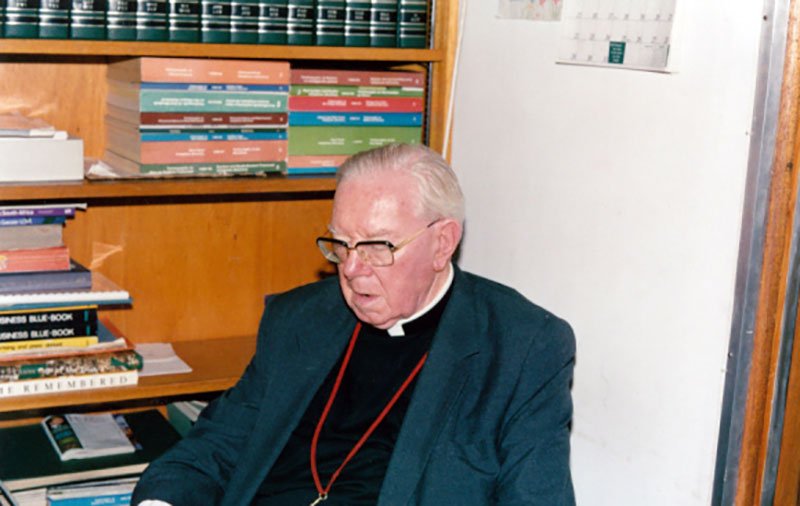
Created cardinal in 1965, the first in South Africa’s history, he participated in the 1978 conclaves that elected Popes John Paul I and John Paul II. After his retirement in 1984, as noted earlier, he returned to the Southern Cross, and died in Wynberg, Cape Town, in 1994, less than a month before South Africa’s first democratic election.
Such is the outline of the life most know. Maclennan’s extensive research fills in so many more details. Two things stand out: McCann’s personality and deep affinity with his Irish Cape episcopal “ancestors”, and the way he negotiated the complex politics of church and state in his relations with the Vatican. Of the former, I shall say that his affinity particularly with bishops Patrick Raymond Griffiths and Thomas Grimley was part of a deeper sense of personal Irish heritage and appreciation for the work of generations of Irish clergy and religious who contributed a significant part to the growth of Catholicism in a South Africa that was often less than welcoming to the Church.
The latter hostility — from almost two centuries of prohibition, through theological dislike to political mistrust by many Calvinists and particularly the strongly Calvinist-influenced National Party — is central to the complexity of McCann’s public role. Maclennan reminds us that McCann was deeply committed to Catholic Social Teaching, and disliked racism intensely, but perhaps, unlike the more bold Hurley, perceived the need to present the case for social change more diplomatically, and in doing so to lessen the potential negative impact of a more “prophetic” stance on the South African Church’s wellbeing.
Maclennan highlights the, albeit shifting, political and social stance of McCann through his journalism and his relations with both the South African government and the Vatican (the latter through a succession of apostolic delegates). It is clear from this that he was for most of his life a “gradualist” regarding ending apartheid, at times echoing a fairly paternalist view common among many liberals in the 1940s. In addition, his views echoed a prominent Catholic Cold War fear of communism, in particular how it might influence African nationalism.
In his diplomatic engagements supporting gradualism, he warned that the absence of government concessions towards ending apartheid could lead to radicalisation. He was also deeply uncomfortable about protest politics, fearing that it would frequently lead to violence.
Maclennan’s biography here makes a fascinating turn, giving us an insight into Vatican diplomacy with South Africa, particularly in the early days of apartheid. What emerges is how quite a few Vatican delegates were equally concerned about communism — not surprising given the Church’s experience in Eastern Europe and China — to the degree that at least one of them seemed partly open to a kind of “benign apartheid”. They also worried about the possible suppression of Catholicism, deportation of foreign clergy, and the collapse of the Church.
This part of the book may surprise some readers and scholars. The temptation, in particular, for some scholars — those leaning to the political or ecclesial left, those who are South African, and especially those who lived through the era — may be to vilify the actors and condemn the Church for its lack of courage. As a historian, I am not surprised by this.
The concept of neutral history is a myth; like historians, all histories have biases. Not least, the words we choose and how we arrange the narrative point to biases. The challenge is how to handle them.
The author — a French citizen of South African descent who teaches at the University of Caen in France — avoids this, evocatively exploring the complexity of the times and the contemporary mindsets of her subjects. It is very hard to transcend your context. It is easy to condemn from hindsight. Maclennan, to her credit, avoids that, focusing on understanding rather than judgment.
What emerges from this biography — which is also in part a diplomatic history of Catholicism in South Africa — is a rich description of Cardinal McCann, highlighting his warmth, diplomacy, liberal convictions, and above all a dedication to the Church he served. This book is a major contribution, too, to South African Church and modern South African history.
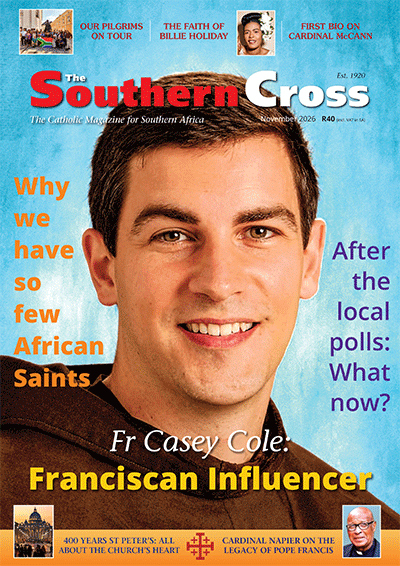
A condensed version of this review appears in the November 2026 issue of The Southern Cross. The book can be bought or ordered from the Catholic Bookshop in Cape Town: www.catholicbookshop.co.za

- Rediscovering Cardinal Owen McCann - November 7, 2026
- Beware a Spiritual Disneyland - November 5, 2026
- Mass Readings: 8 November – 15 November, 2026 - November 3, 2026