Ut Unum Sint — That They May Be One
There are mornings when a run is simply a run, measured in distance, breath and the steady rhythm of footsteps. And then there are mornings when something happens that follows you long after you have stopped running.
On one such morning, as I rounded a familiar bend, the Port Elizabeth Diocesan Chancery came into view. In its quiet grandeur, particularly on rainy mornings, there is something almost heavenly about its presence. The softened light, the glistening stone, the stillness of the grounds. For me, it is a place that whispers: you are close to home.
But that morning, it was not the building that would speak to me. It was a young woman standing outside its gate.She was not moving. Not asking. Not speaking. Just standing.

My first instinct was suspicion. In a city where people living on the streets can become almost invisible, I wondered what she was doing there. I had begun deciding who she was before I knew anything about her. Without a word being exchanged, I had placed her outside the boundaries of my own understanding of belonging.
Then I looked again.
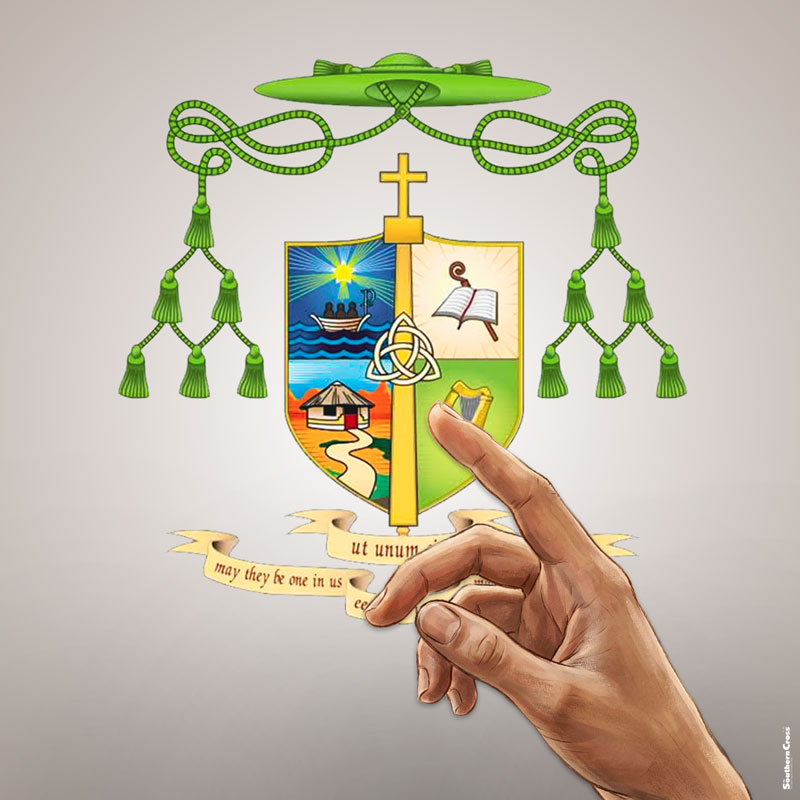
Her gaze was fixed on the diocesan coat of arms displayed on the wall next to the gate. There was a quiet, almost childlike smile on her face. Slowly, carefully, she lifted her hand and traced the outline of the cross at the centre of the emblem with her finger. Not casually. Not absentmindedly. But with what appeared to be tenderness and reverence.
She simply wanted to touch that cross. Nothing more. Nothing less. And there, before the gates of our Diocesan Chancery, I witnessed something that forced me to confront myself. She was not vandalising. She was venerating.
I had seen a woman whose circumstances prompted suspicion. I was now witnessing a moment that appeared deeply personal and sacred. I cannot claim to know what was in her heart, but I could no longer ignore what was happening in mine. I had judged her before she had done anything. And above her, inscribed beneath the diocesan emblem, were words I had passed many times without truly allowing them to question me: Ut Unum Sint.
That they may be one.
Een wees in ons.
Mababe kanye kuthi.
May they be one in us
Not one because we speak the same language. Not one because we share the same culture, circumstances or social standing. But one because, beneath everything that divides us, we stand in need of the same grace and are invited into relationship with the same Christ. In that moment, the words on the gate ceased to be merely a motto. They became a question:
Dear Diocese of Port Elizabeth, this being our motto, what does it mean to carry those words? And what does it mean for the Church to proclaim unity in Christ when someone standing at its gate can so easily be judged by the circumstances of her life rather than encountered in the dignity of her humanity?
This is not an accusation against the Diocese. It is an invitation to all of us, myself included, to examine the distance that can sometimes exist between the Gospel we proclaim and the welcome we extend. Scripture reminds us that “man looks at the outward appearance, but the Lord looks at the heart” (1 Samuel 16:7). That morning, I had looked outwardly and begun writing a story about a stranger. She, without saying a word, was helping me rewrite my own.
I was the runner. She was the outsider. I was moving forward. She was standing still.
I believed I belonged inside the gate. She stood outside it. And yet, in truth, we stood on the same ground. Holy ground. Before the same cross. Drawn by the same hope. Held by the same mercy. I had drawn a line. She erased it without even knowing.
Pope Francis gave us a simple but profound expression of the Church’s universal invitation: Todos, todos, todos. Everyone. Everyone. Everyone.
These words challenge us to consider not merely whom we say is welcome, but whether our attitudes, actions and communities make that welcome real. The Church was never meant to be an exclusive club for those who have their lives together, look respectable, know the right words or fit comfortably within our expectations. Christ repeatedly crossed the boundaries people erected around themselves and others. He sat at tables with those others avoided. He listened to those others dismissed. He recognised human dignity where society saw reasons for exclusion.
If we claim to follow Him, we must be willing to ask ourselves an uncomfortable question: When people encounter us, do they encounter something of Christ, or do they first encounter the barriers we have built around belonging?
It is so easy to speak of compassion from the pulpit. It is more demanding to practise it in the parish hall, in our sodalities, in our ministries, in our leadership structures and in our everyday encounters with people whose lives differ from our own. We can maintain beautiful churches, celebrate reverent liturgies and proclaim sound teaching while still overlooking the person who feels unseen, unheard or unwelcome.
The question is not whether the Church has opened its gates. It is whether those standing outside can recognise, in the way we treat them, the Christ we proclaim within.
Synodality
This is also where the Church’s call to synodality becomes more than a theological concept or an institutional process. Synodality calls us to walk together: to listen, to discern and to recognise that the Holy Spirit speaks through the whole People of God. It asks us to move beyond simply inviting people into a conversation and to consider whether their voices genuinely influence the journey. Are all our parishes included in that journey? Are their experiences heard, particularly those of communities that may feel distant from diocesan decision-making? Do ordinary parishioners, the poor, the marginalised and those on the periphery have meaningful opportunities to speak and be taken seriously? And when they speak, do we listen with open hearts, even when their experiences challenge our assumptions or expose uncomfortable truths?
These are genuine questions on whether or not we are living that mission faithfully. A synodal Church cannot assume that a few voices can speak for everyone. Nor can unity mean that everyone must remain silent to preserve the appearance of harmony. Genuine communion makes room for honest conversation, different experiences and the patient work of discerning together where the Spirit is leading us.
Walking together must mean more than walking in the same direction. It must mean ensuring that nobody is routinely left behind, unheard or treated as though their presence matters less.
In all honesty, over the years, I have encountered so many people who have been hurt within Church structures—by bishops, priests, sodality leaders and those entrusted with leadership in our wards and parishes. Good people. Holy people. People who have found themselves standing outside the very Church they once called home. I know something of that experience myself. I, too, have felt left alone. I became a backbencher, distanced from the place I once called home. But God was not finished with me. In His own time, He called me back.
Perhaps that is why the woman at the gate has stayed with me. I know what it means to feel distant, to stand on the edges. And I know that sometimes all it takes is for God to remind us that the door to Him has never been closed.
How often have we gone looking for those who have drifted away? Have we sought them out, listened to their hurt and asked what it would take to begin healing? Too often, we leave them outside and carry on as though their absence is theirs alone to explain.
To those who have left the Church, or who now stand at a distance because of hurt, disappointment or rejection: do not believe that your story with God is over. If you can no longer find the words to pray, if the pew feels too far away, perhaps begin with something simpler. Trace that cross at the gate. Remember the Christ who drew you to Him in the first place. And when you are ready, come home. Not because your hurt does not matter, but because you still matter.
And to those of us whose words, actions or failures of compassion have contributed to someone walking away: this call is ours, too. We cannot simply wait for people to return and expect them to carry the burden of reconciliation alone. We must have the humility to acknowledge the hurt we caused, the courage to seek them out, and the grace to ask forgiveness where it is needed.
Christ did not wait for the lost to find their way back. He went looking for them. Somebody is standing at the gate, waiting. The question is: will we go out to meet them? Unity cannot remain words on a coat of arms, a line in a prayer or a phrase repeated from a pulpit. It must become visible in how we welcome, how we listen, how we make decisions and how we treat those whose lives look nothing like our own. It is so that sometimes God uses the person we have judged to reveal the prejudice we have yet to confront.
The woman remained at the gate. I continued my run. But I carried away a question that was no longer hers to answer. If Christ stood among us today, would those on the margins recognise Him in our welcome? Would those who feel excluded discover a Church willing to listen? Would every parish have a genuine voice in the journey towards the unity we profess? Or would we be so occupied protecting the boundaries of our belonging that we failed to recognise the One who calls us beyond them?
Ut Unum Sint.
That they may be one.
Todos, todos, todos.
Everyone. Everyone. Everyone.
These are not merely words on a wall next to a gate. They are a test of the Church we claim to be.
That morning, I thought I was simply passing the Diocesan Chancery. Instead, I was being invited to look again: at the woman, at my own heart, and at the Church I love.
She did not vandalise. She venerated.
And without saying a word, she preached a sermon I desperately needed to hear. The question is no longer whether she belongs outside our gate. It is whether we have truly understood what it means to belong to Christ.
- She Did Not Vandalise — She Venerated - October 27, 2026
- Xenophobia: The Conversation We Never Had - October 20, 2026
- When Wooden Spoons Become Instruments Of Grace - October 3, 2026