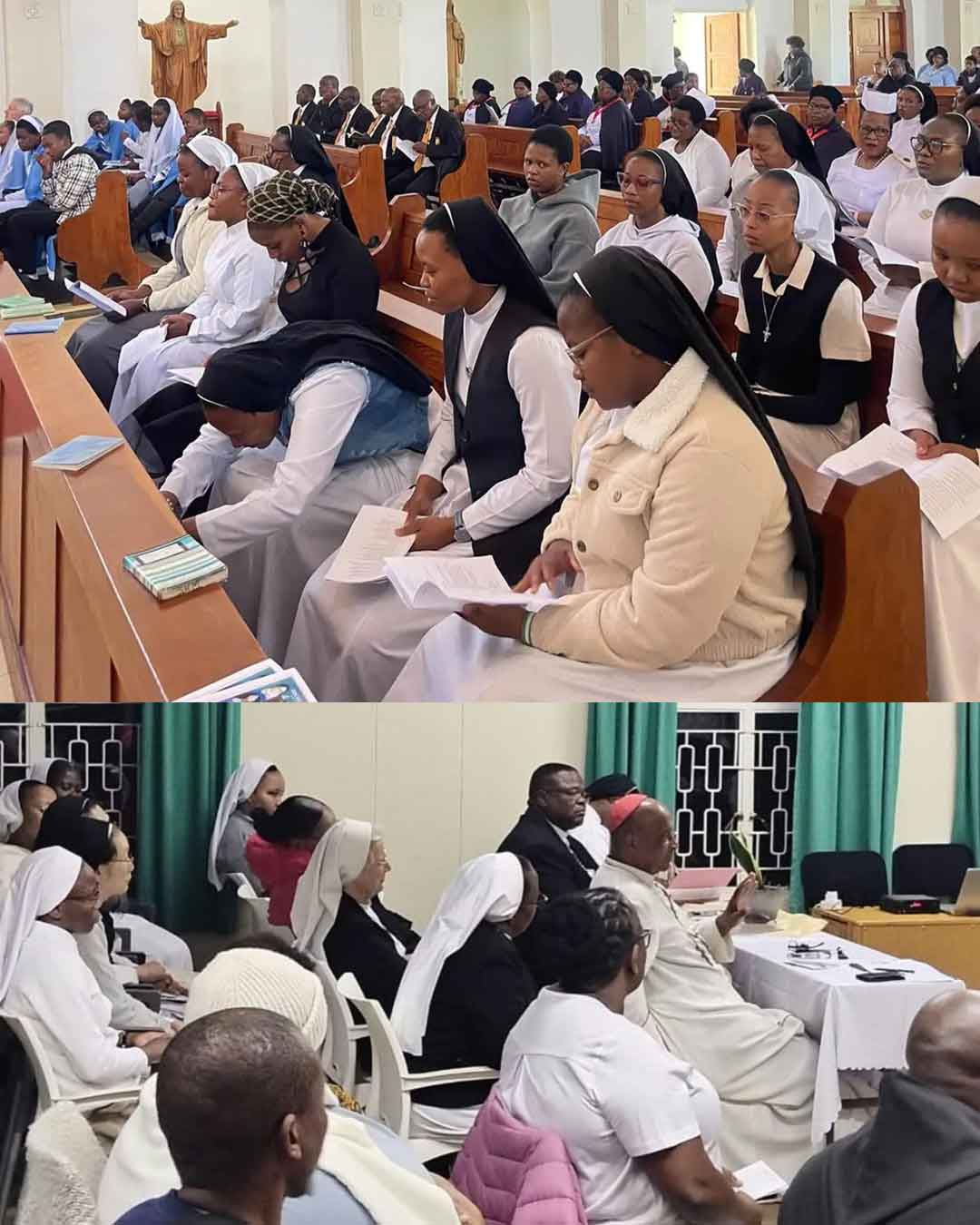
The Eucharist must transform those who receive it, sending them out to serve others, Fr Sifiso Ntshangase told a gathering at the Benedictine Inkamana Abbey near Vryheid, KwaZulu-Natal, marking the 125th anniversary of the birth of Sr Reinolda “uMashiyane” May.
Sr Reinolda was a Benedictine Sister and pioneering midwife who reported a series of apparitions of Our Lady. She was born in Germany on October 21, 1901, and died on April 1, 1981, at Inkamana Abbey and was buried there. Her visions of Our Lady gave rise to the popular Ngome shrine.
Addressing an audience that included Cardinal Wilfrid Napier, apostolic administrator of the diocese of Eshowe, Inkamana prior Fr Maximilian Jacobs, clergy, religious superiors and members of the Missionary Benedictine Sisters of Tutzing, to which Sr Reinolda belonged, Fr Ntshangase spoke on the theme: “We are the Eucharistic Church”.
He explained that it is impossible to remember Sr Reinolda without considering the Eucharist, which was central to the reported apparitions at Ngome. In these accounts, Mary identifies herself as the Tabernacle of the Most High, appearing as a living monstrance holding the Eucharist. She also expresses a desire to see more of the Eucharistic Church gathered in prayer around the altars.

“The Eucharist is the heart of the Church,” Fr Ntshangase said, recalling the Second Vatican Council’s description of it as “the source and summit” of the Church’s life. “It is so because the Eucharist is Christ himself. And in the Eucharist, Christ gives us the gift of himself: ‘This is my body, take and eat. This is my blood, take and drink.’”
The first Tabernacle
He drew a connection between Mary’s role as the first tabernacle and the responsibility of Christians to carry Christ into the world. Referring to Mary’s visit to her pregnant cousin Elizabeth, he noted that Pope Benedict XVI had described her as “the first tabernacle”, carrying Jesus within her as she made the journey.
The encounter, recounted in Luke’s Gospel, culminates when the unborn John the Baptist leaps in Elizabeth’s womb at Mary’s greeting. For Fr Ntshangase, this is an image of Christ already being brought to others through Mary.
But the visit also demonstrates something more practical. Mary recognised Elizabeth’s needs and went to help her, despite her own pregnancy. “Being a Eucharistic Church means that we ought to be aware of the needs of our brothers and sisters in our midst,” Fr Ntshangase said. “We cannot receive Christ in the Eucharist and still be indifferent to those who suffer among us.”
He saw this same spirit in Sr Reinolda, who, according to accounts of her missionary work, walked long and difficult distances to assist women in labour who could not reach a health facility.
“In this way, she became a true example of what I am talking about. If we are the Eucharistic people, we cannot be indifferent to other people’s needs,” the priest said.
“Each time we receive Jesus at every Eucharistic celebration, we become such tabernacles as Mary,” he said. “At the end of each Eucharistic celebration we are actually commissioned to participate in carrying Jesus to our homes and communities, just as Mary carried him to Elizabeth.”
Eucharist must transform us
The second aspect of Eucharistic life, Fr Ntshangase said, is transformation. It is not enough simply to receive Communion; an encounter with Christ should change the person.
He pointed to the Samaritan woman in John’s Gospel, who went to the well and encountered Jesus, but left as a proclaimer of the good news. “An encounter with Jesus Christ is in itself transformative,” he said. “How far do we allow the Eucharist to transform our homes, our workplaces and our parish communities?”
Fr Ntshangase illustrated the point with a story about a man who regularly drove his wife and children to Sunday Mass but never entered the church himself. Instead, he went to a nearby tavern and returned to collect his family afterwards.
When a priest asked him why he did not join his family at Mass, the man replied that he preferred to go to the tavern because, as he saw it, his family returned from church no better than when they had left. He complained that his wife could return “a devil personified” after Mass, while his children were no better.
The anecdote, Fr Ntshangase suggested, exposes the contradiction of religious practice without inner change. “The people who are not transformed by the Eucharist cannot transform others,” he said. “Brothers and sisters, we must become what we eat.”
He then returned to the central place of the sacrament in the life of the Church. Quoting the Vatican II constitution Lumen Gentium and the Catechism of the Catholic Church, he emphasised that the other sacraments and the Church’s apostolic work are oriented towards the Eucharist. He also referred to St John Paul II’s encyclical Ecclesia de Eucharistia, which explores the close relationship between the Eucharist and the Church.
“If there was no Eucharist, there would be no Church,” Fr Ntshangase declared.
Revive old practices
His final challenge was directed at what he regarded as a decline in traditional Catholic Eucharistic devotion. He called on the Church to recover practices that were once familiar among older generations of Catholics.
He recalled how people visiting a parish priest would often go into the church afterwards to “greet” Jesus in the Blessed Sacrament before leaving the parish grounds. Catholics walking past a church would turn towards it and make the sign of the cross. Men would remove their hats in reverence, saying: “Makadunyiswe uJesu Kristo” (Praised be Jesus Christ).
He also expressed concern about the diminishing practice of genuflection before the Blessed Sacrament. In the parish where he currently serves, he said, many people enter the church without genuflecting, while others merely bow or walk in as though entering an ordinary hall.
Fr Ntshangase was equally concerned about the decline in weekday Mass attendance. He remembered older Catholics, particularly grandmothers and grandfathers, who made morning Mass part of their daily routine.
“For them, going to Mass during the week and receiving the Blessed Sacrament was the most beautiful way of beginning their daily activities,” he said. “Where is that now? I do not know who taught our people that midweek Mass is only for the Sisters.”
He concluded with an appeal to those gathered to renew their devotion to the Eucharist and restore the practices that had once shaped Catholic life.
“I am not asking you to go and do extraordinary things,” he said. “I am convinced that the Church of today lost the true sense and devotion to the Eucharist when she neglected what our old Catholics used to do, regarding adoration of the Eucharist.”
His message brought the commemoration of Sr Reinolda back to its central purpose: remembering a missionary whose faith was expressed in service, and asking what that example demands of the Church today.
“If indeed, we are the Eucharistic people,” Fr Ntshangase said, “let us strive to bring back the old Eucharistic practices and so revive Catholicism in our Church.”

- ‘We are the Eucharistic Church’: Remembering Sr Reinolda May - November 28, 2026
- CMI Media Award conferred on Journalist Anto Akkara - November 24, 2026
- Christ the King Prayer - November 22, 2026